


The daily subterranean journey of hundreds of thousands of commuters between New Jersey and New York City is a testament to a century-old engineering marvel. It is also a daily gamble against catastrophic failure. The Northeast Corridor, the spinal cord of American passenger rail, funnels an astonishing volume of economic activity through a single, fragile chokepoint: the North River Tunnel. As of late 2025, this 115-year-old artery is deteriorating, posing a dire threat to the regional and national economy. The solution is one of the most ambitious and complex infrastructure undertakings in modern American history: the Gateway Program, with its crown jewel, the new Hudson Tunnel Project. This article provides a detailed technical analysis of this monumental project, its constituent parts, and, most importantly, addresses the critical question on every commuter’s mind: When will the new tunnel open?
1. The Anatomy of a Crisis: The North River Tunnel’s Slow Decay. New NYC Tunnel
To understand the urgency of the Gateway Program, one must first appreciate the precarious state of the existing North River Tunnel.
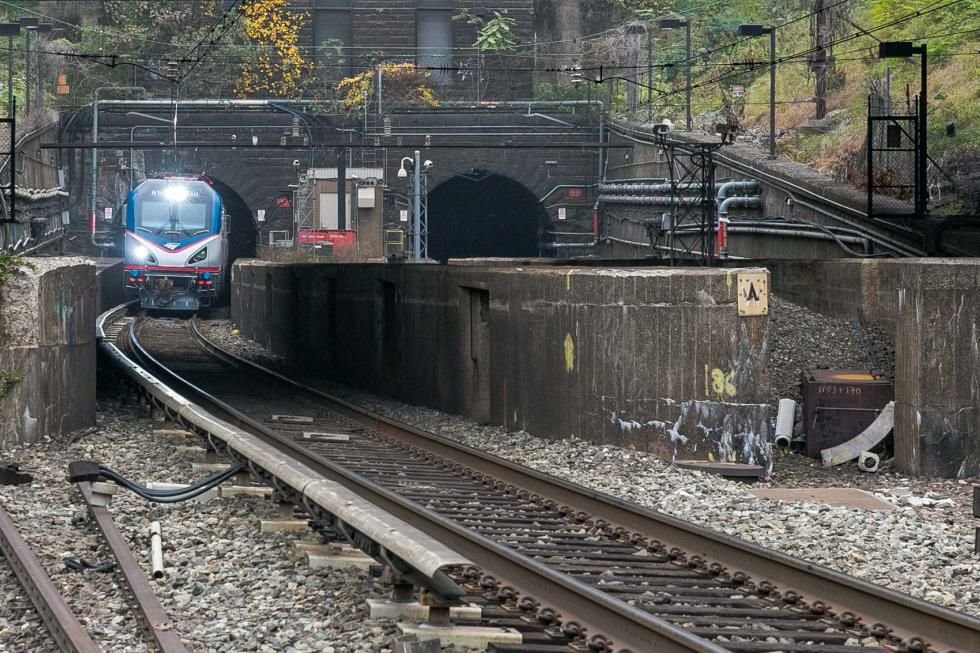
- A Relic of the Gilded Age: Opened in 1910 by the Pennsylvania Railroad, the tunnel was a triumph of its time. Constructed using the “shield method,” workers hand-dug through the silt and rock beneath the Hudson River, protected by a massive, mobile steel cylinder. As they advanced, they installed the tunnel’s skeleton: a series of 23-foot diameter, interlocking cast-iron rings. This century-old structure, containing two single-track tubes, was designed for the locomotives of the early 20th century, not the demands of the 21st.
- The Single Point of Failure: Today, this aging tunnel accommodates approximately 450 Amtrak and NJ TRANSIT trains daily, serving around 200,000 passenger trips. The ten-mile stretch of the Northeast Corridor between Newark, NJ, and New York Penn Station is the busiest in the nation, underpinning a region responsible for 20% of the United States’ GDP. With only one track in each direction, any disruption—a disabled train, a signal malfunction, or a track issue—in one tube creates a cascading effect, leading to severe delays that ripple across the entire corridor.
- The Corrosive Aftermath of Hurricane Sandy: The tunnel’s structural integrity was catastrophically compromised in October 2012 when Hurricane Sandy inundated it with millions of gallons of corrosive brackish water. The saltwater left behind a destructive legacy of chloride ions. These ions have been relentlessly attacking the tunnel’s concrete bench walls, which support the tracks and contain vital electrical and signal cables.
- Technical Analysis of Chloride Attack: Chlorides permeate the porous concrete and initiate an electrochemical reaction with the steel rebar embedded within. This process, known as chloride-induced corrosion, causes the rebar to rust and expand to many times its original volume. This expansion exerts immense internal pressure on the surrounding concrete, leading to spalling (flaking), cracking, and eventual structural failure. The chlorides also degrade the copper signal and power cables and their insulation, leading to the frequent “signal problems” that plague commuters. Amtrak’s inspections have revealed that the concrete is now so saturated with chlorides that simple patching is no longer a viable long-term solution. Engineers estimate that one or both tubes could require long-term closures for emergency repairs within the next 10 to 15 years, a scenario that would cripple the region’s transportation network. New NYC Tunnel
2. The Gateway Program: A Multi-Billion Dollar Modernization
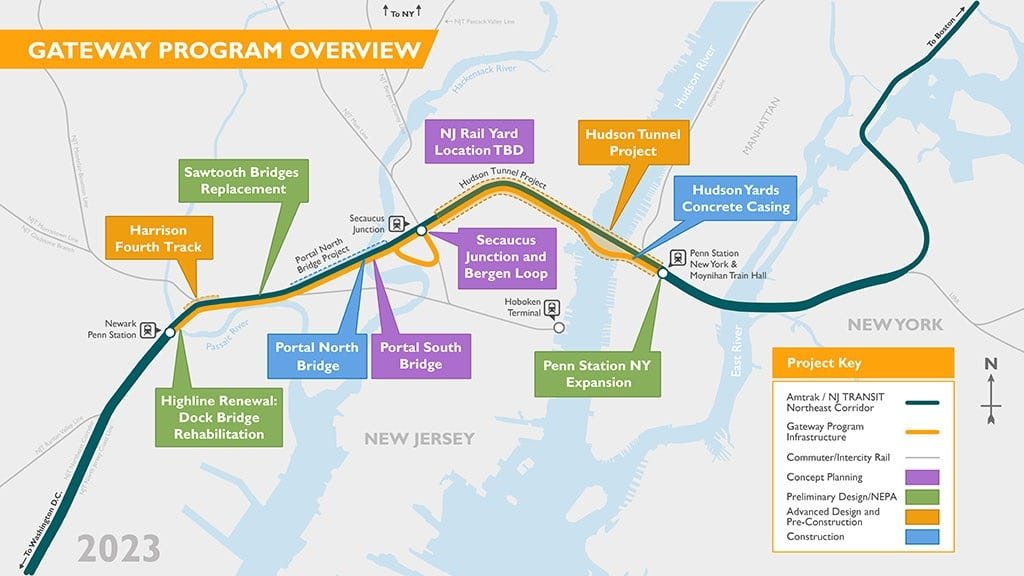
The Gateway Program is not merely a tunnel replacement project; it is a comprehensive, multi-phase suite of strategic infrastructure investments designed to eliminate the chokepoints between Newark and New York Penn Station. It aims to double the track capacity across the Hudson, thereby enhancing redundancy, reliability, and service levels. The program is divided into several interconnected projects, with Phase 1 currently underway.
Phase 1 Projects (Under Construction):
- The Portal North Bridge Project: A crucial predecessor to the tunnel work, this project is replacing a 115-year-old, two-track swing bridge over the Hackensack River in Kearny, NJ. The old bridge is a notorious bottleneck, as its swing mechanism frequently fails to close and lock properly after opening for marine traffic, stranding thousands of passengers. Construction is well advanced and its completion is a critical enabler for the broader Gateway timeline.
- The Hudson Tunnel Project: The centerpiece of the entire program. This involves two major components:
- The construction of a new, two-track tunnel beneath the Hudson River.
- The complete rehabilitation of the existing North River Tunnel once the new tunnel is operational.
- The Hudson Yards Concrete Casing – Section 3: A vital preparatory project on the Manhattan side. This involves constructing the final 500-foot section of a massive, heavily reinforced concrete box that preserves the rail right-of-way under the Hudson Yards development. Sections 1 and 2 were completed in 2018. This third and final section will connect the new tunnel boring machine’s endpoint to the tracks leading into Penn Station.
Future Gateway Program Projects:
The full vision of Gateway extends beyond Phase 1 to create a modern, four-track system. Future projects include:
- Portal South Bridge: Building a second, two-track bridge adjacent to the new Portal North Bridge, bringing the total capacity over the Hackensack to four tracks.
- Sawtooth Bridges Replacement: Replacing a series of 118-year-old bridges in Kearny, NJ, and expanding them from two to four tracks.
- Dock Bridge Rehabilitation: Modernizing and rehabilitating a critical bridge over the Passaic River in Newark.
- Secaucus Junction Capacity Expansion: Reconfiguring tracks and expanding capacity at this key station to accommodate increased service.
- Penn Station Expansion: The ultimate goal of the program is to expand and modernize the chronically congested New York Penn Station, adding new tracks and platforms to handle the increased capacity the other Gateway projects will deliver.
3. A Technical Deep Dive: Building the New Hudson River Tunnel
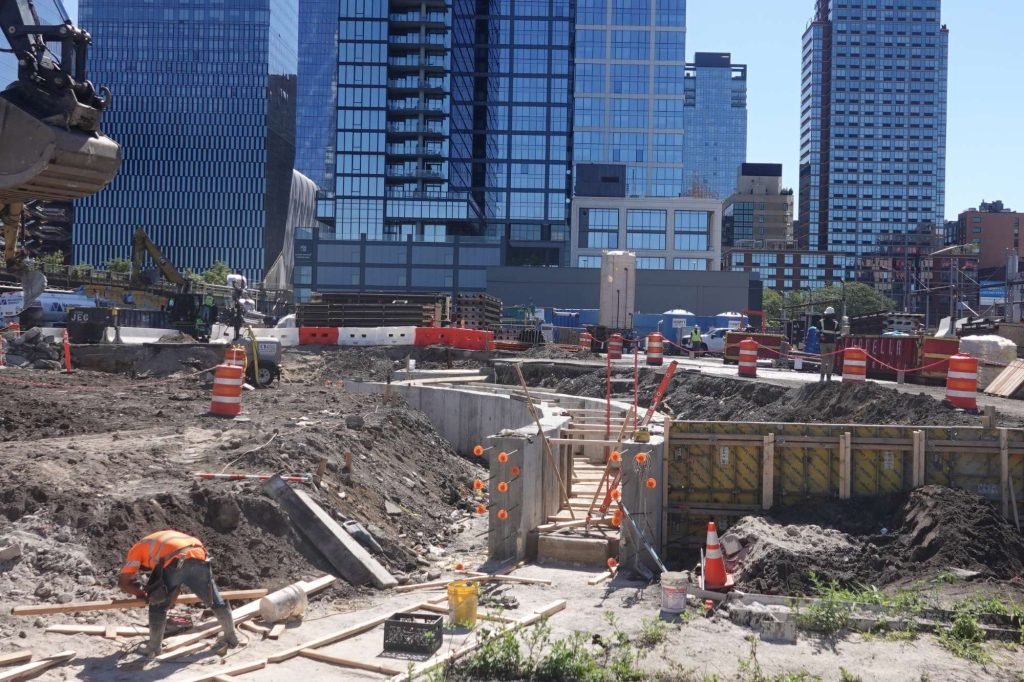
Constructing the new tunnel is a monumental feat of modern engineering, far more advanced than the methods used in 1910. The process involves several distinct, highly technical stages.
- Staging and Preparation (The Tonnelle Avenue Bridge and Utility Relocation): Before any tunneling can begin, significant work must be done on the New Jersey side. The Tonnelle Avenue Bridge project in North Bergen will create a new roadway overpass above the track alignment. This is critical because the open-cut approach to the new tunnel will be built directly through the area where the current roadway sits. This project creates the “staging ground” from which the tunnel boring machines (TBMs) will launch.
- Tunnel Boring Machines (TBMs): The Subterranean Titans: The heart of the tunneling operation will be two state-of-the-art TBMs. These are not simple drills; they are sophisticated, mobile factories.
- Specifications: Each TBM will be approximately 450-500 feet long and weigh over 2,000 tons. The circular cutting head at the front, studded with tungsten carbide cutting discs, will be roughly 40 feet in diameter.
- Earth Pressure Balance (EPB) Technology: The TBMs will likely be Earth Pressure Balance machines, a technology ideal for the soft, silty ground conditions under the Hudson. As the cutting head rotates and excavates material (known as “muck”), it is fed into a pressurized chamber at the front of the TBM. The pressure in this chamber is carefully managed to precisely match the pressure of the surrounding earth and water, preventing ground settlement on the surface and ensuring the stability of the excavation face.
- Tunnel Lining Installation: As the TBM moves forward, a hydraulic erector arm at the rear of the machine will pick up pre-cast concrete segments and place them in a ring to form the tunnel’s permanent, watertight lining. Each ring is composed of several interlocking segments, bolted together and sealed with gaskets. This process of excavating and lining occurs simultaneously, allowing for continuous advancement.
- The Path of the Tunnel: The new tunnel will be approximately 1.5 miles long from its portal in North Bergen, NJ, to the connection point at the Hudson Yards Concrete Casing in Manhattan. It will dive deep under the Palisades cliffs in New Jersey, pass approximately 90 feet below the Hudson River’s surface, and then rise gently towards Penn Station.
- Rehabilitation of the North River Tunnel: Once the new tunnel is commissioned and carrying trains, the real work on the old tunnel begins. Each of the two tubes will be closed—one at a time—for a comprehensive, top-to-bottom rebuild. This is not a simple repair job.
- Deconstruction: The existing track bed, ballast, and the salt-saturated concrete bench walls will be completely demolished and removed.
- Structural Reinforcement: The original cast-iron lining will be inspected, repaired, and reinforced. A new, waterproof inner concrete lining will likely be installed.
- Modern Systems Installation: New tracks, signals, power systems, ventilation, and emergency lighting will be installed to modern standards, drastically improving safety and reliability. This rehabilitation is expected to take approximately two to three years per tube.
4. Economic Impact and the “Buy America” Mandate
The economic implications of the Gateway Program are immense, extending far beyond the daily commute.
- Job Creation and Economic Activity: The Hudson Tunnel Project alone is projected to support over 95,000 jobs (direct, indirect, and induced) and generate an estimated $19.6 billion in economic activity over its lifespan. This includes engineers, construction workers, project managers, and logistics personnel, as well as jobs created in the supply chain.
- U.S. Manufacturing and Supply Chain: Adherence to the federal “Buy America” requirement ensures that the steel, concrete, electrical components, and other materials used in the project are sourced from U.S. suppliers and manufacturers. This provides a significant stimulus to the American industrial base, from steel mills in the Midwest to concrete pre-casting plants in the Northeast. The TBMs themselves, while often manufactured by global firms, will contain a significant percentage of U.S.-sourced components. The vast quantity of pre-cast concrete tunnel lining segments will be a major contract for regional manufacturers.
- The Cost of Inaction: The most powerful economic argument for the project is the staggering cost of failure. A 2019 report by the Northeast Corridor Commission estimated that a long-term failure of one of the North River Tunnel’s tubes would cost the U.S. economy approximately $100 million per day. Such a failure would force a 75% reduction in rail service, grinding NJ TRANSIT and Amtrak to a halt, causing gridlock on roads and bridges, and delivering a severe shock to the nation’s financial capital.
5. The $16 Billion Question: When Will the new NYC tunnel Open?
This brings us to the central question. While a precise date for a project of this scale is subject to change based on construction realities, funding streams, and unforeseen challenges, we can construct a detailed and realistic timeline based on current progress and official projections as of November 2025.
Projected Timeline (as of Q4 2025):
- 2023-2025: Early Works and Final Design. This phase is largely complete. It included the finalization of engineering designs, securing the Full Funding Grant Agreement (FFGA) from the Federal Transit Administration (a major milestone achieved in 2023), and the initiation of early works projects like the Hudson Yards Casing and the Tonnelle Avenue Bridge.
- 2025-2027: Heavy Construction Commencement. The primary construction contracts for the New Jersey and New York sections of the tunnel were awarded in 2024. Throughout 2025 and 2026, the focus will be on site preparation, excavation of the tunnel portals, and the assembly of the Tunnel Boring Machines. The official “launch” of the TBMs from the New Jersey side is anticipated to occur in mid-to-late 2027.
- 2027-2032: The Main Tunneling Phase. This is the five-year period where the TBMs will be actively boring under the Hudson River. Their progress will be measured in feet per day. This is a highly complex phase where engineers will contend with variable ground conditions. Upon reaching Manhattan, the TBMs will be disassembled and removed, having connected to the Hudson Yards Concrete Casing.
- 2032-2035: Tunnel Fit-Out and Systems Installation. Once the concrete shell of the new tunnel is complete, it is still an empty tube. This three-year phase involves the intricate work of installing the tracks, signals, power catenary systems, ventilation fans, and safety and communications equipment. This is a painstaking process that requires multiple specialized trades working in a confined environment.
- 2035: Commissioning, Testing, and Opening. Following the completion of the fit-out, a rigorous period of testing and commissioning will begin. This involves running test trains through the tunnel at various speeds, stress-testing all signal and safety systems, and conducting emergency drills.
Based on this detailed breakdown of the construction schedule, the new Hudson River tunnel is projected to open for passenger service in mid-to-late 2035.
- 2035-2038: Rehabilitation of the North River Tunnel. Immediately following the opening of the new tunnel, the rehabilitation of the existing 1910 tubes will commence. The north tube will likely be closed first for a full rebuild, with all traffic running through the new tunnel. Once it is completed and reopened around 2036-2037, the south tube will be closed for its rehabilitation, slated for completion by 2038.
Therefore, the full benefit of the Hudson Tunnel Project—a modern, four-track, fully redundant system under the Hudson—will be realized by approximately 2038. It is only at this point that the region will be fully insulated from the risk of a single-tube failure and that service expansion can be seriously contemplated.
The journey to a new NYC tunnel is a marathon, not a sprint. It is a generational investment in the future of the nation’s most vital economic corridor. For the millions who rely on this transit artery, the construction noise, detours, and staggering price tag are the necessary costs of securing a reliable and resilient future. While 2035 may seem a distant horizon, the work happening today—deep beneath the city streets and on the banks of the Hudson—is forging a new gateway to the heart of New York City, ensuring that the economic engine of the Northeast continues to run for another century and beyond.
1. When will the new NYC tunnel finally open for commuters?
The new Hudson River tunnel is projected to open for passenger service in mid-to-late 2035. Following its opening, the old tunnel will be closed for a full rehabilitation, with the entire four-track system expected to be fully modernized and operational by 2038.
2. Why can’t we just fix the old tunnel instead of building a new one?
The existing 115-year-old tunnel is too vital to shut down for the multi-year, top-to-bottom renovation it requires. It’s the only rail link of its kind into Penn Station, and a long-term closure would cripple the regional economy. The strategy is to build the new tunnel first, move all train traffic into it, and then take the old tunnel out of service for a complete rebuild.
3. What is the “Gateway Program”? Is it just the new NYC tunnel ?
The Gateway Program is a comprehensive suite of projects designed to modernize the rail line between Newark, NJ, and New York City. The new Hudson Tunnel is its most famous component, but Gateway also includes replacing critical bridges (like the Portal Bridge), adding tracks, and eventually expanding Penn Station to eliminate bottlenecks and increase capacity.
4. What is the price tag for this new NYC tunnel ?
The Hudson Tunnel Project portion of the Gateway Program is estimated to cost approximately $16.1 billion. This cost is shared between the federal government, New Jersey, and New York, reflecting its critical importance to the entire Northeast region.
5. What happens if we do nothing and the old tunnel fails?
A failure of just one of the two tubes in the existing tunnel, which experts warn is a growing risk due to damage from Hurricane Sandy, would force a 75% reduction in train service. This would trigger a transportation crisis, costing the U.S. economy an estimated $100 million per day in lost productivity and gridlock.
6. How exactly do you build a tunnel under a massive river?
Engineers will use sophisticated Tunnel Boring Machines (TBMs). These are gigantic, mobile factories, hundreds of feet long, that excavate earth with a rotating cutting head while simultaneously installing pre-cast concrete segments to form the new, watertight tunnel lining.
7. Will this project actually mean more trains and a better commute?
Yes, eventually. Once the new tunnel is built and the old one is rehabilitated (around 2038), track capacity under the Hudson will double from two tracks to four. This creates redundancy, reduces delays caused by disabled trains, and lays the groundwork for a future increase in both NJ TRANSIT and Amtrak service.
8. What is the Portal North Bridge and why is it important?
The Portal North Bridge is a key Gateway project replacing a 115-year-old swing bridge over the Hackensack River that is a major source of delays. The new, high-level fixed bridge won’t need to open for boats, eliminating a notorious bottleneck and ensuring trains can reliably reach the Hudson tunnel entrance.
9. Will construction cause major disruptions to my current train service?
The project is specifically designed to minimize disruptions. Major construction, like the tunneling itself, occurs away from the active rail lines. Because the new tunnel will be built alongside the old one, current service can continue largely uninterrupted until the new tunnel is ready to open.
10. Is this project creating American jobs?
Absolutely. The Hudson Tunnel Project is projected to support over 95,000 jobs and generate nearly $20 billion in economic activity. Due to federal “Buy America” requirements, materials like steel, concrete, and electrical components are being sourced from U.S. suppliers, boosting domestic manufacturing.
The Gateway Program Development Corporation Official Website
- Link: https://www.gatewayprogram.org/
- Amtrak’s Gateway Program Media Page
- Link: https://media.amtrak.com/gateway-program/
- NJ TRANSIT’s Capital Projects Page
- Link: https://www.njtransit.com/press/portal-north-bridge-construction
- U.S. Department of Transportation (Build.gov Project Page)
- Link: https://www.build.gov/infrastructure/hudson-tunnel-project
- Regional Plan Association (RPA) Gateway Page
- Link: https://rpa.org/work/gateway
