

Discover hook: What happens when the rhythms of jazz become the language of abstract painting? Jumping Jive invites visitors to explore the musical imagination of Norman Lewis through decades of artistic experimentation.
The Rhythm Behind the Canvas
Art and music have long shared a creative language, shaped by rhythm, movement, improvisation, and emotion. At Michael Rosenfeld Gallery in New York’s Chelsea neighborhood, Norman Lewis: Jumping Jive explores this relationship through the work of an artist whose approach to abstraction was deeply influenced by the sounds and cultural energy of music.
On view from September 10 through November 14, 2026, the exhibition brings together paintings and drawings representing more than four decades of Lewis’s artistic career. It examines how jazz, blues, classical music, pop, and reggae informed his visual vocabulary, offering visitors an opportunity to understand the musical foundations behind his distinctive compositions. Michael Rosenfeld Gallery+1
For Lewis (1909–1979), music was not simply an interest outside the studio. It was an important source of creative inspiration, influencing the movement, structure, and atmosphere of his paintings. His work demonstrates how sound can be translated into visual expression without relying on literal representation.
Norman Lewis and the Language of Abstraction
Norman Lewis occupies an important position in the history of American Abstract Expressionism. A pioneering Black artist of his generation, he developed a distinctive approach to abstraction that combined expressive gestures, calligraphic marks, atmospheric compositions, and a strong awareness of social and cultural experience.
Born in 1909, Lewis became an influential figure in New York’s artistic community. His career developed during a period when abstract painting was gaining prominence in the United States, yet Black artists frequently encountered institutional barriers and limited recognition within the mainstream art establishment.
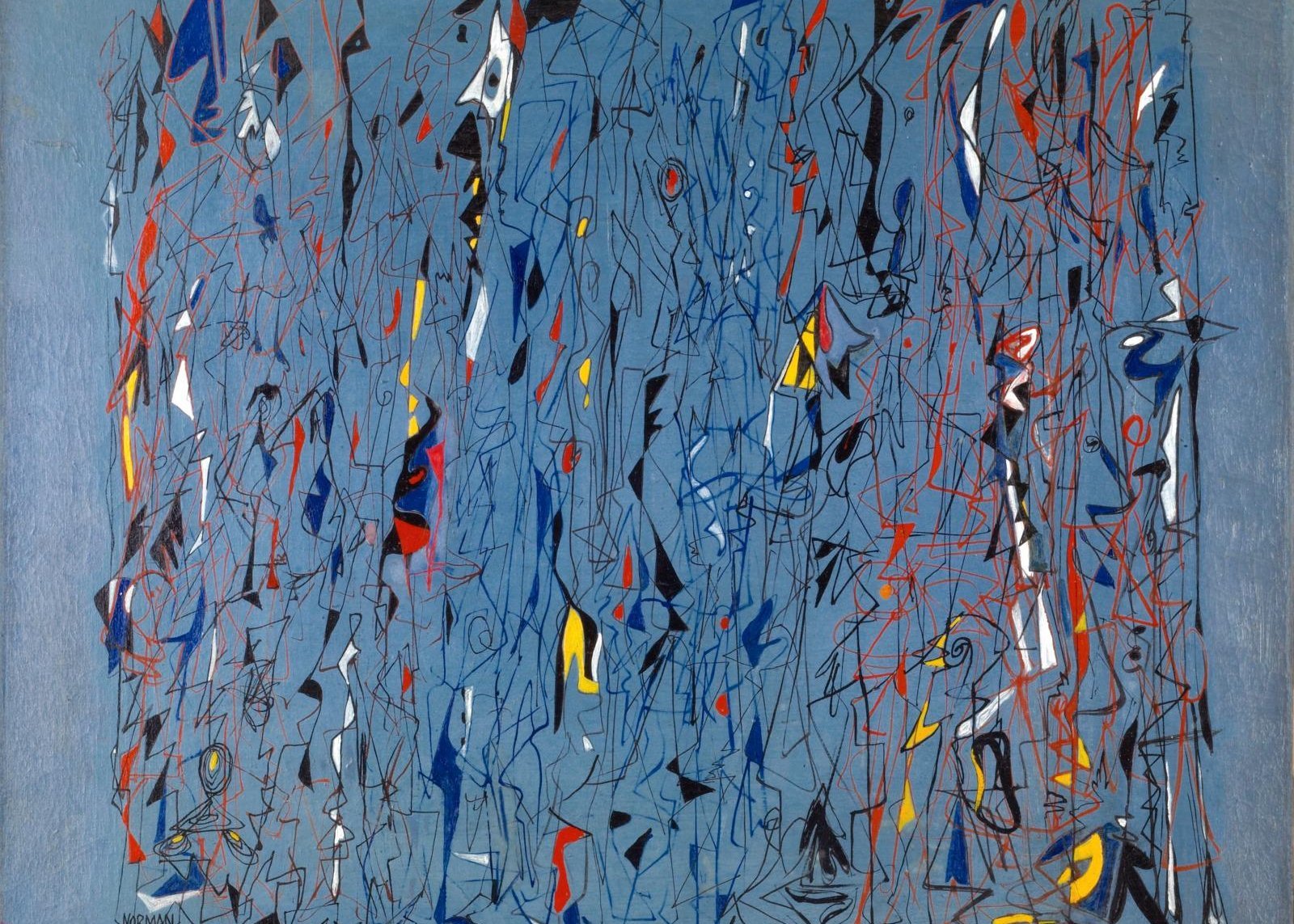
Lewis pursued abstraction throughout his career, creating paintings and works on paper that explored the possibilities of line, color, space, and movement. His visual language often suggested figures, crowds, natural forms, and musical rhythms while maintaining the independence of abstract composition.
The artist’s interest in social justice and racial equality also remained an important dimension of his wider artistic identity. Rather than treating abstraction as separate from lived experience, Lewis developed a practice capable of holding multiple cultural, emotional, and intellectual meanings. Michael Rosenfeld Gallery+1
When Jazz Becomes Visual Expression
The central idea behind Jumping Jive is the relationship between musical improvisation and artistic experimentation. Lewis’s paintings frequently communicate a sense of movement and spontaneity, qualities closely associated with jazz performance.
In his earlier figurative works, music appears through recognizable scenes of musicians, bands, and jazz clubs. As his artistic language evolved, these recognizable subjects increasingly gave way to abstract compositions. Lines, marks, and clusters of color began to suggest musical notes, rhythmic patterns, and the movement of soundwaves.
This transformation provides an important perspective on Lewis’s artistic development. His paintings do not simply illustrate music; they translate its underlying energy into a visual experience.
The exhibition also considers the breadth of Lewis’s musical interests. Jazz and blues were important influences, but classical music, pop, and reggae also contributed to the cultural atmosphere surrounding his creative practice. By bringing these influences together, the presentation offers a broader understanding of the relationship between music and modern American art. GalleriesNow+1
A Gallery Experience Beyond Traditional Exhibition Viewing
One of the distinctive features accompanying Jumping Jive is its connection to Lewis’s personal record collection.
Every Saturday, from 2 to 5 p.m., DJ Adrian (Adrian Yin Michna) plays a three-hour vinyl set featuring records from the artist’s extensive collection. Each performance is recorded and played in the gallery throughout the following week, while the previous weekend’s playlist is shared on Spotify every Wednesday.
This ongoing musical program gives visitors an opportunity to experience the sounds that helped shape Lewis’s artistic imagination. Rather than presenting the paintings in isolation, the gallery creates an environment in which visual art and musical culture can be considered together.
The program also offers a more engaging way to understand how artistic inspiration moves between different creative disciplines. Michael Rosenfeld Gallery
Michael Rosenfeld Gallery’s Continuing Commitment to Norman Lewis
The exhibition marks the seventh solo presentation of Norman Lewis’s work organized by Michael Rosenfeld Gallery. Since its establishment in 1989, the gallery has maintained a longstanding commitment to artists who have made significant contributions to twentieth- and twenty-first-century American art.
Previous exhibitions dedicated to Lewis include Intuitive Markings, Works on Paper, 1945–1975 (1999), Abstract Expressionist Drawings, 1945–1978 (2009), Pulse, A Centennial Exhibition (2009), A Selection of Paintings & Drawings (2016), Looking East (2018), and Give Me Wings To Fly (2023).
The gallery has represented the Estate of Norman Lewis exclusively since 2014, further establishing its role in preserving and presenting the artist’s legacy.
With Jumping Jive, the gallery continues this commitment while placing renewed attention on an especially significant aspect of Lewis’s practice: the relationship between music, abstraction, and artistic expression. Michael Rosenfeld Gallery+1
Why This Exhibition Matters
Norman Lewis: Jumping Jive offers more than an opportunity to revisit the work of an important Abstract Expressionist. It provides a chance to reconsider how artistic innovation emerges through cultural exchange and personal experience.
Lewis’s work challenges conventional distinctions between sound and image, representation and abstraction, and individual expression and collective cultural memory.
His paintings demonstrate that abstraction can communicate ideas and experiences without depending on recognizable subjects. Through rhythm, gesture, and movement, Lewis developed a visual language that remains deeply connected to the musical and cultural traditions that inspired him.
For New York audiences, the exhibition is also a reminder of the city’s importance as a meeting point for artistic experimentation, jazz culture, and the development of modern American art.
As visitors move through the gallery, Jumping Jive encourages them to look closely at the paintings while considering the rhythms and sounds that may have existed behind their creation.
Exhibition Details
- Exhibition: Norman Lewis: Jumping Jive
- Artist: Norman Lewis (1909–1979)
- Venue: Michael Rosenfeld Gallery
- Location: 100 Eleventh Avenue, New York, NY 10011
- Dates: September 10 – November 14, 2026
- Gallery Hours: Tuesday–Saturday, 10 AM–6 PM
- Special Program: DJ Adrian’s vinyl sessions every Saturday, 2–5 PM
- Admission: Contact the gallery for visitor information.
