

The Return of an Enduring Motif
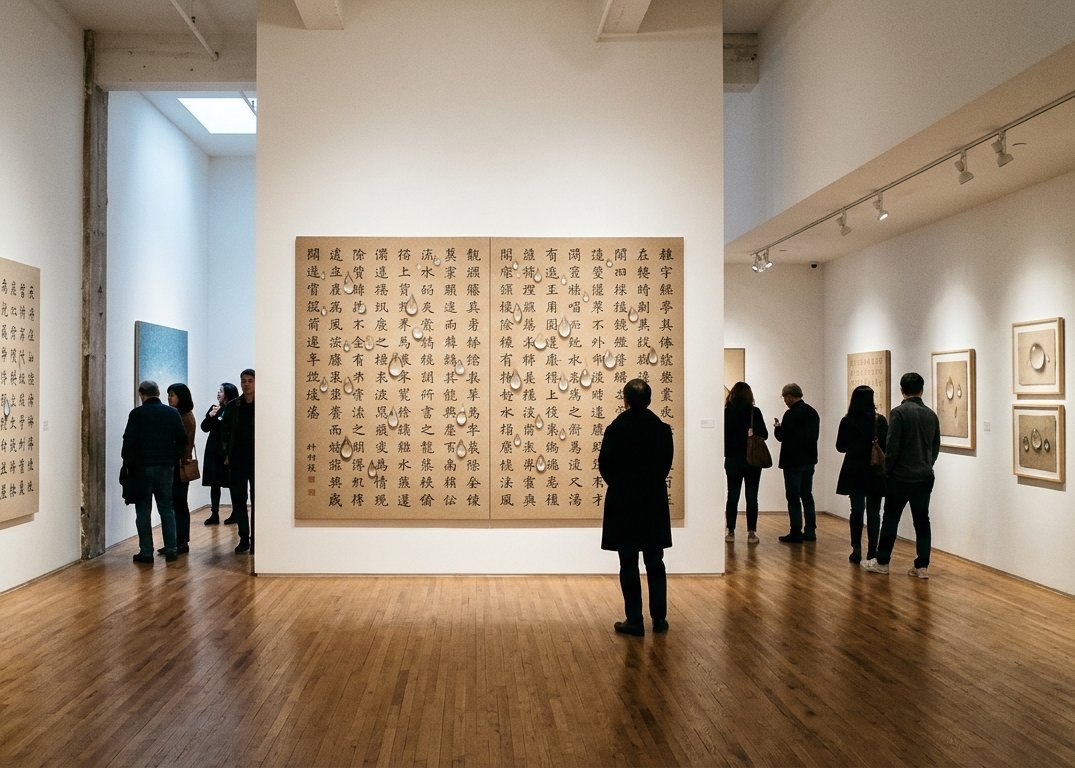
This November, Tina Kim Gallery in Chelsea presents Kim Tschang-Yeul: Recurrence, a solo exhibition devoted to one of the most distinctive visual languages in postwar Korean painting. Opening November 5 and continuing through December 19, 2026, the exhibition brings together works created between the 1980s and 2010s, tracing the evolution of an artistic practice shaped by repetition, material experimentation, and philosophical reflection.
The presentation centers on Kim’s Recurrence series, which emerged in the mid-1980s, alongside significant paintings from his celebrated Waterdrop series. Across these works, a seemingly simple subject becomes an expansive artistic inquiry. The waterdrop is not merely an object to be reproduced with technical precision; it becomes a vehicle for considering time, memory, transparency, and the possibility of returning to a state of nothingness.
For an artist who spent five decades exploring the same recurring image, repetition was never simply a matter of repeating a successful formula. Each painting offered an opportunity to reconsider the relationship between surface, light, material, and perception.
From Personal History to Universal Reflection
Born in 1929 in Maengsan, in what is now North Korea, Kim Tschang-Yeul experienced the upheaval of Japanese colonial rule and the Korean War. The violence and displacement of those years became an important part of his personal and artistic history. After studying at Seoul National University’s College of Fine Arts, he became involved in the development of postwar Korean modernism.
His early paintings were influenced by Art Informel, with expressive surfaces and emotionally charged abstractions. In 1965, he moved to New York, where encounters with new artistic movements contributed to a significant transformation in his approach. He later settled in Paris in 1969, where the waterdrop began to emerge as the defining image of his mature practice.
The origin of the motif was unexpectedly physical. While working in a makeshift studio outside Paris, Kim splashed water onto the reverse side of his canvases. The droplets caught the light, revealing a visual quality that fascinated him. He began exploring ways to preserve that fleeting appearance through painting.
Yet the waterdrop carried meanings beyond optical realism. Kim connected the act of painting with the process of working through memories of violence and loss. Its transparency suggested a form of release: an attempt to dissolve emotional weight and move toward stillness.
The Language of Recurrence
The exhibition’s central series reveals how Kim continually transformed a familiar image without abandoning its essential character. In Recurrence, the waterdrop becomes part of a broader investigation into the painted surface. Changes in scale, density, placement, and material allow the artist to create new relationships between illusion and abstraction.
The works from the 1980s through the 2010s also demonstrate Kim’s growing interest in tactile materiality. He experimented with different grounds and surfaces, while increasingly working on a larger scale. These decisions expanded the possibilities of a motif that might otherwise appear limited by its simplicity.
The waterdrop occupies an unusual position in these paintings. It is recognizable as a physical form, yet it can also seem to dissolve into the surrounding surface. Light and reflection become inseparable from the material beneath them. The viewer is encouraged to look closely, moving between the apparent reality of the droplet and the constructed nature of the painted image.
In this way, the paintings create a quiet tension between presence and absence. What initially appears solid becomes elusive; what seems transparent carries emotional and philosophical weight.
Waterdrops, Night, and the Passage of Time
Alongside the Recurrence works, the exhibition includes notable Waterdrop paintings from the 2000s and 2010s. Some feature droplets spread across raw linen canvases, where the contrast between the painted forms and the exposed ground creates a distinctive visual experience.
Two works from the Nuit series introduce another dimension to Kim’s exploration. Their dark backgrounds recall the atmosphere of his early waterdrop imagery, including Événement de la Nuit, first exhibited in Paris in 1970. Against these darker surfaces, the droplets evoke the stillness of night and the intensity of rainfall.
The dialogue between these works demonstrates the artist’s ability to revisit an early visual idea while allowing its meaning to evolve. The waterdrop can suggest clarity and calm, but it can also carry a sense of isolation, uncertainty, and emotional depth.
A Lasting Contribution to Contemporary Art
Kim Tschang-Yeul died in 2021, but his work continues to receive international recognition. His paintings are represented in major collections, including the Centre Pompidou in Paris, M+ in Hong Kong, the Hirshhorn Museum and Sculpture Garden in Washington, D.C., and the Museum of Fine Arts, Boston. A major retrospective at the National Museum of Modern and Contemporary Art in Seoul in 2025 further highlighted his contribution to modern and contemporary art.
Recurrence offers New York audiences an opportunity to reconsider the breadth of that contribution. Rather than presenting the waterdrop as a signature image frozen in time, the exhibition reveals how Kim continually tested its artistic and conceptual possibilities.
At Tina Kim Gallery, the familiar becomes unfamiliar through subtle shifts in scale, texture, and atmosphere. The paintings invite viewers to slow down and observe what might otherwise pass unnoticed: the movement of light, the complexity of a surface, and the emotional possibilities contained within a repeated form.
Ultimately, Kim’s waterdrops are less about capturing water than about exploring what it means to let things pass, disappear, and return. In their quiet precision, they offer a meditation on impermanence—and on the enduring power of looking again.
Exhibition Information
- Artist: Kim Tschang-Yeul
- Exhibition: Recurrence
- Venue: Tina Kim Gallery
- Dates: November 5 – December 19, 2026
- Location: 525 West 21st Street, New York, NY 10011
- Neighborhood: Chelsea, Manhattan
