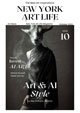


When we see costumes in the theater, we are immediately struck by their magnificent beauty and elegance, and we naturally wonder who is behind all this immense art and breathtaking beauty. The answer is dedicated costume designers, diligent seamstresses, and talented draper professionals. It is an entirely hidden world. The highly talented Katherine Chung is a crucial part of this extraordinary fairytale world. Let us find out much more through this in-depth interview conducted in our New York Art Life Magazine studios.
Katherine Chung is a brilliant New York-based costume maker originally from Taipei, Taiwan. Her educational background is incredibly impressive. She holds a Bachelor of Fine Arts in Costume Design from Taipei National University of the Arts and a prestigious Master of Fine Arts in Costume Production from Carnegie Mellon University. Her extraordinary skills were recently recognized when she was awarded the highly coveted Barbara Matera Award for Costume Making in the year 2025. This accolade firmly established her as a rising star in the highly competitive landscape of theatrical design.
As a draper, the magnificent work of Katherine has recently been seen onstage in the acclaimed City Theatre Company production of The Wickhams Christmas at Pemberley. Her garments have also graced the stage for Quantum Theatre in their production of The Flying Lovers of Vitebsk, as well as the beautiful Carnegie Mellon University production of A Little Night Music. Furthermore, she was a contributing artist helping to create a brilliant sculptural garment for display in the highly praised Flowers Meet Fashion, Inspired by Billy Porter exhibition at the Phipps Conservatory. Additional professional credits include her invaluable work as an intern at Parsons Meares, as well as her service as a First Hand at The Santa Fe Opera and Barrington Stage Company. Currently, in the spring of 2026, she is working full time as a First Hand at the legendary Parsons Meares.
Katherine possesses a deep penchant for historical and traditional clothing. In fact, her capstone project for her Master of Fine Arts thoroughly explores the profound influence of Western tailoring techniques on the traditional Chinese QiPao. This beautifully demonstrates her unique ability to blend distinct cultural histories through fabric and structure. Katherine is currently based in Queens, New York, where she continues to hone her craft daily. For any business inquiries, professionals in the industry are always welcome to contact her. Today, we sit down with her to discuss her creative process, her intricate technical skills, and her inspiring journey to the top of the costume making profession.
NEW YORK ART LIFE MAGAZINE: Katherine, it is an absolute pleasure to have you here in our studios today. To begin our conversation, could you share with our readers how your initial passion for costume design and creation began in Taipei, Taiwan?
KATHERINE CHUNG: Thank you so much for having me here at New York Art Life Magazine. My journey really started back in Taipei when I was quite young. I always had a profound fascination with textiles, history, and the way clothing could completely transform a person. Growing up, I was constantly surrounded by rich cultural traditions, and I found myself drawn to the intricate details of historical garments. When it came time for university, I decided to pursue a Bachelor of Fine Arts in Costume Design at Taipei National University of the Arts. That program provided me with an incredibly solid foundation.
I learned the history of both Chinese and Western costumes, which opened my eyes to the vast global landscape of garment construction. The rigorous training I received there taught me not just how to conceptualize a design, but also the vital importance of understanding the fundamental mechanics of how fabric moves on the human body. It was during those undergraduate years that I truly fell in love with the actual making of the costumes, taking a two dimensional sketch and turning it into a three dimensional reality.
NEW YORK ART LIFE MAGAZINE: Following your studies in Taiwan, you made the significant decision to move to the United States to attend Carnegie Mellon University. How did that Master of Fine Arts program in Costume Production shape your current professional trajectory?
KATHERINE CHUNG: Moving to the United States to attend Carnegie Mellon University was a profoundly transformative experience for me. The Master of Fine Arts program in Costume Production is known for its intense rigor and exceptional faculty. I wanted to transition from primarily designing to focusing heavily on the production and draping aspects of the industry. At Carnegie Mellon, I was able to take highly specialized courses such as Advanced Tailoring, Dancewear, Stretchwear, Couture Techniques, and even Millinery and Armor Making.
My professors, Hugh Hanson and Brian Russman, pushed me to elevate my technical skills to entirely new levels. The environment was highly collaborative but also extremely demanding, which perfectly simulated the professional theatrical world. I learned how to solve complex structural issues, draft precise patterns, and navigate a costume shop effectively. That intense academic and practical training absolutely laid the necessary groundwork for my current career as a draper and first-hand.
NEW YORK ART LIFE MAGAZINE: Last year, in 2025, you were honored with the prestigious Barbara Matera Award for Costume Making. What did receiving that specific recognition mean to you both personally and professionally?
KATHERINE CHUNG: Receiving the Barbara Matera Award for Costume Making in 2025 was an incredibly surreal and deeply humbling moment for me. Barbara Matera is an absolute legend in the world of theatrical costume making, and her shop produced some of the most iconic Broadway costumes in history. To have my name associated with her legacy is an honor I cannot fully put into words.
Personally, it felt like a massive validation of all the countless hours of meticulous labor, the late nights spent perfecting a single element, and the significant sacrifices I made moving across the world to pursue this specific craft. Professionally, the award opened numerous doors for me. It gave me a wonderful platform to connect with industry veterans, and it certainly helped solidify my full time position at Parsons Meares. It serves as a constant reminder to always uphold the highest possible standards of craftsmanship in every single garment I touch.
NEW YORK ART LIFE MAGAZINE: We would love to discuss your current environment. You are now living and working in New York City. How has transitioning to New York City specifically influenced your approach to costume making and your overall professional growth?
KATHERINE CHUNG: Transitioning to New York City has been entirely exhilarating. New York is undeniably the beating heart of the American theater industry, and being immersed in this environment pushes you to be your absolute best every single day. Working full time as a First Hand at Parsons-Meares here in the city means I am directly involved in creating garments for massive Broadway productions and major entertainment events.
The pace is incredibly fast, and the expectations for precision are unbelievably high. New York City demands excellence, and it forces you to adapt swiftly to new materials, unexpected design changes, and tight deadlines. Being surrounded by such an immense concentration of top tier talent from the designers to the stitchers to the fabric buyers is endlessly educational. Every day I walk into the workroom, I am learning a new technique or a more efficient way to construct a complex garment. The city itself, with its endless energy and diversity, constantly fuels my professional drive.
NEW YORK ART LIFE MAGAZINE: Staying on the topic of your local environment, how does the broader cultural and artistic landscape of New York City inspire your creative process outside of the workroom?
KATHERINE CHUNG: The cultural landscape of New York City is an endless well of inspiration. On my days off, I love to explore the various museums, such as the Metropolitan Museum of Art and the Museum at the Fashion Institute of Technology. Examining historical garments up close in those exhibitions provides me with profound insights into historical construction techniques that I can then apply to my theatrical work. Beyond the museums, simply walking through the different neighborhoods of Queens, Manhattan, and Brooklyn exposes me to a vibrant tapestry of street fashion, varied textiles, and unique color combinations.
The architecture, the diverse communities, and the sheer volume of live performances available all contribute to my creative vocabulary. Whenever I am faced with a challenging draping problem, I often find that stepping out into the bustling streets of New York City helps clear my mind and frequently sparks a completely unexpected structural solution. The city essentially acts as an extension of my research process.
NEW YORK ART LIFE MAGAZINE: Let us delve into some of your specific projects. Your work on Carnegie Mellon University production of A Little Night Music was stunning. Can you explain the complex process behind the evening gown you draped for the character Desiree Armfeldt?
KATHERINE CHUNG: The evening gown for Desiree Armfeldt in A Little Night Music was a highly intricate project. The costume designer, Evan Riley, based the design on late nineteenth century research. The challenge was to create a garment that looked historically accurate but also allowed the actress, Susana Cordón, to perform comfortably, particularly during her major musical number Send in the Clowns. The bodice alone was comprised of forty one individual pattern pieces. It featured a highly asymmetrical design, which always adds a layer of complexity to the draping process.
One side had a beautifully draped velvet shoulder detail, while the other side featured a cluster of flowers. I had to carefully engineer the seamed velvet and a delicate lace overlay so that it fit her form flawlessly. The skirt was equally demanding, featuring asymmetrical brocade and bead details, along with a substantial train. To ensure the train moved elegantly on stage, I included interior dust ruffles and a waltz loop. The final touch was the beaded lace trim, which I applied by machine using a specialized omni directional foot to handle the intricate curves perfectly.
NEW YORK ART LIFE MAGAZINE: Another fascinating project was The Wickhams Christmas at Pemberley for City Theatre Company. You created the uniform for the character Cassie. How did you balance the historical empire silhouette with the practical need for quick changes?
KATHERINE CHUNG: That was a wonderful puzzle to solve. The production was set in December of the year 1815, so all the maids had to be outfitted in historically appropriate empire waisted garments. The costume designer, Carrie-Anne Huneycutt, envisioned a very specific look for Cassie, the new housemaid. However, theater is a live medium, and Cassie had an incredibly fast change. To accommodate this, I engineered a custom made uniform that consisted of a dress, an apron, and a cap, all specifically rigged for speed.
The dress featured a snap on drop front that cleverly concealed a hidden zipper closure. This allowed the actress to step into the garment and secure it in mere seconds while maintaining the illusion of period accurate closures. The dress itself was made from a beautiful cotton stripe, and the apron was a delicate cotton pin tucked voile. The cap was particularly special; it featured a vintage crochet doily mounted on silk gauze, which I lined in Italian tulle, matched exactly to the hair color of the actress. We secured it with toupee clips so it would not budge during her energetic scenes.
NEW YORK ART LIFE MAGAZINE: Your Advanced Draping project recreating a Robe de cour from a 1750 portrait is breathtaking. What modern methodologies did you incorporate into this deeply historical garment?
KATHERINE CHUNG: For that particular class project instructed by Hugh Hanson, I chose to recreate the magnificent gown seen in the Portrait of Anne, painted by Tischbein. My primary goal was to remain entirely faithful to the visual aesthetic of a mid-eighteenth-century Robe de cour while utilizing modern methodologies to make the construction more efficient and the garment lighter for the wearer. For the fully boned covered stays, I started with a historical pattern from Janet Arnold but utilized modern synthetic whalebone instead of traditional baleen.
To ensure the modern boning did not show through the delicate silk face fabric, I added a protective layer of baby flannel interlining. The pannier, which provides the incredibly wide hip silhouette, was based on a Norah Waugh pattern. However, I completely modernized the materials by using lightweight nylon horsehair and poly tubing. This drastically reduced the weight of the understructure while perfectly maintaining the required rigid shape. The skirt itself required massive volume, so I cartridge pleated eight full yards of embroidered silk taffeta and bag lined it to silk organza.
NEW YORK ART LIFE MAGAZINE: For your capstone project at Taipei National University of the Arts, you designed and draped costumes for Jekyll and Hyde and so on. How did you approach creating distinct alter ego costumes for a single actress?
KATHERINE CHUNG: That capstone project was incredibly rewarding because I served as both the costume designer and the draper. The script was set in the 1880s, and it required the lead actress, Zhu Sheng Ping, to portray two completely distinct alter egos named Eve and Heidi. I had to design garments that immediately communicated their drastically different personalities while using the same foundational undergarments to allow for efficient backstage transitions.
I started by meticulously drafting and constructing a period accurate corset derived from Norah Waugh research, along with Victorian combinations lifted from a historical patterning book. For Heidi, the look was more exposed and raw, utilizing those foundational pieces heavily. For Eve, the proper and restrained alter ego, I built a complex bustle foundation. Over this, I draped a highly structured bodice and a voluminous draped skirt. Creating these two complete, contrasting characters that originated from the same Victorian base really tested my conceptual design and technical construction skills.
NEW YORK ART LIFE MAGAZINE: Let us talk about your work on Dancewear, specifically the costume for Kitri from the ballet Don Quixote. What are the unique challenges of constructing garments meant for rigorous classical dance?
KATHERINE CHUNG: Constructing dancewear is a completely different discipline compared to standard theatrical costume making. The garments must withstand extreme athletic movement, heavy perspiration, and constant laundering, all while looking effortlessly delicate and beautiful from the audience perspective. For the Don Quixote project, I selected a dramatic red and black color scheme to reflect the dangerous sensuality of the character Kitri. The bodice was cut from a black brocade and featured a plunging neckline and a multi pointed waistline. To ensure the bodice maintained its structure during intense ballet lifts and extensions, I interlined it with durable cotton sateen and strategically utilized synthetic boning at the side front and side back seams.
The skirt was a bell shaped classical tutu featuring a ruffled plate that paid homage to traditional Spanish flamenco costumes. The plate ruffles were precisely gathered to a rigid horsehair base. I employed a highly traditional shoveling method to perfectly pleat the tiered, graduated net layers of the tutu, which I then securely stitched to quilted English bobbinet knickers to ensure complete stability and comfort for the dancer.
NEW YORK ART LIFE MAGAZINE: You participated in the Flowers Meet Fashion Inspired by Billy Porter exhibit at the Phipps Conservatory. This sounds like a highly unconventional project. Can you describe the fabrication of that armor like shell?
KATHERINE CHUNG: That was an absolutely phenomenal collaboration. My partner, costume designer Caifeng Hong, and I focused heavily on the themes of contrast and rebirth found in the autobiography of Billy Porter. We wanted to create a structural piece that acted as a protective armor but also allowed the viewer to see the vulnerable body beneath. We designed an armor like shell that seemingly grew organically from a foundation of fabric ruffles representing lichen and fallen autumn leaves.
Fabricating this required immense patience and highly unconventional materials. I spent countless hours manipulating rigid boning, using industrial zip ties and heavy duty clips to force the material into organic yet purposeful sculptural shapes. Once we finalized the exact silhouette on the dress form, I meticulously covered the entire boning structure in stretch velvet rouleaux. We then laid these complex structured pieces completely flat onto a base of silk organza. I methodically hand whip stitched every single element, securely anchoring the velvet covered structure to the delicate organza base. It was a true marriage of rigid sculpture and soft textile art.
NEW YORK ART LIFE MAGAZINE: The train for that Billy Porter inspired piece also sounds incredibly detailed. How did you construct the floral elements at the base of the garment?
KATHERINE CHUNG: The train was designed to anchor the entire piece to the botanical environment of the Phipps Conservatory. We wanted it to look like a cascading explosion of organic floral matter. To achieve this deeply textured effect, the entire train was comprised of hundreds of individually crafted pearl edged ruffles. We utilized multiple different types of fabrics with varying weights and colors to create a sense of natural depth and shadow. Each ruffle was hemmed and then organically arranged by hand. We spent days carefully hand tacking each individual fabric cluster to the back of the structural shell. The goal was to make it look as though the garment was naturally blooming and shedding at the same time. The sheer volume of handwork required for that specific element was staggering, but the final visual impact of the contrasting textures under the conservatory lighting made every single stitch completely worthwhile.
NEW YORK ART LIFE MAGAZINE: We understand that your capstone project for your Master of Fine Arts explores the influence of Western tailoring techniques on the Chinese QiPao. What drove you to research this specific cultural intersection?
KATHERINE CHUNG: I have always been deeply fascinated by the evolution of traditional garments when they intersect with global trade and cultural exchange. The Chinese QiPao is an iconic garment, but many people do not realize how drastically its construction methods evolved during the early twentieth century. My capstone research delved into how the introduction of western tailoring techniques fundamentally altered the traditional flat patterned structure of Chinese clothing. Historically, Chinese garments relied on two dimensional cutting that draped loosely over the body. However, as western influence permeated urban centers like Shanghai, tailors began incorporating western drafting methods, darts, and precise set in sleeves.
This completely transformed the QiPao into the highly fitted, body conscious silhouette we recognize today. I wanted to rigorously document this technical evolution and practically apply these historical hybrid drafting methods in my own workroom practice. It was a truly fascinating journey to uncover how the merging of these two distinct sartorial traditions birthed a garment that is recognized globally today as a symbol of elegance. Through my thesis, I actively patterned and constructed multiple garments that showcased this precise transition, demonstrating how the introduction of steam allowed the fabric to mold to the human form in a way that ancient flat patterned garments simply never did. This profound research not only deepened my historical knowledge but also heavily refined my own modern tailoring abilities.
NEW YORK ART LIFE MAGAZINE: Your skill set is clearly vastly diverse, extending well beyond traditional draping. You also have a stunning portfolio of fabric modification and embroidery. Could you elaborate on the workroom sample you created in the spring of 2024 under the instruction of Brian Russman, which featured a sketch by Youxuan?
KATHERINE CHUNG: Absolutely, that was a highly specialized class project focused entirely on the intricate art of fabric modification and advanced techniques. In the professional theatrical world. We constantly dye, paint, distress, and embroider materials to give them the precise texture and visual depth required by the costume designer. For that specific sample, based on a beautiful design sketch by Youxuan, I was tasked with combining several highly complex embellishment techniques onto a single cohesive piece. The foundation of the work utilized delicate floss and ribbon embroidery, which creates a wonderful three dimensional floral effect that would catch the stage lighting beautifully. To elevate the texture further, I incorporated tambour beading.
Tambour work requires a specialized hook to apply beads and sequins in a continuous chain stitch from the underside of the fabric, tightly stretched on a frame. It is an incredibly fast technique once mastered, but it requires immense precision and a profound understanding of tension. Furthermore, I integrated top applied beads and heavy bullion work. Bullion involves using specialized wire threads twisted into tight coils, which are then meticulously stitched down to create a raised, metallic, architectural element on the fabric. Blending the soft ribbon embroidery with the rigid metallic bullion work created a breathtaking contrast that truly brought the sketch to vibrant life.
NEW YORK ART LIFE MAGAZINE: It is amazing how you transition from soft, delicate embroidery to working with highly rigid materials. This brings us perfectly to your armor creation project. You constructed a magnificent hood derived from Japanese Kikko style armor. What was the technical process behind creating such a formidable piece?
KATHERINE CHUNG: Transitioning from soft silk fabrics to structural armor was a tremendously exciting challenge for me. The armor creation course, also instructed by Brian Russman, pushed us to explore completely different material sciences. I chose to research and construct a piece inspired by traditional Japanese Kikko armor, which historically consisted of small hexagonal iron or leather plates hidden inside layers of cloth. For my interpretation, I wanted the beautiful geometric structure of the armor tiles to be fully visible and celebrated. I began by utilizing modern technology, specifically drafting the precise hexagonal shapes digitally and using a laser cutter to perfectly slice the tiles from thick, premium vegetable tanned leather.
Vegetable tanned leather is wonderful to work with because it can be highly manipulated, molded, and dyed. After laser-cutting the individual tiles, I dyed each piece to ensure they looked evenly colored and refined. The most time consuming and technically demanding part of the process was the assembly. Traditional Kikko armor is sometimes connected by a complex network of chainmail. I meticulously linked the leather tiles together using hundreds of twisted metal jump rings. It required intense concentration and significant hand strength to weave the jump rings perfectly so that the leather tiles could articulate smoothly, allowing the wearer to move their neck and shoulders freely without the armor buckling or pinching. It was a rigorous exercise in engineering and spatial problem solving.
NEW YORK ART LIFE MAGAZINE: You have held numerous roles in the costume industry, ranging from a First Hand and Draper to a Costume Design Assistant and even a Dresser. Looking back at your time as a dresser for productions like Komische Oper Berlin’s The Magic Flute and War Requiem on tour in Kaohsiung, how did being backstage directly inform your current work constructing the garments in the workroom?
KATHERINE CHUNG: That is a phenomenal question. I firmly believe that every single costume maker should spend a significant amount of time working backstage as a dresser. When you are in the quiet, controlled environment of a costume shop, it is very easy to forget the absolute chaos and the intense physical demands of a live theatrical performance. Working as a dresser on massive touring productions like The Magic Flute and English National Opera’s War Requiem was an incredible education in the practical reality of clothing.
Backstage, you have mere seconds to execute complex quick changes in near total darkness. If a closure is too small, if a zipper catches on a delicate lining, or if a structural element restricts the breathing of a singer, it becomes an immediate crisis. Seeing those specific challenges firsthand fundamentally changed how I approach draping and construction. Now, whenever I am engineering a garment, my very first thought is always about the performer and the dresser. I constantly ask myself how I can make the closures more robust, how I can alter a seam to allow for a greater range of motion, and how I can reinforce areas of high stress so the garment survives a long run. My time as a dresser instilled in me a deep empathy for the backstage crew and the performers, and that empathy directly translates into creating much smarter, highly functional theatrical garments.
NEW YORK ART LIFE MAGAZINE: Considering it is now the spring of 2026, and you are securely established in your full time position as a First Hand at Parsons-Meares, what are your ultimate goals for the future of your career in costume production?
KATHERINE CHUNG: I am incredibly grateful for where my career has taken me so far. Working alongside brilliant professionals like Draper Robert Manning and workroom manager Kathleen Weddle at Parsons Meares is a daily masterclass in theatrical execution. My immediate goal is to continue absorbing every ounce of knowledge I can from these seasoned industry veterans. I want to continue refining my skills in highly specialized areas like complex stretchwear for dance and deeply historical tailoring.
Ultimately, my long term vision is to transition into a lead Draper position where I can run my own team within a major New York theatrical workroom. I also have a profound passion for education, heavily inspired by the incredible mentors I had at Carnegie Mellon University and Taipei National University of the Arts. In the distant future, I would love to return to the academic setting to teach advanced draping and costume production to the next generation of artisans. Passing down these highly tactile, specialized skills is vital to keeping the magnificent art of theatrical costume making alive and thriving. For now, however, I am thoroughly enjoying the incredible energy of New York City and the endless daily challenges of creating spectacular garments for the stage.
Katherine Chung Official Website: https://www.katherinechungcostume.com/
