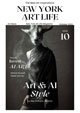


Some designers announce themselves loudly. Arthur Régis Carmo prefers to listen. Yet his work carries remarkable volume across the industry. He is a Creative Director, Art Director, and Illustrator based in New York. Over the past 14 years, he has shaped identities, campaigns, and digital experiences for Google, Nike, TikTok, Twitch, Puma, Coinbase, Brita, and Afterpay. Today, he serves as the top creative lead at Milk Agency, where he directs a multidisciplinary team across fashion, technology, and wellness.
His path began far from Manhattan. In Goiânia, Brazil, he earned a Bachelor of Arts in Graphic Design from Universidade Federal de Goiás. He then built his early craft at Funape and the studio Nitrocorpz, and later led the creative team at Sete Airlines. Eventually, New York called. He completed a specialization in Strategic Design and Management at The New School, and later earned a Master of Fine Arts in Communications Design from Pratt Institute. From there, he rose through Social Chain US and then dotdotdash, part of TBWA Worldwide.
The last four years mark a defining chapter. During this period, his practice grew from regionally rooted projects into global creative leadership. He helped conceive a Nike project native to generative AI, one that became part of the brand’s global culture. Also, he brought rigor and craft to Google’s experiential and digital work. Meanwhile, he helped create a symbol for Salford City Football Club alongside an ownership group led by Sir David Beckham. Beyond client work, his lettering appeared in Ascenders Vol. 1 from Capsule Books, and Abduzeedo featured his celebrated paper-craft piece, Cali Lifestyle. He has also judged portfolios for NYCFotoWorks in New York.
Through it all, his philosophy stays disarmingly humble. As he puts it, every project already knows what it wants to become, and his job is simply to get out of its way. So we sat down with Arthur in New York for a long conversation. Together, we explored scale, leadership, technology, and the discipline of staying quiet enough to hear what a project wants to say. What follows is a portrait of a creative mind at the height of a remarkable ascent.
From Goiânia to New York
New York Art Life Magazine: You began your career in Goiânia, Brazil, moving from an in-house role at Funape to the multidisciplinary studio Nitrocorpz, and later leading the creative team at Sete Airlines. What did those early Brazilian years teach you, and what ultimately pulled you toward New York?
Arthur Régis Carmo: Those years gave me my foundation, and I still lean on them daily. At Funape, I learned discipline. I directed corporate identity, print periodicals, and social channels for an accelerator supporting academic research. So I had to make serious subjects feel human. Then Nitrocorpz opened up my range completely. Over two years there, I designed illustrations, CD covers, posters, and websites. Because the studio moved between print, branding, animation, and interactive work, I never settled into one lane. That variety became my identity.
Later, Sete Airlines handed me real responsibility. I led the creative team for a private jet operator and built a new nationwide brand strategy. However, I began to feel a ceiling forming above me. I wanted to test my ideas against the best in the world. New York represented that test. Also, I sensed that my colorful Brazilian sensibility could stand out there rather than blend in. So I made the leap, and I have never once regretted it.
New York Art Life Magazine: You hold a Master of Fine Arts in Communications Design from Pratt Institute and a specialization in Strategic Design and Management from the New School. How did formal education in New York reshape a designer who had already worked professionally for years in Brazil?
Arthur Régis Carmo: Honestly, it rebuilt me from the inside out. I arrived with strong craft, but I lacked a strategic vocabulary. First, the New School taught me to think about design as management, as systems, and as business. Then Pratt pushed my conceptual thinking further than I believed possible. My professors kept asking why, and at first that question frustrated me. Over time, it became my favorite tool. Today, I ask why before I ever open a design file.
Also, school gave me a community. My classmates came from everywhere, and their perspectives widened mine. In fact, Pratt still features my work today. The Communications Design department once interviewed me about my process on its social channels, highlighting a project I made for MadeInNYC. That felt like a full-circle moment. Because education shaped my career so deeply, I love giving something back to the students who now sit where I once sat.
New York Art Life Magazine: People often describe your design sensibility as playful, enthusiastic, and colorful, and you have said it reflects your Brazilian roots. How does that heritage actually show up when you are working for enormous global brands with strict guidelines?
Arthur Régis Carmo: Brazil taught me that joy is a serious strategy. Our visual culture celebrates color, rhythm, and warmth, and I carry that everywhere. However, heritage is not a paint bucket. Instead, it is a way of seeing. For example, I look for the human pulse inside every brief. A payment product can feel welcoming. Likewise, a technology brand can smile. So my Brazilian eye finds the emotional door into rational categories.
Of course, global brands come with strict systems, and I respect them completely. Yet guidelines describe boundaries, not ceilings. Within those boundaries, I push for energy, surprise, and play. Because I grew up between cultures, I translate between them naturally. That skill matters enormously in global work. A campaign must travel across languages and contexts, and my background prepared me for exactly that journey. Ultimately, my roots keep my work honest, warm, and alive.
Learning the Language of Social
New York Art Life Magazine: At Social Chain US, you rose from Senior Art Director to Design Director, guiding strategies for TikTok and Twitch and helping bring to life the widely covered #NoFilterNoFuture campaign for Brita, in which 21 Instagram influencers simultaneously posted idyllic beach photos that had been Photoshopped to show those same paradises buried under single-use plastic waste. What did those years inside a social-led agency teach you about modern attention?
Arthur Régis Carmo: They taught me humility, above all. On social platforms, nobody owes you their attention. Instead, you must earn every single second. The Brita #NoFilterNoFuture campaign taught me the most. We had 21 influencers post picture-perfect beach photos at the exact same moment, except every image had been Photoshopped into an apocalyptic scene of plastic waste and discarded bottles. The captions warned of a future without pristine places and pointed to Brita Filtering Water Bottles as the reusable alternative. It flipped Instagram’s visual language against itself, and the media coverage followed. As lead creative and main animator, I crafted concepts and animated them myself. Because of that, I learned exactly how fast an idea must land. Three seconds, sometimes less. That pressure sharpened everything about my thinking.
Later, as Design Director, my job changed. I managed a team of art directors, animators, and designers and guided strategy for TikTok and Twitch. Suddenly, my craft had to travel through other people. So I learned to give feedback that opens doors, not closes them. Also, I learned that clever, on-brand creative beats loud creative every time. Social Chain believed in building brands that earn a meaningful share of people’s lives. That phrase still guides me today.
New York Art Life Magazine: In December 2021, you joined dotdotdash, part of TBWA Worldwide, as Associate Creative Director, leading projects end to end for Coinbase, Nike, and Google. How did stepping into a global agency network change the scale and nature of your responsibilities?
Arthur Régis Carmo: Everything grew at once. The budgets grew, the stakes grew, and the rooms grew. At dotdotdash, I led projects from the first spark of concept through final execution. Moreover, I collaborated constantly with strategy, production, and account teams. That taught me a crucial lesson. Great creative work is a team sport, and the idea must serve the business objective. Otherwise, it is just decoration.
Also, the mediums multiplied. One month I art directed a photoshoot, and the next month I built an interactive digital experience. Because clients like Google and Nike operate at a planetary scale, they scrutinize every detail. Millions of people would see the work, so nothing could be left to chance. That pressure could crush you, or it could refine you. Fortunately, it refined me. I learned to hold ambition and responsibility in the same hand, and that balance defines my leadership now.
Nike, Google, and a Crest for a City
New York Art Life Magazine: You describe your Nike collaboration as a defining chapter: an AI native creative project that became part of Nike’s global culture and reached a vast community of fans worldwide. Can you walk us through that project and what made it so significant for you?
Arthur Régis Carmo: That project changed how I understand my own craft. From the start, we conceived it as native to generative AI. In other words, the technology was not a patch or a shortcut. Instead, it lived at the very center of the creative idea. We treated the tools as genuine collaborators, and we pushed them with the same rigor we apply to any craft. As a result, the work felt fresh in a way traditional methods could not achieve.
What moved me most, however, was the reach. The project became part of Nike’s global culture, and it connected with a vast community of fans worldwide. For a kid from Goiânia, that still feels surreal. Nike carries meaning for billions of people, so contributing to that story carries real weight. The project also proved a point I care about deeply. New technology can honor craft rather than replace it, but only when creative intent leads the process.
New York Art Life Magazine: Generative AI remains controversial in the creative industries, yet you have pioneered its integration into agency workflows, first at dotdotdash and now at Milk Agency. What do you say to skeptics, and how do you keep the technology from flattening creative originality?
Arthur Régis Carmo: First, I take the skeptics seriously, because their fears are reasonable. Careless use of AI produces generic work, and generic work erodes trust. However, I draw a sharp line between a shortcut and a collaborator. A shortcut replaces thinking. A collaborator provokes it. At Milk Agency, I deliberately brought these tools into our workflow. As a result, our creative speed increased, and new conceptual and visual possibilities opened for our clients.
Still, rules matter enormously. Human intent starts every project, and human judgment ends it. The machine sits in the middle and never at the head of the table. Also, taste remains the true differentiator. AI can generate a thousand options, but only a trained eye knows which one sings. Therefore, I tell young designers to sharpen their taste above all. Ultimately, the tools will keep changing, yet the value of a clear point of view will only grow.
New York Art Life Magazine: Your work for Google pushed you to bring rigor and craft to experiential and digital projects for one of the most iconic companies on the planet. What does craft mean at that scale, and how do you protect it under such scrutiny?
Arthur Régis Carmo: At that scale, craft means invisible discipline. Google’s audience is essentially everyone, so the work must feel effortless to wildly different people. Behind that effortlessness sits obsessive labor. For example, we would interrogate every transition, every texture, and every word. Because experiential work lives in physical space, the stakes rise even higher. A digital mistake gets patched. However, a physical mistake stands there in front of you.
So how do I protect craft under pressure? Mostly, I protect the time to care. Schedules always squeeze the polish phase first, and I fight for it constantly. Also, I keep my own hands in the work. I still design, illustrate, and animate, and that keeps my standards honest. A creative director who abandons craft starts approving work by memory. Instead, I want to feel the work directly. That habit came from Brazil, and it survived every promotion since.
New York Art Life Magazine: Perhaps your most emotionally resonant project is the symbol you helped create for Salford City Football Club, developed alongside an ownership group led by Sir David Beckham. What was it like designing an identity for a club that carries the weight of an entire city?
Arthur Régis Carmo: That project humbled me completely. Football clubs are not brands in the ordinary sense. Rather, they are inheritances. Fans pass them from grandparents to grandchildren, and the crest holds all of that memory. So we began by listening. We studied Salford, its history, and its devoted supporters. Because the ownership group included Sir David Beckham, the project drew global attention. Yet the local meaning mattered far more to me than the spotlight.
Working near that ownership group taught me something valuable, too. People at that level obsess over authenticity, not flash. They asked whether the symbol would honor the fans, and they asked again and again. In the end, a crest succeeds when a supporter wears it with pride on a cold Tuesday night. Nothing about that is abstract. Consequently, I consider that project one of the great honors of my career, and I hold it close.
Leading at Scale
New York Art Life Magazine: You have framed the last four years as the period when your work grew from independent, regionally rooted projects into creative leadership at global scale. Looking back, what changed most in your approach as that scale and maturity arrived?
Arthur Régis Carmo: My definition of authorship changed most. Early on, I measured myself by what my own hands produced. Now, I measure myself by what my teams become. That shift sounds simple, but it demanded real growth. First, I had to learn patience. A leader who grabs the mouse teaches nothing. Then I had to learn clarity. At global scale, vague direction multiplies into expensive confusion, so I learned to articulate intent precisely.
Also, responsibility reshaped my ambition. When you touch brands like Nike and Google, your choices ripple outward into culture. Therefore, I began asking harder questions about meaning, not just beauty. Does the work respect its audience? Does it deserve the attention it requests? Meanwhile, maturity brought a strange freedom. I stopped chasing every trend, and I started trusting my own compass. Ironically, the work grew bolder once I stopped trying to prove myself with it.
New York Art Life Magazine: As Creative Director of Milk Agency, you direct a multidisciplinary team across fashion, technology, and wellness, and you serve as the final creative authority on every deliverable. How do you balance brand coherence with the creative freedom and risk-taking your team needs?
Arthur Régis Carmo: I think of it as holding two truths at once. Coherence protects the client, while risk protects the work. Lose either one, and everything suffers. So I set the frame tightly, and then I open the field widely. In practice, that means I define the strategic intent with real precision. After that, I invite the team to surprise me inside it. Because the boundaries are clear, the experiments become safer and braver.
Also, I preserve explicit space for creative risk in our process. Teams need permission to fail, and permission must come from the top. Otherwise, everyone quietly retreats to the safe option. As the final creative authority, I own the quality bar for every deliverable. However, I never want that authority to feel like a wall. Instead, it should feel like a safety net. My best days at Milk happen when someone shows me an idea I could never have imagined.
Craft, Community, and Philosophy
New York Art Life Magazine: Beyond your agency career, Capsule Books featured your lettering in Ascenders Vol. 1: Leaders in Contemporary Lettering, and Abduzeedo profiled your paper-craft piece, Cali Lifestyle, an artwork built entirely from colored paper, foam paper, and glue. What role does analog, personal craft play in your life now?
Arthur Régis Carmo: It plays the role of oxygen, honestly. Client work feeds my ambition, but personal craft feeds my soul. Cali Lifestyle is a good example. I built that piece by hand at 33 by 21 inches, using colored paper, foam paper, and glue. The warm tones referenced the California sun, while the cooler tones evoked the ocean and sky. At its center sat original hand lettering of the word California, inspired by the state’s license plate. Abduzeedo praised the depth of its layered construction, and that recognition meant a great deal.
Similarly, appearing in Ascenders Vol. 1 placed my lettering beside artists I deeply admire from around the world. Capsule Books even donated the proceeds to Book Aid International, which made it sweeter. Ultimately, analog work keeps my digital work honest. Paper resists you, and glue dries when it wants. Therefore, the hand stays humble, and humility improves everything I touch.
New York Art Life Magazine: You have also served as an invited reviewer and judge for NYCFotoWorks, evaluating photographers’ portfolios for the advertising industry, and Pratt’s Communications Design department has featured you as an alumni voice. What do you look for in emerging talent, and why does mentorship matter to you?
Arthur Régis Carmo: Mentorship matters because generous people once opened doors for me. Now I try to hold those doors open for others. At NYCFotoWorks, I reviewed portfolios from professional photographers seeking advertising work. I assessed technical execution, creative concept, and commercial viability, and then I gave direct, honest feedback. Because those sessions run one-on-one, honesty becomes a gift rather than a wound.
So what do I look for? First, I look for a point of view. Technique can be taught, but conviction cannot. Second, I look for curiosity, because curious people keep growing long after school ends. Third, I look for care in the smallest details, since small care predicts large care. Meanwhile, speaking with Pratt students reminds me of my own beginnings. Their energy recharges me, and their questions sharpen my thinking. In truth, mentorship flows in both directions.
New York Art Life Magazine: You often say that every project already knows what it wants to become, and that you see yourself less as a creator and more as a translator. That is an unusually humble philosophy for a Creative Director. Where does it come from, and how does it work in practice?
Arthur Régis Carmo: It comes from experience, mostly from my failures. Early in my career, I imposed my style onto everything. Sometimes it worked, but often it fought the project. Eventually, I noticed a pattern. My best work happened when I listened first, then designed. So I reframed my whole role. A project carries its own truth, formed by the brand, the audience, and the moment. My job is translation, turning what a project wants to say into something people can see.
In practice, this changes everything about process. First, I sit with the brief far longer than most people find comfortable. Then I ask what the work is trying to become, rather than what I want to make. Good design is not imposed, in my view. Instead, it is uncovered. Therefore, I try to stay quiet enough to hear what is already there. That quietness, ironically, has become my loudest professional signature.
The City and the Road Ahead
New York Art Life Magazine: New York has been your home base since your graduate school years, and your practice sits at the intersection of culture, technology, and storytelling. What does the city give your work that nowhere else could, and how do you stay connected to Brazil?
Arthur Régis Carmo: New York gives me density, in the best sense. Every discipline, culture, and ambition collides here daily. Because of that, ideas cross-pollinate at incredible speed. I can visit a gallery in the morning and then debate technology over dinner. The city also holds you to a standard. Excellence surrounds you constantly, so complacency becomes impossible. For a creative director, that pressure is a gift.
Meanwhile, Brazil never leaves me. I carry it in my color sense, in my warmth with teams, and in my instinct for joy. I stay connected through family, through language, and through the Brazilian creative community here in New York. In fact, distance sharpened my appreciation for home. Today, I see my in-between position as an advantage. I belong to both worlds, so I can translate between them. That translation lives inside all of my work.
New York Art Life Magazine: At Milk Agency, you now shape new business, client resourcing, and team structure alongside the creative product itself. Looking forward, what excites you most about the next chapter, and what advice would you give young designers dreaming of a similar path?
Arthur Régis Carmo: The blank page excites me most, truthfully. At Milk, I help shape pitches, resourcing, and team structure, so I influence not only the work but the conditions that produce it. That is a designer’s dream, really. I get to design the studio itself. Looking ahead, I want to keep proving that generative tools and deep craft can thrive together. Also, I want our fashion, technology, and wellness clients to feel genuinely braver because of us.
For young designers, my advice is simple, though not easy. First, build your craft with your own hands, because craft is your passport. Second, stay curious beyond design, since culture feeds concepts. Third, protect your point of view fiercely, but hold your ego loosely. Finally, remember that careers are long. Mine began with posters in Goiânia, and it led to Nike, Google, and a football crest in Salford. So start where you are, and then keep walking.
Find Arthur Régis Carmo
Our conversation ended, fittingly, with quiet gratitude. Arthur thanked the baristas, gathered his sketchbook, and stepped back into the city that sharpened him. His story reminds us that great creative leadership begins with listening. Explore his portfolio at arthurregis.com, follow his daily work on Instagram, and connect with him professionally on LinkedIn. For collaborations, reach him at hello@arthurregis.com.
