

A Monumental New York Debut
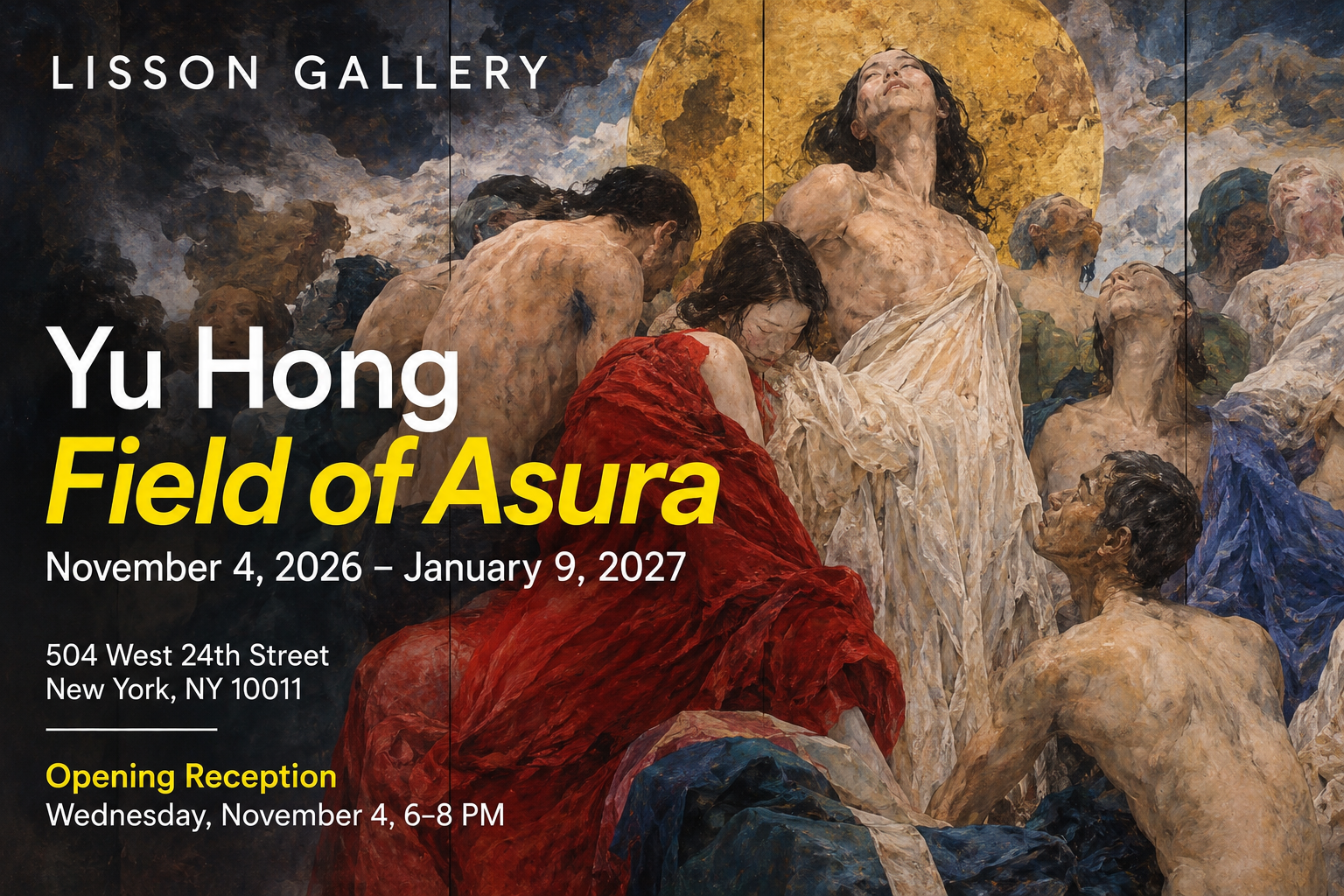
Lisson Gallery will present Yu Hong: Field of Asura at its Chelsea location from November 4, 2026, through January 9, 2027. Marking the artist’s debut at Lisson New York, the exhibition brings together new and recent paintings that extend her ambitious exploration of contemporary life through allegory, historical references, and expressive representations of the human body.
Anchored by a group of large-scale paintings, the presentation includes newly completed multi-panel compositions inspired by the structure of classical European altarpieces, alongside selected mid- and small-scale works. Through sweeping brushwork and heightened physical intensity, Yu Hong creates scenes populated by figures caught between vulnerability and endurance, intimacy and isolation, destruction and transformation.
The exhibition takes its title from the Asura realm, a concept found in Buddhist and Hindu traditions associated with conflict, rivalry, and restless struggle. This idea becomes a framework for examining the tensions of modern existence. Rather than presenting a straightforward narrative, Yu Hong constructs complex painterly worlds in which human bodies communicate emotional and psychological states.
The Human Figure as a Record of Contemporary Life
Born in Xi’an, China, in 1966, Yu Hong graduated from the Oil Painting Department of the Central Academy of Fine Arts in Beijing in 1988, where she has also pursued an academic career. Over several decades, she has developed a distinctive practice centered on the human figure and its relationship to personal experience, social change, and collective history.
Her paintings frequently combine recognizable human subjects with allegorical settings and references to the history of art. Friends, family members, acquaintances, and figures drawn from contemporary life have all informed her visual narratives. Through these subjects, she explores how individual experiences intersect with larger historical and cultural forces.
One of her significant long-term projects, Witness to Growth, began in the 1990s. The series connects moments from her own life with images and records of contemporary events, creating a visual dialogue between private memory and public history.
In Field of Asura, that interest in the relationship between individual experience and collective conditions takes on a more dramatic form. The figures appear within turbulent environments, where their physical gestures suggest struggle, dependence, vulnerability, and the search for stability.
Classical Altarpieces Reimagined
One of the exhibition’s defining features is its group of monumental multi-panel paintings inspired by classical European altarpieces. Historically, altarpieces organized religious imagery into elaborate visual structures, using multiple panels to communicate spiritual narratives.
Yu Hong adapts this format to address contemporary concerns. Her compositions bring together bodies, movement, and atmospheric spaces in scenes that feel both theatrical and psychologically charged. The scale encourages viewers to experience the paintings as immersive environments rather than isolated images.
The title work, Field of Asura, presents a turbulent gathering of figures within a monumental composition. The imagery evokes a world governed by instability, where bodies appear caught in cycles of conflict and transformation. Its visual structure connects the spiritual associations of the Asura realm with the uncertainty and emotional pressures of modern life.
Another major work, Lament, draws inspiration from Rogier van der Weyden’s celebrated fifteenth-century painting The Descent from the Cross. Yu Hong reinterprets the historical composition through a contemporary image of a naked corpse being lowered into a funerary shroud. The reference places present-day human suffering in conversation with centuries of religious and artistic imagery.
In contrast, Wind Rising introduces a gathering of nymphs against the atmosphere of a sunset. Its imagery moves toward a more dreamlike register, exploring a different relationship between the human body, nature, and imagined space.
Bodies Between Vulnerability and Isolation
A striking feature of Yu Hong’s paintings is her treatment of the human gaze. Her figures frequently avoid looking directly at the viewer. This decision creates a sense of distance and alienation, directing attention instead toward posture, gesture, and the physical relationships between bodies.
Figures may appear locked in struggle or held in moments of intimate contact. Their elongated and contorted forms communicate states of being that words might struggle to describe. The body becomes a visual language through which fear, grief, exhaustion, desire, and mutual dependence can be expressed.
This approach also complicates the distinction between individual and collective experience. Although each figure occupies a particular position within a composition, the surrounding bodies create relationships that suggest shared vulnerability. The paintings move between scenes of human suffering and moments that hint at escape or transformation.
The result is an emotionally charged visual world that refuses easy resolution. Conflict remains present, but so does the possibility of connection.
Art History as a Contemporary Conversation
Yu Hong’s engagement with European painting traditions extends beyond the altarpiece format. The exhibition also includes Night Walk (2023), the only previously existing work in the presentation. It references Pieter Bruegel the Elder’s The Blind Leading the Blind (1568), a painting widely associated with the consequences of misguided leadership and collective blindness.
Yu Hong transforms this historical reference into a disturbing procession that moves from light toward darkness. The work establishes another connection between historical imagery and contemporary anxieties, suggesting how familiar visual narratives can acquire renewed significance in changing political and social circumstances.
These references are not simply quotations from art history. They allow Yu Hong to place contemporary human experience within a broader visual tradition, bringing historical memory into dialogue with the present.
Her first major U.S. solo museum presentation took place at the SCAD Museum of Art in Savannah in 2023. In 2024, her work was also featured in a major European exhibition in Venice organized by the Guggenheim Museum’s Asian Art Initiative. The Lisson presentation marks another important chapter in the international recognition of her practice.
A World of Struggle, Memory, and Possibility
Field of Asura offers a powerful examination of contemporary existence through the physical and emotional possibilities of painting. Its monumental compositions connect classical artistic traditions with the uncertainties of the present, while its human figures reveal the complex relationships between suffering, resilience, and dependence.
For visitors exploring Chelsea’s contemporary art scene, Yu Hong’s New York debut promises an encounter with painting that is both visually ambitious and intellectually layered. The exhibition does not offer a single interpretation of the world it depicts. Instead, it invites viewers to consider how individuals endure within larger systems of conflict—and how moments of connection might emerge even in turbulent circumstances.
At Lisson Gallery, the human figure becomes a witness to the instability of the world and a reminder of the fragile relationships that hold people together.
Exhibition Information
- Artist: Yu Hong
- Exhibition: Field of Asura
- Venue: Lisson Gallery, New York
- Dates: November 4, 2026 – January 9, 2027
- Address: 504 West 24th Street, New York, NY 10011
- Neighborhood: Chelsea, Manhattan
- Gallery Hours: Monday–Friday, 10 AM–6 PM, according to the gallery’s official listing.
