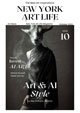


In the heart of New York City’s ever-evolving creative landscape, Ifah Pantitanonta has carved a distinct space for herself, one that is not easy to categorize, and that’s the point. Originally from Bangkok, Thailand, she built a practice that sits deliberately at the intersection of design and strategy, where aesthetics and strategic thinking aren’t in competition. One sharpens the other.
She’s spent her career turning complexity into something people can see, trust, and act on. Today, she brings that to the Vision AI space, where she leads creative marketing and operations, translating technical systems that most people can’t visualize into narratives that business leaders can actually use.
For Ifah, design is not a decorative act. It is a business enabler: a strategic discipline that shapes how people understand, engage with, and make decisions about complex ideas. That philosophy has guided her across sectors, from hospitality to enterprise AI, and earned her the Graphic Design USA (“GDUSA”) Digital Design Award in 2026 for her healthcare AI exhibition work. The recognition wasn’t just for how it looked; it helped people in a high-stakes professional environment understand something genuinely difficult and feel confident enough to act on it.
Her background is as layered as the city she now calls home. She has worked with globally recognized personal brands, agility-focused startups, and everything in between, which has developed a sharp sense of how design shapes perception and builds long-term business value. In this conversation, we explore her creative process, the influence of New York on her thinking, and why she believes the most important design decision happens before you open any tool.
New York Art Life: Ifah, you have a very specific view of design as a strategic discipline rather than just an aesthetic one. Can you tell us how your early life in Bangkok and your transition to New York City helped form this perspective?
Ifah Pantitanonta: Growing up in Bangkok gave me a visual foundation built on layering; tradition and modern commerce coexisting in the same space, sometimes on the same street. That environment taught me to read complexity before I had formal language for it. New York added urgency. Here, everyone is competing for attention, and being visually interesting isn’t enough. You have to be purposeful.
But honestly, the shift in how I think about design wasn’t about location. It was about paying attention. I started seeing design as a bridge between what a brand is trying to say and what an audience actually needs to hear. That realization could have happened anywhere. What Bangkok and New York gave me was exposure to the full range of what that gap looks like across very different cultures, industries, and audiences. That range is what I draw from.
New York Art Life: You currently lead creative marketing design at a start-up company focused on Vision AI. How do you approach the challenge of making such a complex, technical field accessible to a broader audience?
Ifah Pantitanonta: AI is now undeniably part of how we live, but the understanding of it has yet to catch up. Vision AI, in particular, is abstract to most people. When you start talking about neural networks or vision language models, even experienced business leaders can feel lost. My role is to act as a translator.
I start by stripping away the jargon and looking for the human impact, then I raise myself questions: what does the product actually do? What are the real use cases? What does someone need to know to make a confident decision? From there, I build visual narratives around utility rather than mechanics, such as diagrams, product visuals, clear system maps, or anything that helps an enterprise client see how this fits into their existing workflow.
Clarity is the measure. If a design looks beautiful but leaves the viewer confused about what the product does, then I’ve failed as a strategist. That’s why I work closely with the technical team to ensure nothing I simplify is inaccurate. The aesthetic has to be welcoming. The information has to be trustworthy, and they have to work together.
New York Art Life: You recently won a GDUSA Digital Design Award for your Exhibition Display for Healthcare AI. What was the core strategy behind that specific project?
Ifah Pantitanonta: Healthcare is a precise and regulated sector; integrating AI into that world still faces considerable skepticism. When designing the exhibition display, I knew I had to convey innovation, reliability, and seamless integration into existing workflows. The strategy was to position Vision AI as enhancing what doctors and researchers already do, not as something that disrupts or replaces them.
The layout was clean and structured, with bold visual cues that made the AI capability readable without feeling overwhelming. The goal was to make the data feel tangible and actionable so that the visitor could look at it and immediately understand it, even from a distance. High-fidelity mockups and intentional copy choices made sure the most important information landed first.
Winning the award was meaningful because it validated something I strongly believe: that technical communication is a form of design in its own right. When you get it right, even the most complex workflow can become a clear, engaging experience. The work just has to start with the viewer, not the technology.
New York Art Life: Many people see marketing and design as separate departments. How do you integrate these two functions in your daily work?
Ifah Pantitanonta: I’ve had the fortune of working across both throughout my career, which gave me a perspective most people on either side don’t have. They’re more similar than people think, as both are trying to achieve a goal, communicate a message, and move someone toward a decision. The difference is in depth and function.
For me, it’s one continuous process. It starts with thinking like a strategist, which involves defining the goal, the audience, and what success looks like. Then comes the intersection where strategy and creativity meet: carving out the narrative, shaping the concept, deciding what story needs to be told and how. That’s where the most important work happens. The visual execution comes last, as it is the expression of everything already decided upstream.
When design and marketing are treated as separate steps, something always gets lost in the translation. When they come from the same thinking, the work has a coherence that you can feel and measure.
New York Art Life: Before your current role, you worked in the hospitality sector. How did designing for a physical space and a service brand differ from your current tech-focused work?
Ifah Pantitanonta: It’s a different end of the industry, but even then, hospitality was beginning to shift toward integrating more digital touchpoints into the guest experience. So the gap wasn’t as wide as it might seem, at least where I worked.
What hospitality taught me was how design affects people in real time, in a physical space. You see the reaction immediately: a guest may feel welcome and oriented, or they may not. That feedback loop makes you very honest about whether the work is actually doing what it’s supposed to. Design in that context isn’t just about aesthetics; it encompasses the full experience, the atmosphere, and how someone moves through a space and feels within it.
Tech-focused is a different kind of challenge. The impact isn’t felt in a room; it’s felt in a boardroom decision, a product adoption, a shift in how an entire organization understands something. The complexity is higher, the audience is harder to reach, and the stakes of getting the communication wrong are bigger. But the core question is the same: does this land with the person on the other end? The context changes, but that question doesn’t.
New York Art Life: You have a quote where you say New York pushes you to “think sharper, move faster, and focus on what matters most.” How does this manifest in your design process?
Ifah Pantitanonta:
“New York is defined by its diversity and constant opportunity. Being immersed in its people, culture, history, and art has shaped how I see and think creatively, pushing me to think sharper, move faster, and focus on what matters most.”
In practice, it means I’ve become much more decisive. A slower environment, you might spend weeks overthinking a single decision. In New York, especially in the startup world, you don’t have that luxury. You rely on your strategic foundation to move quickly and effectively. I’ve learned to prioritize the core message and remove anything that doesn’t serve a clear purpose.
But speed doesn’t mean sacrificing quality; it means the thinking happens earlier. I spend more time understanding the problem and less time moving things around aimlessly. By the time I open any tool, I already have a clear mental model of where I’m going.
New York also constantly feeds the creative side. Every neighborhood has its own character, its own visual language, its own cultural layer. That variety keeps my eye sharp and reminds me that good design is always in conversation with the world around it.
New York Art Life: You worked as an award-winning web designer specializing in personal branding, supporting notable figures. What did you learn from working with such high-profile personal brands?
Ifah Pantitanonta: That role was an awakening for me. But what made it distinct was the nature of the work itself; you’re not designing for a product or a company, you’re designing for a person. Their values, their voice, and their credibility are all on the line with every visual decision. There’s no hiding behind a brand identity. It has to feel true to who they actually are, at every touchpoint, at massive scale.
That pressure taught me how consequential design choices really are. A single inconsistency across platforms could affect how a global audience perceives someone. It sharpened my attention to detail and my understanding of brand consistency in a way that product work never could.
It was also where my interest in narrative and marketing as disciplines really started. I saw how storytelling and strategy worked together and what happened when they were aligned. That integration has stayed with me and shaped how I approach everything since.
New York Art Life: How do you handle the balance between the “crazy creative” side of design and the “strategic business” side in an in-house role?
Ifah Pantitanonta: In an in-house role, your creativity is focused on solving specific business challenges. It might not always look like experimental art, but the creativity lies in the strategy. I find immense creative satisfaction in finding a simpler way to explain a complex idea. My creativity is directed toward clarity, structure, and impact. I believe that design is most
successful when it feels effortless to the user, even if the thought process behind it was incredibly complex.
I do not see the business side as a constraint. I see it as a set of parameters that push me to be more innovative. When you have a clear goal, like increasing user engagement by a certain percentage, it forces you to think outside the box to find the most effective visual solution. I stay creatively inspired by working on diverse projects, from motion graphics to high-level investor documentation. The variety keeps my skills sharp and prevents my work from becoming stagnant.
New York Art Life: What specific tools and technologies are most essential to your workflow today?
Ifah Pantitanonta: It really depends on what the work needs. I use the full Adobe suite regularly, from Photoshop, Illustrator, InDesign, After Effects, and Premiere Pro. Each program is suited to a different kind of output. Figma for anything collaborative or interface-related. And generative AI tools have become genuinely fascinating to work with, as they’ve changed how I approach certain parts of the creative process.
Honestly, the tool matters less than knowing which one to reach for and why. The work dictates the medium, not the other way around.
New York Art Life: As an international designer from Thailand, what advice do you have for other creatives looking to establish themselves in the New York market?
Ifah Pantitanonta: My biggest piece of advice is to embrace your unique perspective. Your background is your superpower. In a city as diverse as New York, having a global outlook is a massive asset. Coming from a different culture, you carry a mindset and way of working that’s uniquely yours. That difference is what gives you a fresh perspective. The instinct to blend in is natural, but the designers who stand out here are usually the ones who leaned into what made them different, not away from it.
I also recommend focusing on the “why” behind your work. When you interview for roles in the United States, employers want to hear about your process and the impact of your designs. They are looking for thinkers, not just makers. Be prepared to explain how your work drives business value. Finally, stay resilient. Moving to a new country and starting a career is challenging, but the opportunities in this city are limitless if you are willing to put in the work and stay true to your vision.
New York Art Life: Working in a field that moves as fast as AI, how do you stay aligned with where the product and market are heading?
Ifah Pantitanonta: The AI space is constantly evolving. How companies position themselves, how the market shapes their direction, how a product finds its fit, all of it is moving at the same time. And honestly, many AI startups are still in the early stages, so there’s still a lot to learn for everyone in the field.
For me, staying updated happens through the work itself. Being part of the conversation with both the engineering and sales teams means I’m seeing shifts in real time. That internal awareness, combined with keeping an eye on the competitive landscape and how the broader market is responding to AI, is what keeps me current. It all feeds into how I shape the marketing and creative strategy. You can’t communicate something well if you don’t understand where it sits in a constantly shifting field.
New York Art Life: Can you describe your process for creating visual systems for a brand?
Ifah Pantitanonta: I always start with the core values: what the brand is genuinely trying to represent and what they want the clients to feel or experience when they encounter it. That’s the foundation everything else is built on.
From there, I distill it into three words that capture the brand’s essence. Those three words become the creative brief for every decision that follows, including typography, color palette, visual language, and style. It keeps the process grounded and gives you something to test decisions against. Does this typeface feel like those three words? Does this color system?
The usage context matters just as much. A visual system has to work for how the company actually operates, whether that’s pitch decks, exhibition displays, social content, or product interfaces. It’s like setting the parameters for your creativity; boundaries that don’t limit you, they direct you. Because at the end of the day, a visual system is how a company is perceived. It shapes how people understand who you are before you say a single word. Getting that right is one of the most consequential things design can do for a business.
New York Art Life: How do you use data visualization to help business decision makers?
Ifah Pantitanonta: Data has a way of overwhelming people. When everything is presented as rows of numbers and text, the important things get lost. Data visualization is about pulling out what actually matters and making it impossible to miss, whether that’s a change, an impact, or something that needs urgent attention. That might take the form of a chart, a graph, an infographic, or a dashboard, whatever format best serves the story being told.
The key is knowing your audience. An executive needs a high-level read at a glance. A technical lead needs the details. The same data, two completely different designs. So before I touch anything visual, I ask: what is the single most important thing this person needs to walk away understanding? Everything else is secondary.
That’s where the strategist part of my role really comes in. The visual is just the output. The real work is deciding what story the data is telling and who needs to hear it.
New York Art Life: Looking back at your journey from SVA to your current role, what has been the most rewarding part of your career so far?
Ifah Pantitanonta: Each milestone taught me something different, with its own learning curve. Together, they built and shaped who I am today. I don’t think of it as one rewarding moment. It’s the accumulation of experiences that got me here. Working across different industries, types of companies, and ways of working all broadened my perspective and helped me understand things more holistically.
What I’m most proud of is the space I’ve built for myself at the intersection of creative, marketing, and strategy. That’s where I belong, and it’s the direction I see my career continuing to grow toward. The world keeps changing, and so do I. The recognition and awards along the way have been an affirmation that something I never expected, but deeply grateful for.
New York Art Life: What is next for Ifah Pantitanonta? Are there any new areas of design or technology you are excited to explore?
Ifah Pantitanonta: I’m watching the AI and creative space very closely right now, and I think everyone in this industry should be. A few years ago, people were saying technology would never replace creativity and craftsmanship. Now we’re living in a moment where that assumption is being tested in real time. I find that genuinely fascinating, and a little unsettling if I’m honest.
What I’m most curious about is how designers, marketers, and strategists are going to adapt, not just survive it, but find ways to work with these tools in a way that makes the work better. Generative AI, Vision Language Models, the way imagery is now being trained as data and turned into insight, these aren’t distant developments. They’re already reshaping how industries operate.
I don’t think the human side of design disappears. But I do think the role has to evolve. I want to stay close to that shift, understand it deeply, and be part of figuring out what design and creative strategy look like on the other side. The future is uncertain, but that’s exactly what makes it worth exploring.
Ifah Pantitanonta works as Lead Creative Marketing Designer and Operations at Vision Tech AI startup. You can follow her design work on Instagram at @_iiifah and explore her portfolio at iiifah.com. Connect with her professionally on LinkedIn at linkedin.com/in/ifah-pantitanonta.
Official Portfolio: iiifah.com
Professional Network: LinkedIn Profile
Creative Showcase: Instagram (@_iiifah)
