


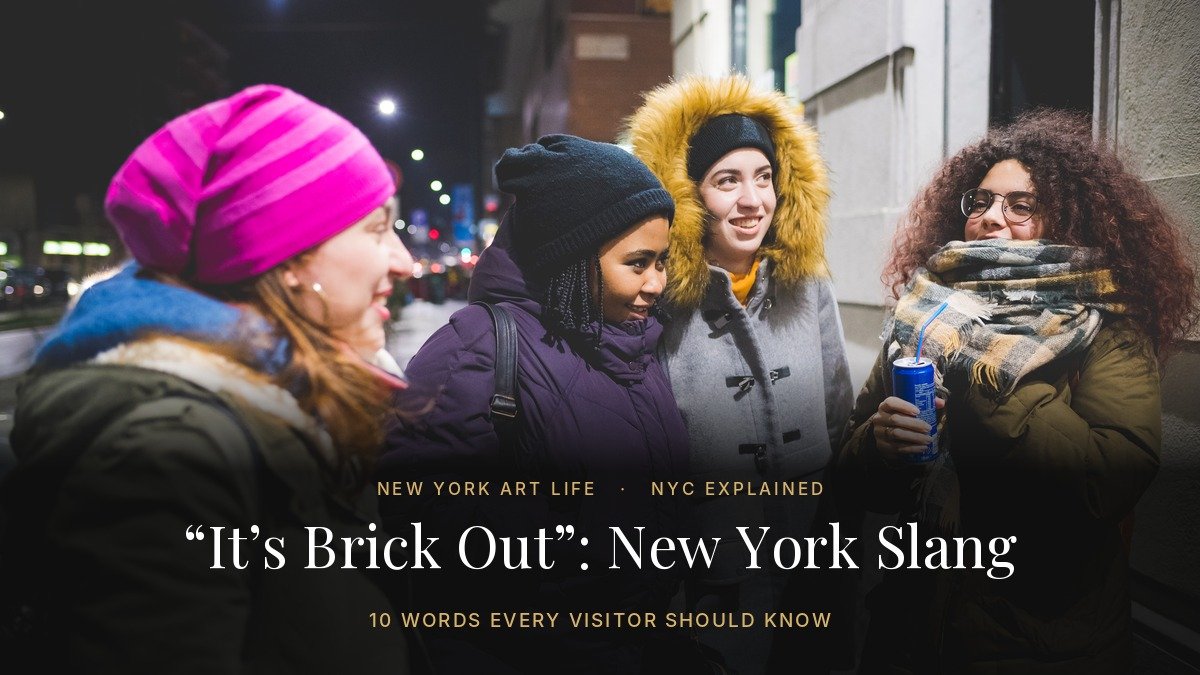
Is it brick outside? Are you deadass? Did you stand on line at the bodega for a bacon, egg and cheese? New York has its own language, and here are the 10 slang words every visitor should know, with their meanings and the stories behind them.
How New York Talks
Every big city has slang, but New York’s is special. For more than a century, it has mixed English with Yiddish, Italian, Spanish, Dutch and the language of the streets. In fact, words born here on stoops, subway platforms and street corners now travel the world through movies, music and social media.
Many of the most famous words also come from Black and Latino New Yorkers and from hip-hop, which was born in the Bronx in 1973. As a result, New York slang is not a museum piece. Instead, it changes every year, and young New Yorkers keep inventing new words.
This guide explains ten words you will really hear in the city today. For each one, you get the meaning, an example and a little history. Then, at the end, a few tips on how to use them without sounding like a tourist.
By the Numbers
01The Weather and the Street
Brick Very cold
If a New Yorker says “It’s brick out,” put on your heaviest coat. Brick means very, very cold. You will hear it on every subway platform from December to March. For example: “It’s mad brick today, I’m not leaving the house.”
Nobody knows exactly where the word comes from. However, one popular theory says that brick walls feel even colder than the air on a winter day. Either way, the word is pure New York, and it is one of the most searched pieces of city slang online.
How to use it: “Brick” works alone, too. Step outside in January, look at your friend and just say “Brick.” Everyone will understand.
Stoop Front steps
The stoop is the staircase in front of a brownstone or apartment building. It comes from the Dutch word stoep, a memory of the time when the city was New Amsterdam. Above all, the stoop is a social space. Neighbors sit there on summer nights, kids play there, and people sell old books and clothes at “stoop sales.”
On line In line
In most of America, people wait in line. In New York, they often wait on line. According to Merriam-Webster, the phrase is “largely local to the New York City region,” and it has been seen as a local habit since at least 1962. So if someone asks “Are you on line?” at a bakery, they just want to know if you are waiting.
In New York, you don’t wait in line. You wait on line.
02Talking to Friends

Yerrr Hey!
Yerrr (or yurrr) is a loud, happy greeting. It means “hey” or “what’s up,” and it often works as a call across the street. The right answer is an even louder “Yerrr!” In a 2024 survey by Wordtips, reported by FOX 5 New York, it ranked as New Yorkers’ second favorite slang word.
Deadass Seriously
Deadass means “seriously” or “I’m not joking.” It can be a question, too. For instance: “You’re moving to Queens? Deadass?” The word grew up on New York streets and is now used all over the country. In fact, singer Billie Eilish helped it reach a national audience.
Mad Very, a lot
In New York, mad doesn’t always mean angry. Instead, it often means “very” or “a lot of.” “The line at the museum was mad long.” “There were mad people at the parade.” It is simple and very useful, so it is a good first word to try.
The Big Apple, the dream of every lad that ever threw a leg over a thoroughbred.
John J. Fitz Gerald, New York Morning Telegraph, 1924
Did you know?
The city’s most famous nickname came from horse racing. In the 1920s, sportswriter John J. Fitz Gerald used “the Big Apple” for New York’s racetracks, the top prize for any jockey. Then, in the 1970s, the city’s tourism office brought the name back to fight New York’s bad reputation. Today, the corner of West 54th Street and Broadway is named “Big Apple Corner” in his honor.
Food and coffee
03Ordering Like a Local
New York slang is at its best in places where people eat. Indeed, many of these words came with immigrants who opened shops, delis and bakeries.
Bodega Corner store
A bodega is a small corner store that sells almost everything: coffee, sandwiches, milk, snacks and lottery tickets. Many are open all night. The word is Spanish for “cellar.” It spread with the Puerto Rican shops that opened across the city in the twentieth century. Many bodegas also have a cat, and New Yorkers love them.
Schmear Spread
Order a bagel “with a schmear” and you will get a layer of cream cheese. The word comes from Yiddish, the language of many Jewish immigrants on the Lower East Side. Similarly, New Yorkers schlep (carry something heavy) and nosh (have a snack), two more Yiddish words.
Regular coffee Milk and sugar
Elsewhere, a “regular” coffee is plain. In a New York deli, however, regular coffee traditionally means coffee with milk and sugar. If you want it black, say so. Otherwise, your first cup in the city may be a sweet surprise.
04The Classic
Fuhgeddaboudit Forget about it
Fuhgeddaboudit is “forget about it,” said the old Brooklyn way. It can mean “no way,” “don’t worry” or “it’s the best.” The full phrase already appeared in print in 1919. Later, movies and TV made the Brooklyn version famous around the world. Former Brooklyn Borough President Marty Markowitz even put it on signs for drivers leaving the borough. It remains the most famous New York word of all.
Insider tip
When New Yorkers say “the city,” they usually mean Manhattan, even if they live in Brooklyn or Queens. And be careful with “bridge and tunnel”: it is a teasing name for visitors from the suburbs, so don’t use it for your hosts.
05Five More Words You Will Hear
Ten words are a good start. However, New York has many more. Here are five extra words, each with a story that only this city could tell.
Hero
A long sandwich, called a sub or hoagie elsewhere. One story says you had to be a hero to finish it.
Pie
A whole pizza. Italian immigrants may have used it to tell a whole pizza from a single slice.
86’d
Sold out, or banned from a bar. One legend links it to Chumley’s, the old speakeasy at 86 Bedford Street.
Gridlock
Traffic so bad that nothing moves. The word became common during the 1980 New York transit strike.
Bronx cheer
A rude raspberry sound made with the lips. Fans still use it at ballgames when a player lets them down.
Where New York Slang Comes From
New York slang is a map of the people who built the city. The Dutch left words like stoop. Jewish immigrants brought Yiddish words like schmear, schlep and nosh. Italian families gave the city its pie and many of its gestures. Then, Puerto Rican and Dominican New Yorkers made the bodega a symbol of the city.
In the 1970s and 1980s, hip-hop changed everything. Words from the Bronx, Harlem and Brooklyn spread through music to the whole world. Today, social media does the same job, only faster. As a result, a word heard on a Queens subway platform in the morning can be on screens everywhere by night.
How to Use New York Slang Without Sounding Like a Tourist
The best advice is simple: listen first. Slang depends on tone, age and neighborhood. For example, a teenager in the Bronx and a retired teacher on the Upper West Side don’t talk the same way. Start with easy words like “mad,” “brick” and “on line.” Then, keep the bolder ones for friends.
Above all, don’t fake an accent. New Yorkers are proud of how they talk, and they notice right away. Instead, enjoy the words in their natural place: at the bodega, on the stoop, on the subway and at the ballgame. For more stories about how the city lives, read our NYC Explained series.
Quick Guide
10 New York Slang Words
- Brick
- Very cold · “It’s brick out.”
- Stoop
- The front steps of a building
- On line
- In line · “Are you on line?”
- Yerrr
- Hey, what’s up
- Deadass
- Seriously · “Deadass?”
- Mad
- Very, a lot · “Mad long line.”
- Bodega
- Corner store, often open all night
- Schmear
- Cream cheese on a bagel
- Regular coffee
- Coffee with milk and sugar
- Fuhgeddaboudit
- Forget about it
