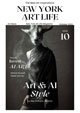


Eleanor Katie Holliday—known professionally as Ellie—is a rising interdisciplinary visual artist whose innovative audio-visual works have electrified New York’s creative scene and beyond. An Audio-Visual Specialist at the Metropolitan Museum of Art and former Design Intern at IIIXL Studio, Ellie’s portfolio radiates with multimedia installations, theatre set designs, viral projection mapping experiments, and evocative soundscapes composed for stage and screen. With roots spanning London and New York, Ellie’s work fuses emergent technologies with poetic storytelling, most notably recognized in her TikTok-viral projection works and her immersive collaborations with Audible, The National Theatre, and Berklee NYC.
In this exclusive interview, Ellie shares insights into her creative process, the challenges and revelations of interdisciplinary practice, and why her most profound achievements reach far beyond millions of views.
New York Art Life Magazine: You’re celebrated for seamlessly blending visual art with sound, technology, and performance. What initially sparked your journey toward becoming an interdisciplinary artist?
Ellie Holliday: My practice has always been driven by a desire to tell stories that are felt physically and emotionally, not just observed. I realized early on that no single medium could fully capture the worlds I wanted to build. Emotion is a multi-sensory experience, so the language I use to express it needs to be as well. This realization guided me away from specializing in one discipline and toward a more fluid approach where video, sound, light, and physical form are all interconnected tools. I see myself as a world-builder, and I use whichever combination of media is best suited to create a specific atmosphere or narrative that an audience can step into. Ultimately, my practice is driven by curiosity and the refusal to accept that boundaries are fixed.
New York Art Life Magazine: A central theme in your work is “immersive storytelling.” How do you begin the process of translating an abstract emotion or concept into a physical, visual, and sonic language?
Ellie Holliday: It always starts with the core feeling. Before considering any technology or material, I focus on the specific emotion I want to evoke—whether it be nostalgia, tension, catharsis, or awe. From there, I build a sensory palette. I ask myself: What does this feeling sound like? Is it a low-frequency hum or a sharp, crystalline note? What color is it? Does it feel expansive or claustrophobic? This process allows me to create a blueprint. For instance, in my projection-mapped installation for the Liminal Spaces exhibition at International House NY, the feeling of being “in-between” was translated into visuals that fluidly morphed and wrapped around architectural features, creating a space that felt both familiar and unsettlingly transient.
New York Art Life Magazine: Your TikTok projection mapping videos, like the famous “Projection mapping diaries part 1,” gained viral reach and even inspired others to pursue creative careers. What did this recognition mean to you?
Ellie Holliday: It was genuinely surreal. Going viral was never the goal—I share my experiments on TikTok to demystify the process and connect with fellow creatives. But hearing a student say, “You’re the reason I’m here,” was beyond anything I’d imagined. It transformed my understanding of impact. You see a number like 11.7 million views, but it only becomes real when you meet someone whose life was changed because they encountered your work. It reminded me why I create: to spark curiosity, inspire others, and give them permission to try. The recognition from numbers is fleeting, but the knowledge that I helped someone find their path is a responsibility—and an honor—I carry forward.

New York Art Life Magazine: As an Audio-Visual Specialist at The Metropolitan Museum of Art, how has your work in such a historic institution influenced your art practice?
Ellie Holliday: The Met is a playground for the senses and a crucible for creativity. Working there, I’m constantly surrounded by objects and stories that span millennia, and I help translate those into dynamic, contemporary experiences—whether it’s staging in the Grace Rainey Rogers Auditorium or projection mapping in the Uris Center. The technical challenges—ensuring technology enhances, not dominates—push me to think deeply about dialogue between old and new. I often sketch in the galleries during breaks; inspiration seeps in everywhere, be it the rhythm of an ancient textile or the light glancing off bronze. The Met encourages reverence and reinvention, both of which echo throughout my personal work.
New York Art Life Magazine: Your collaboration with Audible and The National Theatre resulted in sound design and composition for plays like “£39” and “Ashes to Ashes.” How is your creative process different when working with narrative audio compared to visual media?
Ellie Holliday: Storytelling is at the heart of both, but with audio drama, you construct a universe purely through sound. Every footstep, echo, and silence must carry weight. I worked closely with directors and writers to shape the emotional landscape, using music to underline psychological shifts and designing textures that suggest space and tension. It’s visceral and intimate—audio leaves room for imagination to fill in the gaps. In visual media, I can play with color, movement, and light; in audio, I’m painting with frequencies and rhythm. Both are satisfying, but audio demands a certain discipline in restraint and an acute attention to timing.
New York Art Life Magazine: Projection mapping is central to your recent work, from installations to live shows. What draws you to this technology, and how do you see it evolving your artistic voice?
Ellie Holliday: Projection mapping excites me because it’s both ephemeral and transformative—you’re animating architecture, disrupting how we perceive space. It lets me treat any surface as a canvas, whether it’s an actor’s body in the theatre, a window seat for “Liminal Spaces,” or the walls of my apartment for a viral TikTok. What’s fascinating is the plasticity: projections are here, then gone, existing at the mercy of light. This idea inspires me to create art that is temporally bound and constantly shifting. As I experiment with interactivity and spatial audio, projection mapping has become a blueprint for how I approach all my work: shape, disrupt, and reimagine the familiar.
New York Art Life Magazine: You’ve directed a diverse range of music videos for artists like LAWRENCO, Ann Aarat, and Looi. What is your starting point when an artist approaches you? How do you begin that process of translating their sonic world into a visual one?
Ellie Holliday: It always starts with a deep listening session and a conversation. Before I even think about a camera or a set, I need to understand the song’s emotional core and the artist’s intention. I ask them questions like: What feeling were you channeling when you wrote this? What story is hiding beneath the lyrics? What textures and colors do this song evoke for you? My goal is to become a temporary custodian of their vision. Music is the blueprint; my job is to build a world around it that feels both authentic to the artist and compelling as a standalone piece of visual art.
New York Art Life Magazine: Your credits on these projects often list you as Director, Videographer, Set Designer, and Editor. How do you navigate wearing so many hats? Does this comprehensive control help you achieve a more unified artistic vision?
Ellie Holliday: It’s a marathon, but that holistic approach is fundamental to my practice as an interdisciplinary artist. By designing the set, I can ensure the physical space directly reflects the emotional tone I want to capture as a director. By operating the camera, I can frame shots with the final edit already taking shape in my mind. It creates a seamless feedback loop. When I designed the set for Danny Ritz’s ‘House in the Space,’ for example, I built it specifically with certain camera movements and projection effects in mind. This integration means that every element—the lighting, the set pieces, the camera angle, and the rhythm of the edit—is speaking the same language. While I love collaborating with a larger team, having that end-to-end control allows for a level of cohesion that is incredibly satisfying and often necessary on independent projects.
New York Art Life Magazine: From ARIA’s ‘Timida’ to ANRJ’s ‘Wine Drunk,’ your videos have very distinct aesthetics. How do you balance maintaining your own artistic signature with honoring the unique identity of each musician?
Ellie Holliday: I see my artistic signature less as a specific visual style and more as a method or a feeling. The common thread in my work is dedication to creating atmosphere and telling a story through texture, light, and space. Whether the aesthetic is moody and raw for an artist like LAWRENCO or ethereal and polished for someone like Leah Nawy, the underlying goal is the same: to create a tangible world for the song to inhabit. My role is to be a visual translator. I bring my toolkit—my love for projection mapping, atmospheric lighting, and deliberate composition—to the table, but the final visual language is a unique dialect co-created with the artist. The diversity of the output is what excites me; it proves that the process works.
New York Art Life Magazine: Could you share your experience as part of Berklee NYC’s Live Music Production and Design program? How did it shape you?
Ellie Holliday: Berklee NYC was transformative—it was the first place I felt my interdisciplinary instincts weren’t just tolerated but celebrated. The program encouraged radical experimentation; one week we’d design a set for an avant-garde opera, the next we’d prototype immersive AR visuals for a gospel concert. The faculty and my peers came from wildly different backgrounds, which challenged my preconceptions and sharpened my collaborative sensibility. Perhaps most special was the full-circle moment returning for the student showcase; seeing the next generation cite my work as an inspiration was deeply moving. It underscored the importance of legacy and mentorship.
New York Art Life Magazine: “The Science of Youth,” the audio-visual theatre production at Annex Theatre, allowed you to fuse set design, projections, and sound. How did you craft a unified world across these layers?
Ellie Holliday: It was one of the most ambitious projects I’ve done—almost like building a sensory “ecosystem.” Collaboration with writer-director Danny Ritz was key; we began by mapping the emotional spine of the story and identifying motifs that could travel seamlessly across disciplines. For example, the idea of “fractured memory” informed the set’s fragmented sculptural pieces, glitchy projections, and granular sound design. I spent hours in rehearsals tweaking cues live—timing a light pulse to a spoken word moment, syncing projection shifts with choreography. Unity comes from respecting each element as equal partners in storytelling, rather than layering one on top of another.
New York Art Life Magazine: Your work as a curator, notably with the “Women On Screen and Behind The Camera” film program, sparks conversations about representation in media. How does curating inform your own creative output?
Ellie Holliday: Curation is about creating context and dialogue. When programming “The Voices,” I realized that the act of selection—whose stories, whose perspectives—shapes not just our understanding, but what is possible for audiences and artists alike. Curating sharpens my critical eye: what themes are urgent, what voices are missing, what narratives need elevation? It also frees me from my own aesthetic preferences—I learn a great deal from the artists and filmmakers I program. This has made me more intentional in my own practice: whose stories am I representing? How do I challenge norms? Curation and creation are two sides of the same coin for me.
New York Art Life Magazine: Setbacks are part of any creative path. Can you share a challenging episode in your career and how it influenced your growth as an artist?
Ellie Holliday: Absolutely—one particularly tough moment was during the short film “Phantom of You,” which I animated, sound designed, and composed for. Time was tight, tech failed repeatedly, and I questioned my competence almost daily. But being a finalist for BBC New Creatives showed me that “failure” is often relative—what feels unfinished or imperfect to you can still resonate deeply with others. It taught me resilience and the value of iteration: sometimes, what survives the pressure is the most compelling part. I also learned that seeking support and being honest about struggles are not weaknesses but strengths.
New York Art Life Magazine: The technical component of your practice is formidable, but your work is also deeply emotional and poetic. How do you balance innovation and feeling?
Ellie Holliday: I see technology as a tool for intimacy, not spectacle. The most powerful art makes you feel—and that comes from holding onto human stories even while pushing technological boundaries. I constantly ask: what’s the emotional core of this piece? What do I want my audience to feel or question? If a projection doesn’t serve the narrative, I cut it. I spend as much time sketching and writing as I do coding or configuring equipment. For me, innovation should always be in terms of meaning. The trick is not to let the “how” outshine the “why.” Whether it’s a flickering light, an ambient sound, or a fleeting image, I want it to land in someone’s heart, not just their eyes.
New York Art Life Magazine: Looking back over your diverse projects—across continents and disciplines, what accomplishment or moment stands out as a turning point in your artistic journey?
Ellie Holliday: There have been several milestones, but that conversation I had at Berklee, when a young woman told me my TikTok projections had inspired her to apply, really shifted my perspective. Up to then, I measured success by shows, commissions, or press coverage. But realizing that my openness and willingness to “show the process”—mistakes, experiments, wins—could help someone else discover their path was profound. It reminded me that art is a conversation across generations and mediums. The viral moment was a nice boost, but the legacy is in connection and community. That’s what keeps me moving forward, even when the next step feels uncertain or intimidating.
New York Art Life Magazine: As emerging artists look to you for inspiration, what advice would you offer those seeking to build their own interdisciplinary practice—especially in an age of rapidly evolving technology and global uncertainty?
Ellie Holliday: First, trust your instincts—even (or especially) if they lead you off the beaten path. Interdisciplinary practice is as much about curiosity and patience as it is about technical skills. Don’t be afraid to fail in public; share your process, not just your polished outcomes. Technology is a tool, not an identity, so focus on what you want to express and let the medium serve the message. Build relationships—with mentors, collaborators, and communities online and off—and be generous in both giving and receiving feedback. Most importantly, stay humble and hungry: every discipline, every patch of new ground you enter, has something to teach you. Your unique blend of experiences is your superpower.
New York Art Life Magazine: How do you recharge creatively when you’re not immersed in projects or installations?
Ellie Holliday: I’m a firm believer in creative cross-training—sometimes the best ideas come while doing something completely unrelated to my main practice. I cook, go for long walks in the city, and sketch in coffee shops. Museums are still my sanctuaries—I visit exhibitions without the pressure to analyze, just to absorb. Collaborating with friends on no-pressure projects—jam sessions, zine-making nights—reminds me why I started creating in the first place. I also consume art outside my field: jazz gigs, poetry readings, indie games. Inspiration is everywhere, if you’re open to it. Above all, I try to protect unstructured time for reflection and rest; creativity needs space to breathe.
New York Art Life Magazine: You’ve spoken about demystifying the process and sharing openly online. Why is transparency with your creative method so important to you?
Ellie Holliday: When I was starting out, I was often discouraged by how opaque creative disciplines could feel. The myth of the “solitary genius” still lingers, but most work is built on trial, error, and community support. By sharing not only successes but also the missteps and technical hacks, I hope to encourage others to experiment without fear of failure or embarrassment. Teaching—whether through TikTok, workshops, or studio visits—is about empowerment. I want others, especially young women and nonbinary artists, to see themselves as capable of mastering both art and technology. Transparency can dismantle gatekeeping and expand the field for all.
New York Art Life Magazine: Looking ahead, what is the goal or dream you are working toward with your artistic practice?
Ellie Holliday: My goal is to continue creating spaces and experiences that foster a deep sense of connection to oneself, to others, and to the world around us. I want to build worlds that not only mesmerize but also provoke introspection and empathy. Whether it’s a massive public installation or an intimate gallery piece, my dream is for people to walk away from my work feeling that they have been seen, moved, and perhaps changed in some small but meaningful way.
Website: link
TikTok: link
Read also:
How New York Art Magazines For Artists Inspire and Reach Wide Audiences
