

Valeria Navarrete Ferrari moves between two cities and two ways of seeing. She grew up in Mexico City, yet she first arrived in New York at fifteen for a summer film photography program at Columbia University. There, in a darkroom, she discovered a craft and a city at once, and ever since, she has been chasing both. Today, she lives in Brooklyn, and her work still keeps returning home.
In the cover photo: “Valeria Navarrete Ferrari alongside María Fernanda Espinosa Garcés, former President of the United Nations General Assembly, at the Women Economic Forum Iberoamérica, UN SDG Media Zone, New York”
Her practice runs in two clear directions. On one side, her documentary and portrait work turns toward Mexico, toward the women who raised her, and toward the inherited roles of girlhood in a Catholic and patriarchal country. On the other side, her street photography turns outward, onto New York and the strangers she will meet once and never again. Notably, she shoots the first on digital and the second on film. For her, the medium is never accidental.
Her thesis documentary, Las Niñas de Alfredo de Musset, examines Mexican girlhood, femicide, and gender violence. It premiered at the Parsons BFA Thesis Exhibition in May 2025, and now it sits in post-production ahead of its festival run. Meanwhile, she coordinates film and television production in New York for Atlantic Pictures. Beyond that, she has contributed to the contemporary art world across both cities, through galleries such as Kurimanzutto, Allouche Gallery, and Georgina Pounds Gallery. She is trilingual in Spanish, English, and French, having completed her entire schooling at the Lycée Franco-Mexicain, where she also studied Italian.
We met to talk about all of it: the apartment that started a film, the men she photographs, the women she honors, and the marches she joins. Throughout our conversation, she returned to one idea again and again. Indeed, she speaks the way she shoots, slowly and with great care. Above all, she makes images so that the lives she loves will not go unseen.
New York Art Life Magazine: You first came to New York at fifteen, for a summer film photography program. What happened in that darkroom?
Valeria Navarrete Ferrari: I came expecting very little from it. Instead, the darkroom changed everything for me. I still remember the red light, the smell of the chemicals, and the slow magic of an image rising in the tray. Suddenly, photography felt physical, almost like cooking or prayer. The program itself lived at Columbia University, and at fifteen, the campus felt impossibly grand to me. Still, the darkroom there became my entire world. Inside those walls, I learned to develop film, to print, and to wait. So Columbia gave me my first real training, and in a sense, it handed me the key to everything that followed.
Meanwhile, the city itself pulled me in completely. I walked for hours every day, and every block offered a new face. As a result, two loves arrived at the same time: the craft and the place. Of course, I was only fifteen, so I did not have the words for any of it yet. Still, somewhere inside me, I already knew I wanted to keep both.
Then I went home to Mexico, yet a part of me stayed here. Eventually, I came back for good. Today I live in Brooklyn, and honestly, I am still chasing that first feeling from the darkroom. Because of that summer, my whole path took shape. In a way, a teenager with a roll of film decided my future, and I thank her for it.
Looking back, I also think the wait taught me something. After all, a print does not appear at once. Instead, it rises slowly, and you learn to trust the process. So patience became part of my craft from the very first day. Even now, I carry that lesson into every project.
New York Art Life Magazine: Your work moves in two directions, toward home and toward the street. How do you describe that split?
Valeria Navarrete Ferrari: I think of it as two compasses inside me. One needle points home, toward Mexico and the women who raised me. The other needle points outward, toward New York and its strangers. Naturally, the two directions pull against each other, yet they also feed each other constantly.
When I look toward home, I become patient and tender. I sit with people I love, and I wait for the truth to surface. By contrast, when I shoot on the street, I turn quickly and alert. There, a moment lasts a single second, and then it disappears forever.
So the two modes ask for different parts of me. Home asks for trust, while the street asks for instinct. Together, however, they hold the full range of how I see the world. Honestly, I would feel incomplete with only one of them.
Moreover, the contrast keeps me awake as an artist. Because I switch between intimacy and chance, I never grow lazy. In the end, both directions belong to the same person, who is simply trying to pay attention.
New York Art Life Magazine: You shoot at home on digital and on the street on film. Why does the medium matter so much to you?
Valeria Navarrete Ferrari: Because each medium carries a different kind of memory for me. Film suits the street perfectly. After all, a roll of film is unrepeatable, and a stranger is unrepeatable too. So the grain and the chance feel honest for a face I will never meet again.
Digital, on the other hand, suits the home. With digital, I can shoot freely, return again, and stay close for hours. Consequently, I build trust slowly, frame after frame, until the women forget the camera entirely. In other words, the street asks for one decisive try, while home asks for endless patience.
For that reason, I never pick a camera at random. Instead, the subject tells me which tool the moment deserves. Sometimes the choice even feels moral to me.
Still, people often assume the medium is just a style. Yet for me, it is meaningful. Because film resists control, it matches the chaos of the street. Meanwhile, digital allows repetition, so it matches the slow devotion of home. Ultimately, the camera is never an accident in my work.
New York Art Life Magazine: Let us talk about Las Niñas de Alfredo de Musset. It began with an apartment. Tell me about that place.
Valeria Navarrete Ferrari: In the summer of 2013, my parents were going through their divorce, and my mother moved her three daughters into an apartment in Polanco. The address was Alfredo de Musset number twenty-seven. Inside those walls, we built a world that belonged only to us.
Soon, it became a refuge with its own rules. Friends came and went through a revolving door, while the women who raised us kept the home as their own. Naturally, that apartment held our laughter and our grief at the same time. It also held our becoming, the slow work of turning into who we are now.
So when I started the film, I returned there first. After all, every story I carry began inside those rooms. The kitchen, the shared bed, and the nearby market each still live in my memory.
Therefore, the apartment is not just a setting in the film. Rather, it is a character, almost a mother of its own. Because I grew up there, I could film it from the inside. In a sense, the whole documentary is my way of going home again.
New York Art Life Magazine: You center the women who raised you, Juanita, Carmen, and Mari, as storytellers rather than subjects. Why that choice?
Valeria Navarrete Ferrari: Because they raised me, and yet history rarely lets women like them speak. In many Mexican homes, the women who cook, clean, and care stay completely invisible. So I wanted to turn the camera the other way for once.
To me, Juanita, Carmen, and Mari are not subjects at all. Rather, they are companions and storytellers. The camera stays close to them, in unscripted conversation, in long silence, and in the small intimacies of a kitchen. Meanwhile, my own presence stays only at the edges.
You hear my laugh, and you feel my arm around your shoulder, yet you never see my face. Ultimately, you see me in the way I hold the women I love.
Moreover, I wanted to honor their wisdom directly. Juanita, for instance, carries a quiet, questioning intelligence that taught me how to think. Consequently, the film hands them the microphone, not the other way around. After all, they ran our household for many years. Now, at last, they get to narrate it.
New York Art Life Magazine: The film carries a grave truth at its center. One of those women lost her cousin, Janet Córdova, to femicide. How did that shape the work?
Valeria Navarrete Ferrari: It changed the weight of everything in the film. Until then, the work lived mostly in tenderness and memory. After that loss, however, it had to face the danger that surrounds Mexican women every single day.
Janet Córdova was a young mother, and her death never felt like a statistic to us. On the contrary, it sat at our kitchen table, inside our own family. So I dedicated the film to her memory without hesitation.
In truth, I had no choice, because her story is the reason the film grows so urgent. Femicide is not a distant headline in Mexico. Instead, it touches the very women who taught me how to love.
Therefore, the film could not stay gentle alone. It had to hold beauty and danger together. Because Janet was real, the stakes became real for every viewer. Still, I refused to turn her into a symbol. Rather, I kept her a person, a cousin, a mother. In the end, her memory gives the film its conscience.
New York Art Life Magazine: From that loss, the film builds toward the 8M march. For readers outside Mexico, what is that day?
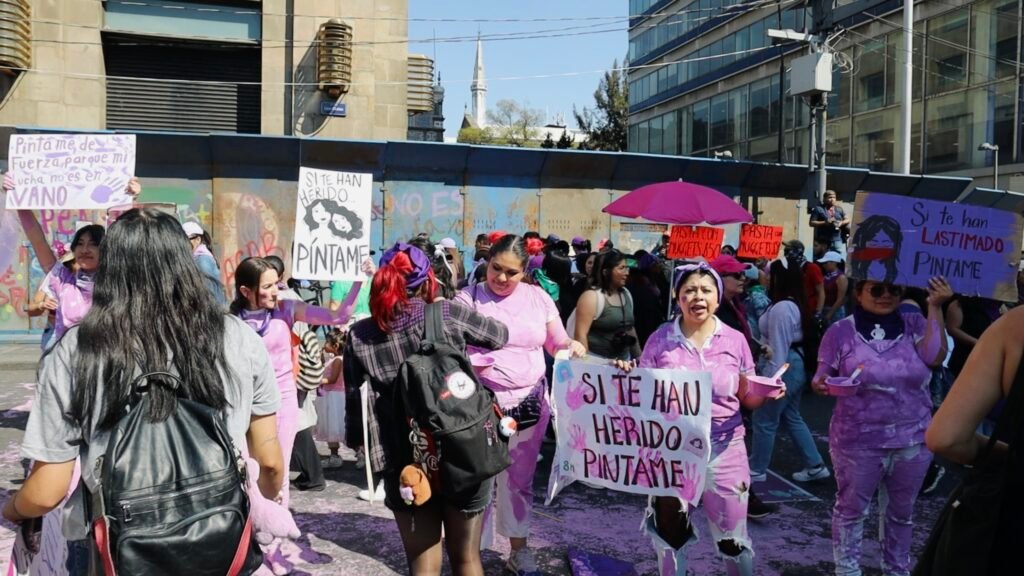
Valeria Navarrete Ferrari: In Mexico, the eighth of March is not a gentle celebration of Women’s Day. Because of the femicide crisis and the constant gender violence, it became a day of protest instead. On that day, we flood the streets, and we become one in sororidad.
For the film, the march is the culmination. There, every girlhood in the story collides at once. My grandmother’s inherited faith meets Juanita’s quiet questioning. Meanwhile, the niña bien meets the niña del barrio.
So the women who raised me walk beside the women I grew up among. Finally, we all move as one body, one voice, one demand. To me, that image holds both grief and power in the same frame.
Moreover, the march feels like the natural ending of the film. Throughout the story, the women stay inside private rooms. Then, on 8M, they step into the public street together. As a result, the personal becomes political before your eyes. In the end, the march is where love turns into action.
t
New York Art Life Magazine: You made a deliberate choice to stay invisible. We never see your face. What does that absence give the film?
Valeria Navarrete Ferrari: It keeps the focus exactly where it belongs. After all, the film is not about me. Rather, it is about the women who made me who I am.
Still, I am present everywhere in it. My voice slips in behind the lens, and my laugh escapes now and then. In a sense, my absence becomes a kind of love. By staying out of frame, I hand the screen to them completely.
Moreover, I believe the intimacy grows stronger that way. Because you never see me, you lean closer to them. So viewers feel held, not watched.
Of course, some people ask why I hide. Yet I never feel hidden at all. Instead, I feel like the arms around everyone in the picture. Far from vanity, the choice is humility. Because these women raised me, the least I can do is let them shine. In the end, the invisibility is not distance. Rather, it is closeness, the closeness of someone who would always rather hold the camera than stand in front of it.
Besides, the absence also frees the viewer. Because no narrator stands between you and the women, you meet them directly. So the film feels less like a lecture and more like a visit. Naturally, that intimacy was my whole goal.
New York Art Life Magazine: You place the film in a lineage you love, from Cuarón and Iñárritu to Graciela Iturbide and Sally Mann. Yet you call the gaze a woman’s. How do you hold both?
Valeria Navarrete Ferrari: I love that lineage deeply, and I learned so much from each name. From Cuarón and Iñárritu, I take intimacy and a strong sense of Mexico. From Graciela Iturbide, I take dignity and patience. Meanwhile, from Sally Mann, I take familial closeness.
However, my gaze comes from inside the rooms I film. Those earlier images often look at women from a certain distance. By contrast, mine looks from within, because I grew up in the very kitchen I point the camera at.
As a result, the tenderness is not observed but lived. So the film carries a woman’s point of view in every choice. In short, I honor the lineage, yet I gently bend it toward my own eyes.
Moreover, I think representation changes when the maker belongs to the world she films. Because I am one of these girls, I cannot romanticize them. Instead, I show their full humanity, both the beauty and the constraint. Therefore, the lineage gives me a language, while my life gives me the voice.
New York Art Life Magazine: Let us turn to Juan Pablo. The project examines machismo internalizado. You argue it cages men, too. Explain that.
Valeria Navarrete Ferrari: Yes, and that idea sits right at the heart of the work. We often speak of machismo only as something done to women. Of course, that harm is real and enormous. Yet machismo also builds a cage around men.
Juan Pablo in the project is not a real person. Instead, he is a composite, a stand-in for a kind of man. The name is so common across Mexico and Latin America that it belongs to everyone and no one at once.
He inherits his role rather than choosing it. Therefore, he wears a heavy silver cross like a talisman, an emblem of everything he received and never questioned. Still, my Juan Pablo breaks away from that script.
In fact, he is my best friend and my muse for the project. Because he questions the cage, he shows another way to be a man. So the work is not an attack on men at all. Rather, it is an invitation to set down the heavy role. In the end, freedom helps everyone, women and men alike.
New York Art Life Magazine: That series is staged in a softer, painterly register, while much of your practice is documentary. How do you move between the two?
Valeria Navarrete Ferrari: I move between them by listening carefully to the subject. My documentary work observes real life as it unfolds. By contrast, I built the Juan Pablo series frame by frame, almost like a painting.
In that softer register, I deliberately arrange the male body and the symbols of Catholic authority. So nothing there happens by accident. Meanwhile, in documentary mode, I surrender control and follow whatever happens in the room.
Honestly, both modes thrill me equally. The raw and the composed simply ask for different muscles. Therefore, as an artist, I refuse to choose only one.
Moreover, moving between the two keeps my eyes flexible. Because I stage one project, I learn light and composition deeply. Then, because I document another, I learn timing and trust. As a result, each mode improves the other. In short, the observed and the constructed live side by side in me. Ultimately, the work itself decides which register a story needs, and I simply follow its lead.
New York Art Life Magazine: Catholicism runs through everything you make, from the silver cross to La Virgen de Guadalupe. How do you hold faith inherited and faith questioned?
Valeria Navarrete Ferrari: I hold them together, with both tension and love. I grew up Catholic, and that faith shaped my whole family. Indeed, my grandmother’s belief remains unshakeable, and I treasure it deeply.
Yet I cannot ignore a painful contradiction. In Mexico, we crown La Virgen de Guadalupe, and meanwhile, women are killed across the country every day. So faith becomes both shelter and question for me.
In the film, my grandmother carries the inherited faith. By contrast, Juanita carries a quiet, questioning wisdom. Together, the two of them show the full picture.
After all, I do not want to resolve the tension neatly. Instead, I want to sit honestly inside it. Because faith gave my family comfort, I cannot simply reject it. Yet because faith coexists with so much violence, I cannot accept it blindly either. Consequently, I keep both women on screen, the believer and the questioner. In the end, the cross at Juan Pablo’s chest and La Virgen above the door tell the same complicated story.
New York Art Life Magazine: You have advocated for gender equality for years. You first attended the Women’s Economic Forum summit in New Delhi at 17. How does that advocacy feed your art?
Valeria Navarrete Ferrari: It feeds the art constantly, in ways I rarely separate. In April 2019, I attended my first Women Economic Forum summit in New Delhi, and I was only seventeen. Afterward, I also took part in a forum in Mexico City.
More recently, I joined the Women Economic Forum Iberoamérica as a delegate during the United Nations General Assembly Week. There, I listened to leaders such as María Fernanda Espinosa Garcés, the former President of the General Assembly. Naturally, those rooms shaped the thinking behind Las Niñas de Alfredo de Musset.
In other words, the policy and the poetry talk to each other inside me. Advocacy gives me data and urgency, while art gives the numbers a face and a name.
Moreover, the two protect me from each other’s blind spots. Because advocacy can feel abstract, art keeps it human. Meanwhile, because art can feel private, advocacy keeps it connected to the wider world. So I never treat them as separate careers. Instead, there are two languages for the same belief.
New York Art Life Magazine: Alongside your own work, you coordinate film and television production for Atlantic Pictures. How does that day job shape your eye?
Valeria Navarrete Ferrari: It sharpens me in very practical ways. As a production coordinator, I learn how a real set actually runs. So I understand schedules, crews, and the thousand small decisions that go into a single shot.
Because of that knowledge, my own projects move far more smoothly. I plan better, and I waste much less time. Meanwhile, I watch experienced people solve problems under pressure, and I quietly absorb their calm.
Of course, the larger industry and my personal work feel very different. Yet they teach each other every day. On one hand, production gives me discipline and structure. On the other hand, my art gives me a reason to keep that discipline alive.
Moreover, the job reminds me that filmmaking is a collective effort. Because so many hands build one frame, I respect every role on a crew. Therefore, I carry that respect back into my own sets. In the end, the day job and the art are not rivals. Instead, together they make me a more complete filmmaker.
New York Art Life Magazine: You have contributed to the contemporary art world in both New York and Mexico. What have those gallery worlds taught you?
Valeria Navarrete Ferrari: They taught me how images truly live in public. Over time, I have worked with galleries such as Kurimanzutto as well as Allouche Gallery in New York and Georgina Pounds Gallery in Mexico City.
Through those spaces, I saw how an artwork finally meets its audience. Moreover, I learned how context changes meaning in an instant. The same photograph speaks differently in Mexico than it does here in New York.
As a result, I now think harder about where my work belongs. Still, the two art worlds share one hunger, the hunger for honesty.
Furthermore, the galleries showed me the business behind the beauty. Because art must also survive, I learned to value both vision and structure. So I no longer separate the romantic side from the practical side. Instead, I hold them together. Ultimately, both cities push me to make images that matter, not images that merely decorate a wall. In the end, the gallery taught me responsibility toward the viewer.
New York Art Life Magazine: Las Niñas de Alfredo de Musset is heading toward its festival run. What do you hope viewers carry out of the theater?
Valeria Navarrete Ferrari: Above all, I hope viewers carry the women out of the theater with them. I want the film to be a gesture of love and defiance at once. So I made it as a tribute to the women and girls who shaped me.
First, I hope viewers feel the tenderness of that apartment in Polanco. Then I hope they feel the danger surrounding it. Finally, I hope they refuse, exactly as I refuse, to let these lives go unseen.
Beyond the festival run, I will keep working in both of my directions, toward home and toward the street. After all, the medium may change, yet the mission stays the same.
Moreover, I hope the film opens a conversation about femicide far outside Mexico. Because the crisis crosses borders, the story must travel too. Therefore, I will follow it to every festival that will have it. In the end, I make images for one simple reason. I want the people I love to remain visible, today and long after I am gone.
Finally, I hope young women see themselves in it. Because representation matters so much, I want them to feel counted. So if one girl feels less alone after the credits, then the film has already succeeded. After all, that is why I picked up a camera in the first place
