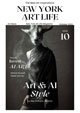


In the sprawling, hyper-specialized landscape of New York City’s creative scene, it is rare to encounter an artist who moves with such fluid confidence across disciplines. Ann Aarat, the 25-year-old artist born in Delhi, India, is one such talent. Operating as a singer, songwriter, music producer, sound designer, filmmaker, and DJ, she is an actual multidisciplinary creator whose work is unified by a deep, almost obsessive fascination with the architecture of sound.
Her music is a carefully constructed blend of experimental ambient electronica, visceral bass music, and subtle afro-beat rhythms, all filtered through a lens of avant-garde sound design. Aarat builds her sonic worlds from unconventional materials: field recordings captured on city streets, reversed vocal samples that become ghostly melodies, and intricate digital effects that transform the human voice into a full orchestra. This is music that prioritizes texture and tension, creating immersive experiences that are as anxious as they are beautiful.
Beyond her four released singles, including the intricate vocal tapestry “Wake up,” Aarat is expanding her artistic universe. Her upcoming EP is a testament to her innovative spirit, crafted entirely from vocal samples sourced from over 20 individuals, meticulously processed to mimic drums, bass, and synthesizers. Simultaneously, she has ventured into filmmaking with her debut short, why her?—a psychological drama born not from a script, but from a musical score she composed first, allowing the sound to dictate the narrative. As a DJ, she has brought her unique curatorial sensibilities to prominent New York venues like Mood Ring, Pianos, and the Magic Hour Rooftop Bar. New York Art Life Magazine sat down with Ann Aarat to discuss her unique creative process, the symbiosis between sound and image, the power of tension, and the freedom she discovered behind the DJ decks.
New York Art Life Magazine: Ann, you wear many hats: producer, sound designer, filmmaker, DJ. When you’re first struck by a creative impulse, how do you determine which medium it belongs to? Does an idea arrive as a sound, an image, or a feeling?
Ann Aarat: That’s a great question, and it’s something I think about a lot. For me, the initial impulse almost always arrives as a sound or a texture first. It might be a specific field recording I’ve captured, like the sound of rain hitting a metal awning, or it could be a vocal phrase that I start manipulating in my software. The texture of that sound dictates its path. If it feels rhythmic and grounded, it might become the foundation of a bass-heavy track. If it’s more ethereal, spacious, and evocative, I’ll lean into my ambient and sound design sensibilities.
The transition to filmmaking or visuals occurs when a sound begins to suggest a narrative or a distinct emotional atmosphere that feels larger than a single track. For my film, why her?, It started with a particular musical theme—a haunting, cyclical melody. That piece of music felt like a character’s internal monologue. It had a story embedded within its notes, and the only way to fully explore that was to build a visual world around it. So, in a way, I don’t choose the medium; the core idea chooses its own form.
New York Art Life Magazine: Your music is described as creating a sense of “anxiety and high where the listener would want to stay before resolving.” Why are you drawn to creating and sustaining this specific kind of tension?
Ann Aarat: I’m fascinated by the space between anticipation and release. In both music and life, that’s where the most potent emotions lie. Pure resolution can feel placid, even dull at times. The tension, the feeling of being on the edge of something, is an active state. It forces the listener to be present and engaged. I want my music to be an experience you can’t have passively in the background.
Sonically, I build this tension by using unexpected transitions, dissonant harmonies that hover without resolving, and rhythmic patterns that feel slightly off-kilter. I might introduce a steady, grounding bassline and then layer it with reversed vocal samples that seem to pull time backward, creating a disorienting push-and-pull. It’s that feeling of being held in a moment of beautiful unease that I find so compelling. It’s like the peak of a roller coaster, right before the drop. My goal is to make that peak last as long as possible, to let the listener explore that heightened state.
New York Art Life Magazine: Let’s talk about your upcoming EP. The concept of building entire tracks solely from vocal samples is incredibly ambitious. Could you walk us through the process of turning a human voice into, say, a kick drum or a bassline?
Ann Aarat: It’s a process that is both highly technical and deeply intuitive. It began with collecting a diverse library of source material. I recorded over 20 different people, including myself, capturing everything from long, sustained notes to short, percussive breaths, whispers, and consonant sounds.
To create a kick drum, for example, I might take a recording of a low-pitched vocal pop or a “buh” sound. I’ll then use a transient shaper to emphasize the initial attack, followed by heavy EQing to boost the sub-bass frequencies and cut the highs. I’ll often layer several of these sounds, slightly detuned, and run them through a compressor to make them punchy and cohesive. For a bassline, I would take a sustained hum or an “ooh” sound, pitch it down several octaves, and then use filtering and saturation to shape its harmonic content until it has the warmth and weight of a synth bass. The real magic happens in the layering and micro-editing. The challenge is to make these sounds function as instruments while still retaining a hint of their human origin—that little bit of breath or texture that reminds you it all started with a person.
New York Art Life Magazine: This EP features voices from over 20 people. What was the significance of using a community of voices rather than just your own?
Ann Aarat: Using a multitude of voices was central to the project’s concept. While I could have technically created all the sounds from my own voice, I wanted the EP to be a reflection of a collective human experience. Each person’s voice has a unique timbre, texture, and emotional quality. By weaving them together, the project becomes a tapestry of different identities and energies. It’s a subtle way of saying that even in a highly processed, electronic world, the foundation is still fundamentally human and communal. It also adds a rich, organic complexity to the sound that would be difficult to achieve with a single vocal source. You can feel the different personalities in the final tracks, even if you can’t consciously identify them.
New York Art Life Magazine: Your short film, why her?, was developed in a very unconventional way—music first, narrative second. How did this process influence the final story and the visual direction of the film?
Ann Aarat: Composing the score first was both liberating and challenging. It completely flipped the traditional filmmaking process on its head. The music became the screenplay. The theme I composed had distinct emotional movements: a section of quiet introspection, a build-up of paranoid tension, a chaotic climax, and a final, ambiguous resolution. These musical movements became the scenes of the film, defining the emotional arc before a single line of dialogue was written.
This music-first approach profoundly influenced the visual direction, leading me to a crucial cinematic choice. To translate the internal, sonic feeling of the score into a visceral visual experience, I decided to shoot almost the entire film from the main character’s point of view. The reason I went that route was to immerse the viewer directly in her anxiety and stress. By locking the audience into her perspective, they don’t just watch her experience these emotions; they are forced to feel them as if it’s their own point of view. Every disorienting sound from the score, every quick, nervous glance, every moment of paranoia is shared. This POV technique makes the psychological aspect of the story immediate and unavoidable, ensuring the visual language was as subjective and immersive as the music that inspired it.
New York Art Life Magazine: As an artist who values shaping your own visual identity, what is the relationship between the “Ann Aarat” you present visually and the sonic worlds you create?
Ann Aarat: The visual identity is a direct extension of the sonic one. My music is textural, layered, and often plays with the line between the organic and the digital. I try to reflect that in my visuals. This can mean using film grain, light leaks, and distorted projections in my music videos to create a tactile, imperfect feel. It also means playing with shadow and silhouette, suggesting things rather than showing them explicitly, which mirrors the way I use tension and ambiguity in my music. I’m not interested in a polished, picture-perfect image. I’m drawn to visuals that feel immersive, a little bit mysterious, and emotionally resonant, just like the soundscapes I aim to build.
New York Art Life Magazine: You’re originally from Delhi and now based in New York. How do these two incredibly dense and vibrant cities inform your use of field recordings and your overall sonic palette?
Ann Aarat: Both cities are sonic characters in my work. Delhi has a very particular soundscape—a constant, layered hum of life. You have the calls of street vendors, the ringing of temple bells, the cacophony of traffic, and the chatter of countless conversations all coexisting. Growing up in that environment trained my ear to find music in noise and to appreciate sonic density.
New York has a different kind of energy. It’s more mechanical and architectural—the screech of the subway, the hum of air conditioners, the reverb of voices in concrete canyons. I love capturing these sounds. A recording of a subway car pulling into a station can become a percussive element. The ambient noise of a crowded room can be filtered and stretched into an atmospheric pad. My field recordings are like a sonic diary of my experiences in these two worlds, and they bring a sense of place and authenticity to my electronic productions. They ground the avant-garde in the real.
New York Art Life Magazine: You’ve DJed at notable NYC venues like Mood Ring and Pianos. How does your approach to a DJ set differ from your process as a producer? Are you telling a different kind of story?
Ann Aarat: It’s a very different but complementary process. As a producer, I have unlimited time to meticulously craft every single second of a track. It’s a solitary, inward-looking process. DJing is the opposite. It’s immediate, communal, and responsive. You’re in a live dialogue with the energy of the room.
My approach to a DJ set is all about narrative flow. I don’t just play tracks; I try to build an emotional arc over the course of an hour or two. I love blending genres and tempos in unexpected ways—moving from deep, ambient techno into a syncopated afro-beat track, for example. The art is in the transition, in finding the harmonic or rhythmic thread that connects two seemingly disparate pieces of music. In that sense, I am still a storyteller, but the medium is curation and live mixing, and my collaborators are the artists whose music I’m playing and the audience on the dance floor.
New York Art Life Magazine: You mentioned that a major highlight of your career was realizing you could “perform your heart out” without being in front of a microphone. Can you tell us more about that discovery and what it unlocked for you as an artist?
Ann Aarat: For a long time, as a singer and songwriter, I equated performance with being a frontperson—with my voice and my physical presence being the center of attention. There’s a certain vulnerability and pressure that comes with that. When I first started DJing seriously, I was behind the decks, focused on the music and the technology. My role was to facilitate an experience for others.
The revelation was that I felt just as expressive, if not more so, in that role. I was channeling my passion and energy through my song selection and the way I blended them. Seeing a crowd connect and react to a journey I was guiding them on was incredibly powerful. It made me realize that performance isn’t limited to one format. This unlocked a new kind of confidence. It affirmed that my primary identity is that of a sound artist and a curator of moods, whether the tool is my own voice, a synthesizer, or a pair of turntables.
New York Art Life Magazine: With influences ranging from ambient and bass music to afro-beats, how do you ensure these diverse elements feel cohesive within a single track or project?
Ann Aarat: The key to cohesion for me is texture and sound design. While the rhythmic foundations might pull from different genres, the overarching sonic atmosphere is what ties everything together. I use my signature techniques—processed vocal layers, granular textures from field recordings, and specific types of reverb and delay—across all my tracks. This creates a consistent sonic fingerprint. So, even if a track has a driving afro-beat rhythm, the space around that rhythm will be filled with the same kind of immersive, ambient details as one of my more experimental pieces. It’s like using the same set of paints to create different pictures. The color palette remains consistent, which gives the body of work its coherence.
New York Art Life Magazine: The title of your film, why her?, is very evocative. It touches on themes of comparison, anxiety, and the psyche. Are these themes you find yourself returning to in your music as well?
Ann Aarat: Absolutely. The question “Why her?” or “Why not me?” is a deeply human one that stems from insecurity, comparison, and the stories we tell ourselves. It speaks to the unpredictable nature of our own minds, which is a central theme in all my work. My music often explores this internal landscape. The tension and anxiety I build sonically are meant to mirror the feeling of an overthinking mind—the cyclical thoughts, the sudden shifts in mood. Tracks like “Wake up” and “Stay awake” are literally about navigating states of consciousness. So yes, the psychological drama of why her? is very much a visual manifestation of the emotional territory I explore in my sound design and songwriting.
New York Art Life Magazine: In an industry that often pressures artists to pick a lane, you’ve chosen to be a polymath. Have you faced any challenges or resistance due to your multidisciplinary approach?
Ann Aarat: The main challenge is external perception. The industry loves simple labels, and when you do many things, it can be harder for people to quickly categorize you. There can be pressure to brand yourself as “the DJ” or “the filmmaker” to be more marketable. I’ve had to learn to resist that pressure and trust in my own integrated vision. The other challenge is purely practical: time management. Juggling a film project, an EP, and DJ gigs requires a lot of discipline and organization. But for me, the benefits far outweigh the challenges. Each discipline feeds the others. What I learn about pacing from DJing informs my film editing. What I learn about storytelling from film informs my songwriting. It’s all part of one creative ecosystem.
New York Art Life Magazine: What does your creative workspace look like? Do you have specific tools or pieces of software that are essential to your process?
Ann Aarat: My workspace is fundamentally digital and minimalist. I’m a big believer in maximizing the use of what I already have, so my studio setup is streamlined. I don’t use any analog gear. Instead, my creative hub consists of high-quality microphones for capturing source sounds—such as vocals, found percussion, and field recordings—and my preferred Digital Audio Workstation, Ableton Live.
Within that software environment is where all the magic happens. I use a lot of emulated plugins of classic analog gear so that I can get the warmth and character of those tools, but it’s all done from within my computer. For me, that’s the essence of sound design: being able to create the exact sound you envision from the tools you have at your disposal, pushing them to their creative limits. The one exception to my in-the-box approach is for DJing. For practicing, I have a DJ controller. It’s a very physical art form, and I need to be able to turn the knobs and spin the decks to truly feel the transitions and connect with the music in a tactile way.
New York Art Life Magazine: Your quote is, “Never underestimate yourself and never believe that you can only excel in one or two things.” What advice would you give to a young artist who is curious about many fields but feels pressured to specialize?
Ann Aarat: I would tell them to follow their curiosity relentlessly. Specialization is a valid path, but it’s not the only one. Your passion is your most valuable guide. If you are genuinely excited about both photography and music, explore both. Don’t let an imaginary rulebook stop you. The skills you learn in one field will unexpectedly benefit you in another. The most innovative work often happens at the intersection of disciplines. So, permit yourself to experiment. Try everything that brings you happiness and fulfillment. Your unique combination of skills and interests is not a weakness; it is your greatest strength. It is what will make your voice truly original.
New York Art Life Magazine: Looking ahead, what’s next for Ann Aarat? Are there any other creative fields you’re eager to explore, or are you focused on deepening your work in music and film?
Ann Aarat: Right now, my main focus is getting the vocal-sample EP and the short film why her? out into the world in a way that feels meaningful. I’m planning some immersive listening events for the EP and submitting the film to festivals. Looking further ahead, I’m really interested in exploring the world of interactive art and installation. I dream of creating large-scale, multi-sensory experiences where audiences can walk through a physical space and have the sound and visuals react to their presence. It feels like the ultimate culmination of my love for sound design, visual storytelling, and creating immersive environments. But for now, I’m excited to share the worlds I’ve already built.
New York Art Life Magazine: Finally, we’ve spent this time talking about your incredibly hands-on, artistic approach to deconstructing and rebuilding sound. It seems like you’re deeply invested in the very DNA of music. I’m curious, how does this deep engagement with sound manifest outside of your personal projects? How do you stay connected to the tools and technologies that are shaping the future of music creation?
Ann Aarat: It’s interesting you frame it that way, because the connection is incredibly direct. Outside of my own art, I’m professionally immersed in the very tools that many artists, including myself, use to create. I’ve been working as an Artistic Metadata Auditor at Output Inc., a music technology company that creates innovative software and hardware tools for music producers, composers, and sound designers. It’s a role that perfectly aligns with my passion for the building blocks of sound.
Specifically, I’ve been working on auditing samples for one of their reputed software instruments, Arcade, along with their new AI-powered software, Co-Producer. My job involves listening critically to thousands of sounds and tagging them with descriptive, emotional, and functional metadata. In essence, I’m helping to map the sonic and emotional DNA of these sounds so that other creators can find exactly what they need to bring their own ideas to life. It’s a fascinating synthesis of my analytical and artistic sides. This work not only keeps me on the absolute cutting edge of music technology but also constantly exposes me to new sonic palettes, which inevitably seeps back into my own creative practice as Ann Aarat. It’s a beautiful, symbiotic relationship between my professional life and my personal art.
Read Also:
10 Best Female Singers in America
Exclusive Interview with Psyclo: Insights into the Artist’s Mind
