


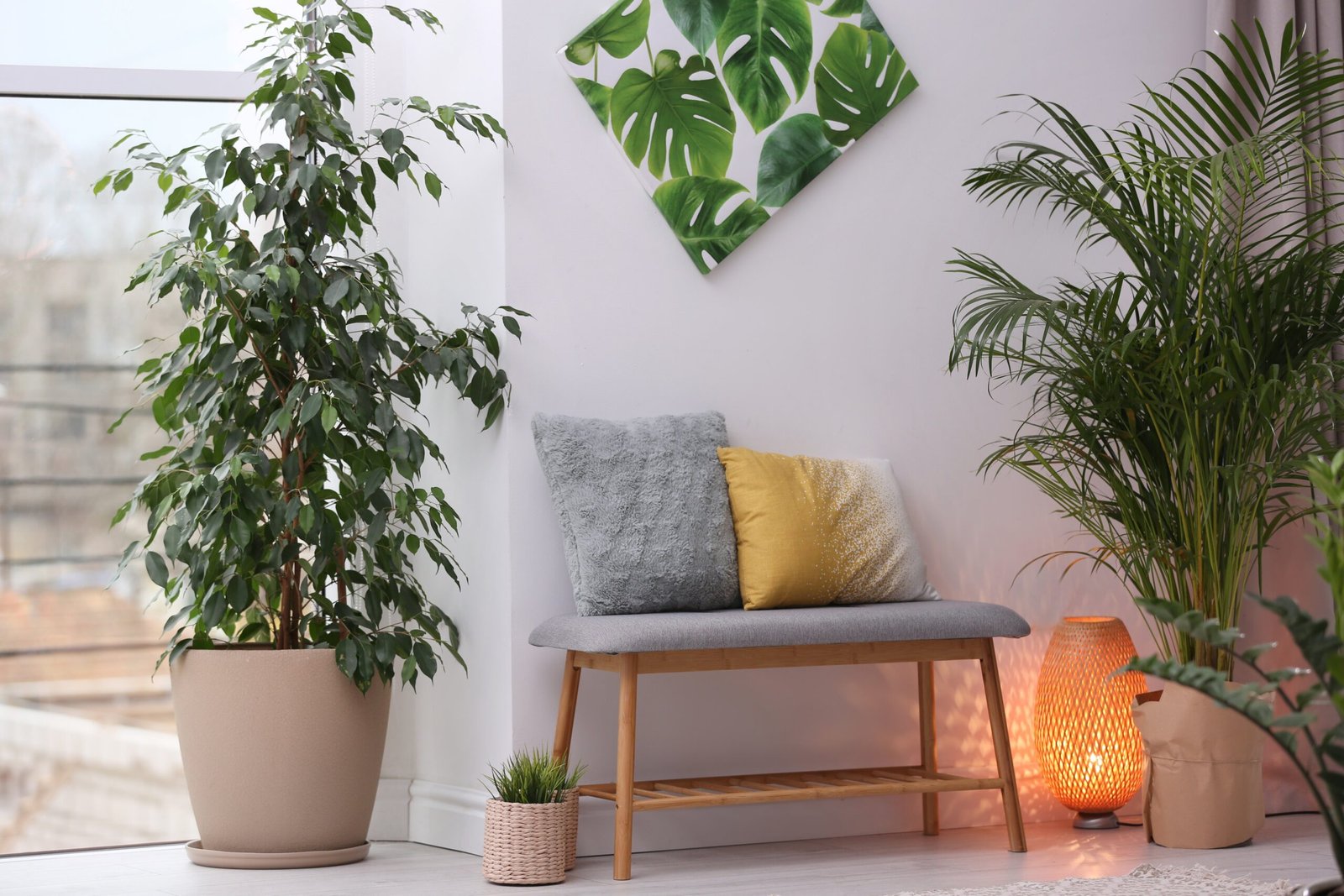
New York interiors have spent years balancing two competing impulses: the clean geometry of modern design and the emotional need for warmth in an intensely urban environment.
In 2026, that tension is producing a new visual language.
Call it “Soft Modern.”
The look retains the discipline of contemporary interiors—clean architecture, edited furniture, restrained palettes—but introduces something that traditional minimalism often suppresses: texture. Linen, wool, woven fibers, handmade textiles, natural wood, stone, soft lighting, and sculptural surfaces are becoming increasingly important to how a room feels.
At the same time, biophilic design is evolving beyond the familiar indoor-plant formula. New York designers are increasingly turning to organic materials, nature-derived colors, irregular forms, and tactile artworks to create interiors that feel connected to the natural world without becoming literal botanical environments. Current NYC design coverage reflects this shift toward organic shapes, natural fibers, earthy palettes, and more nuanced forms of biophilic design.
Fiber art is particularly well suited to this moment.
When Art Becomes Atmosphere
For decades, textile art was frequently positioned between craft and fine art. Today, that distinction feels increasingly irrelevant.
Contemporary fiber artists work with weaving, knotting, felting, embroidery, quilting, dyeing, stitching, soft sculpture, and experimental materials to create works that can occupy an entire wall—or an entire room.
The medium brings something painting cannot easily reproduce: physical softness.
A woven artwork changes the way a wall appears. A tufted piece introduces shadow. Loose fibers create movement. A dense textile absorbs light differently from plaster or glass. A hanging work can create a subtle sense of depth without requiring architectural intervention.
The effect is especially powerful in New York apartments, where space is often limited and every surface carries visual responsibility.
Rather than filling a room with objects, a large textile artwork can establish an atmosphere with a single gesture.
Recent New York fiber exhibitions demonstrate how broad the medium has become. Woven Together: TOUCH, presented by Intertwine Arts, explicitly explored fiber through softness, texture, weight, structure, and touch, while New York’s Textile Art Gallery continues to present contemporary textile practices that move across abstraction, material experimentation, sustainability, and storytelling.
The New Meaning of “Soft”
Soft Modern does not necessarily mean pastel, feminine, or traditionally cozy.
Its softness is more architectural.
Think rounded furniture rather than sharp-edged silhouettes. Bouclé and wool instead of highly polished synthetic surfaces. Linen curtains that allow daylight to filter through. Handwoven wall pieces replacing perfectly flat artwork. Stone with visible irregularity rather than flawless uniformity.
The objective is not to make a room look rustic.
It is to make modernism feel human.
That distinction matters in New York, where many residential interiors begin with hard architectural conditions: concrete, steel, glass, exposed brick, high ceilings, and rectilinear floor plans.
Fiber introduces a counterweight.
It softens acoustics, absorbs light, breaks up geometry, and gives the eye something tactile to follow.
A room can remain contemporary while becoming considerably less clinical.
Biophilia Without the Jungle
The first generation of contemporary biophilic interiors often announced itself through dramatic greenery: living walls, oversized plants, hanging gardens, and indoor trees.
Those gestures remain popular, but the vocabulary is becoming subtler.
In 2026, biophilic design increasingly operates through material and sensation.
Natural fibers can evoke the irregularity of grasses, bark, nests, woven vegetation, and geological surfaces. Hand-dyed textiles can introduce colors associated with moss, clay, sand, water, and stone. Organic compositions can suggest growth without literally depicting leaves or flowers.
One current NYC design source describes the movement as a shift toward organic shapes, natural fibers, and earth-inspired colors including clay, moss green, ochre, sand, and copper.
The result is nature translated into an interior vocabulary rather than simply imported into the room.
Why Fiber Works So Well
Fiber has a unique ability to occupy the space between image and object.
A woven wall piece may initially read as a composition of lines and colors. Move closer and the viewer begins to see individual threads, knots, fibers, stitches, or variations in tension.
That transition—from distance to intimacy—is increasingly important in contemporary interiors.
Digital screens have made visual information abundant. Fiber does the opposite. It asks for physical attention.
Its imperfections become part of the experience.
A slightly irregular weave can feel more alive than a digitally perfect pattern. A hand-dyed gradient can reveal the process behind the finished surface. A thick wool construction can cast shadows that change throughout the day.
The artwork is therefore never entirely static.
Light changes it.
Distance changes it.
Touch changes our understanding of it.
The Rise of the Tactile Wall
The traditional gallery wall tends to favor framed paintings, photographs, and prints.
Interior designers are increasingly treating the wall as a more experimental surface.
A large textile can function almost like an architectural element. It can define a seating area, introduce color into a neutral room, or provide a visual transition between architectural zones.
In smaller apartments, this can be particularly effective.
Instead of adding multiple decorative objects, one substantial fiber work can provide pattern, texture, color, and personality simultaneously.
The result is a kind of functional maximalism within a minimalist framework.
The room remains edited, but the surfaces become richer.
From Craft to Collectible
The growing interest in fiber also reflects a broader reassessment of craft.
Contemporary collectors are increasingly interested in works that reveal labor and material knowledge. A textile’s value is not only in its image but also in the time embedded in its construction.
This is particularly visible in artists whose practices blur the boundary between sculpture, design, and fiber.
Brooklyn-based artist Liam Lee, for example, works with wool sculpture and biomorphic forms while also engaging with textile design. His practice demonstrates how fiber can move freely between fine art, furniture, and interior environments.
That crossover is significant.
The contemporary home is becoming less interested in rigid categories. A piece can be sculpture, textile, furniture, or architecture—and sometimes several of these simultaneously.
A More Personal Kind of Modernism
Perhaps the strongest reason Soft Modern is gaining traction is emotional rather than stylistic.
After years of interiors dominated by stark whites, hard surfaces, black metal, and visual minimalism, designers and collectors are increasingly interested in spaces that communicate personality.
Current 2026 design coverage emphasizes comfort, personal expression, natural materials, warmer hues, and more individualized interiors.
Fiber naturally supports that shift.
It carries evidence of the hand.
It can reference family traditions, cultural histories, domestic craft, landscape, memory, and place.
Even when abstract, it often retains an unmistakably human quality.
That makes it particularly compelling within homes designed around technology.
The more automated the surrounding environment becomes, the more meaningful handmade objects can feel.
New York’s Particular Relationship With Texture
New York is uniquely suited to this movement.
The city’s interiors frequently juxtapose historic and contemporary materials: cast iron, exposed brick, plaster, steel, timber, marble, glass, and concrete.
Fiber can mediate between them.
A handwoven piece can soften a loft’s industrial architecture. A wool sculpture can introduce warmth into a minimalist condominium. A natural-fiber installation can connect a highly engineered space to organic rhythms.
In this context, biophilic design becomes less about creating an imitation of nature and more about restoring sensory complexity.
That may ultimately be its greatest contribution.
The Future Is Soft
The next phase of New York modernism may not be about adding more.
It may be about choosing better.
One beautifully made textile can replace a wall of generic decoration. One sculptural fiber work can transform an otherwise austere room. One natural material can introduce warmth without compromising contemporary architecture.
Soft Modern is therefore not a rejection of minimalism.
It is its evolution.
The new luxury is not necessarily visual abundance. It is material richness—the visible weave, the imperfect edge, the natural fiber, the shifting shadow, the handmade surface.
