


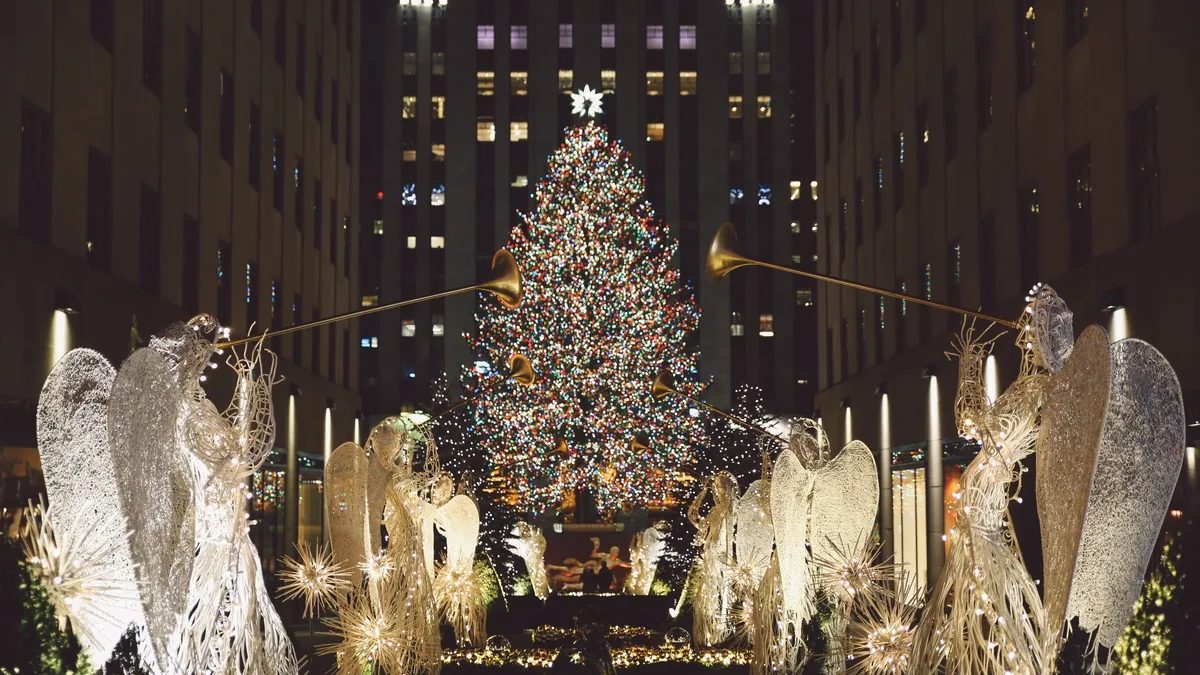
On Christmas Eve 1931, in the middle of the Great Depression, construction workers put up a small fir tree in the mud of a building site. Ninety-five years later, the Rockefeller Center Christmas Tree is the most famous tree in the world. This is the real history of the Rockefeller Tree: where it comes from, how it travels, who lights it, what it costs and what happens to it when the holidays are over.
The Real History Behind the Rockefeller Tree
In December 1931, the land between Fifth and Sixth Avenues, from 48th to 51st Street, was not yet Rockefeller Center. It was a huge construction site. Two years earlier the stock market had crashed, and the opera house that John D. Rockefeller Jr. had planned for the site was gone. He decided to build anyway: fourteen new buildings in a new style, on twelve acres of land leased from Columbia University.
For the men who worked there, the project was a lifeline. Close to 40,000 people would find work on Rockefeller Center during the Depression, at a time when millions of Americans had none. Outside the site, the city was poor and cold. That month, The New York Times reported that Christmas trees were “a glut on the market”: more than 120 carloads of trees could not be sold, because few families could afford one.
Christmas Eve, 1931
On Christmas Eve, the workers pooled their money and bought a twenty-foot balsam fir. They set it up in the mud and decorated it with what they had: strings of cranberries, paper garlands and tin cans, some made by their wives and children. The tree had no lights. Then the foreman put a small table under it, and the men lined up, one by one, to collect their pay before going home for the holiday.
A photograph of that line still exists. The men wear caps and heavy coats; behind them stands the little tree. It is not a beautiful picture. But it is a picture of gratitude, and it is where the most famous Christmas tree in the world began.
The workers put up the tree in gratitude for their jobs.
Rockefeller Center archive, caption of the 1931 photograph
The Rockefeller Tree by the Numbers
01From a Gesture to a Tradition
Two years later, the first buildings of Rockefeller Center were open, and the managers understood the power of that image. In 1933, a publicist turned the workers’ gesture into an official event. That December, a fifty-foot tree stood in front of the new RCA Building, today 30 Rockefeller Plaza, and for the first time it was lit in a public ceremony, with 700 lights. The Rockefeller Tree tradition was born.
The idea was simple and brilliant. Rockefeller Center was a private business that needed visitors, tenants and shoppers. A Christmas tree turned the plaza into a public square. People came to see the lights, and while they were there, they discovered the shops, the restaurants and the new Art Deco towers. Almost a century later, the strategy still works.

02The Golden Neighbor: Prometheus
In 1934, a golden giant arrived in the lower plaza, just below where the tree stands today. Prometheus, by the American sculptor Paul Manship, is made of gilded bronze, cast at the Roman Bronze Works in Corona, Queens. It is about 18 feet tall and weighs about eight tons. The model for the figure was Leonardo Nole, a young Italian-American lifeguard from New Rochelle, who posed for three months in the spring of 1933.
In Greek myth, Prometheus stole fire from the gods and gave it to humanity. Manship shows him flying through a ring of the zodiac, the heavens, above a mountain that stands for the Earth and a pool that stands for the sea. On the granite wall behind him, words adapted from the Greek playwright Aeschylus explain the meaning.
Prometheus, teacher in every art, brought the fire that hath proved to mortals a means to mighty ends.
It is worth stopping on this idea. In the darkest years of the Depression, Rockefeller Center chose as its symbol not a banker or a saint, but a rebel who brought light to humankind. Every December, the Christmas tree rises right behind him, and the two lights seem to answer each other. Restorers regilded the statue in 2025, so this winter it shines brighter than it has in years.
03The Rink
The lower plaza was not designed for skaters. At first, it served as a sunken entrance to the shops below, and few people stopped there. In 1936, the managers tried something new: they froze the plaza and opened an ice rink. To celebrate, that Christmas the plaza had two trees instead of one, and skaters held a competition on the new ice.
The rink turned the plaza into a stage. Since then, the tree, the golden Prometheus and the skaters circling below have formed the picture that the world calls “Christmas in New York.” It appears in countless films, postcards and TV specials. Few people remember that it was born as a solution to a problem: what to do with an empty corner of a business center.
04The War Years
During World War II, the tree became a mirror of the country. In 1942, the country needed metal and other materials for the war, so Rockefeller Center replaced the single tree with three smaller ones, each decorated in one color of the American flag: red, white and blue. Two years later, in 1944, the tree stood completely dark, because blackout rules forbade lights at night in coastal cities.
When the war ended in 1945, the solution was creative. Engineers pointed six ultraviolet projectors at the tree, and its 700 fluorescent globes seemed to glow in the dark. Even in its darkest years, the tree found a way to shine.
05Who Lights the Tree
In 1951, NBC, whose studios were inside 30 Rockefeller Plaza, broadcast the lighting for the first time, on The Kate Smith Show. Decorating the tree took 20 workers nine days. From that moment, the tree was no longer only a New York tradition: it belonged to the whole country.
Who actually turns it on? On television, it looks like one person pressing a big button at the end of a countdown. For many years, the mayor of New York and the owners of Rockefeller Center have shared that moment, often with the hosts of the show. In 2013, for example, Michael Bloomberg flipped the switch for the last time as mayor. The truth is less romantic: technicians control the lights from a panel in the sub-basement of Rockefeller Center, and after the ceremony a timer switches them on and off every day. “We make sure it goes on and off each day correctly,” says Erik Pauzé, the head gardener.
This year, Cynthia Erivo hosts the broadcast on Wednesday, December 2, with performances by Kelly Clarkson, Kirk Franklin, Alanis Morissette, Brad Paisley and the Radio City Rockettes, among others.
06Where the Tree Comes From
Every year, one man chooses the Rockefeller Center Christmas Tree: Erik Pauzé, Rockefeller Center’s head gardener, who has worked on the tree for decades. He drives thousands of miles, mostly through New York State, New England and Pennsylvania, looking at spruces in backyards, fields and parking lots. Sometimes he spots a tree years in advance and returns to check on it.
Most trees come from private families. Some write to Rockefeller Center to offer their tree; others answer a surprise knock on the door. Almost always, the tree is a Norway spruce, because its shape is full and symmetrical, and it holds heavy decorations well. It must be very tall, wide, healthy and beautiful from every side, because visitors walk all around it.
Not every tree has come from the United States. In 1966, Canada donated the tree to celebrate the centennial of its Confederation, the first tree from outside the country. The tallest tree in the history of the tradition arrived in 1999: a 100-foot Norway spruce from Killingworth, Connecticut.
Who Gives the Tree, and What They Get
The donors are not paid. The tree is a gift. In return, Rockefeller Center plants new trees on their property, and the family enjoys a moment of fame: their name on the news, their town on national television, and the joy of knowing that millions of people will see their tree. Many donors say the spruce had been part of the family for generations, planted by a grandparent or growing next to the house where their children played. Giving it away, they say, is a way to share it with the world.
07The Journey to Manhattan
Moving an 11-ton tree is a small engineering project. About a week before the cut, workers climb the tree and tie up its branches, wrapping them close to the trunk so they will not break. This takes about six days. Then a large crane arrives, resting on mats to protect the ground, with counterweights to balance the load. The crane holds the tree while a worker cuts the trunk with a chainsaw, and then lifts it gently onto a long flatbed truck, where it is strapped down.
The journey to Manhattan usually happens at night, with Rockefeller Center banners on the truck and a police escort. A tree from about 200 miles away takes a day or two to arrive. Along the way, people stand by the road to take photos.
Some trees had more unusual trips. In 1977, the tree came down the Hudson River on a barge from Stony Point. Then, in 1998, a tree from Richfield, Ohio, flew to New York on the world’s largest transport plane.
Raising the Tree
At the plaza, another crane lifts the tree upright and places it on a steel spike in the stand. Workers then attach cables, anchored at several points in the plaza, to bracing on the trunk, so the tree can resist the winter wind. Then the scaffolding goes up, level by level, all around it: it takes two full days before decorating can even begin. The tree drinks too, about 90 gallons of water a day.
08The Lights and the Star
The first official tree, in 1933, had 700 lights. Today there are more than 50,000 multicolored LEDs, on about five miles of wire, installed by a team that includes some twenty electricians.
In 2007, the tree went green. Energy-efficient LEDs replaced the old bulbs, and daily electricity use fell from about 3,510 kilowatt-hours to about 1,297. That year, solar panels on the roof of a Rockefeller Center building also helped to power the display.
The star is a story of its own. In 2004, Swarovski placed a crystal star on top of the tree for the first time: 550 pounds and 25,000 crystals, designed by Michael Hammers. In 2018, the architect Daniel Libeskind, the master planner of the new World Trade Center, designed a new one with three million crystals, nine feet four inches wide and 900 pounds in weight. A crane lifts it to the top. Experts estimate its value at around $1.5 million.
09What It Costs
Rockefeller Center does not publish an official budget for the tree, but some numbers are public. Experts estimate that a spruce of this size is worth upwards of $70,000, and yet the family donates it for free. The costs of cutting, transport, installation and decoration are paid by Tishman Speyer, the company that owns Rockefeller Center, and they include cranes, trucks, police escorts, scaffolding and weeks of work by hundreds of people. The star alone may be worth $1.5 million.
It is an investment that pays back. At the busiest moments of the season, more than half a million people a day pass by the tree. They shop, eat, skate and take photos in front of the tree and the Prometheus. For the stores, restaurants and offices of Rockefeller Center, the tree is the most effective advertisement in New York.
Insider tip
To see the tree with fewer people, go early in the morning on a weekday, or late at night, after 10 p.m. Avoid Friday and Saturday evenings in December, when the plaza is packed and the police sometimes create one-way walking lanes.
10Mysteries and Special Cases
A tradition this old has collected its share of strange stories.
The Owl in the Tree 2020
In November 2020, a member of the crew raising the tree heard something move between the branches. Inside was a tiny northern saw-whet owl, about seven inches tall, one of the smallest owls in North America. She had traveled about 200 miles from Oneonta, New York, hidden in the spruce, probably for days without food or water. The wildlife rehabilitator Ellen Kalish, of the Ravensbeard Wildlife Center, cared for her and named her “Rockefeller,” or “Rocky.” After six days of rest, Rocky was released at dusk, on November 24, into the woods of upstate New York. In a difficult year, the little owl became a national celebrity.
The “Sad” Tree 2020
That same year, the first photos of the tree, just arrived and still tied up after its long trip, looked thin and bare. They went viral, and the internet called it the perfect tree for 2020. A few days later, once its branches had relaxed and opened, the tree looked full and beautiful again. Every tree arrives a little “sad”: the branches need time to recover after being tied for the journey.
The Dark Tree and the Glowing Tree 1944–1945
The only year the tree stayed completely dark was 1944, during the wartime blackout. The following year, ultraviolet light made it glow without ordinary bulbs, a small mystery for the crowds who could not understand where the light came from.
The First Tree Was Not Here 1912
The Rockefeller Center tree is the most famous public Christmas tree in New York, but not the first. That honor goes to Madison Square Park, where a tree was lit in 1912, almost twenty years before the workers’ fir. A tree is still lit there every December, and it is much quieter: a good alternative if you want to see a holiday tree without the crowds.
Did you know?
Engineers once spent three months building a computer program just to get the twinkling of the lights right. And the tree is not “decorated” in the usual sense: apart from the lights and the star, it has no traditional ornaments. Its beauty comes from the shape of the spruce itself.
11After the Holidays: A Second Life
When the season ends, the tree does not disappear. In 1971, Rockefeller Center recycled it for the first time, turning it into mulch for nature trails in upper Manhattan. Today it has a more meaningful destiny. In January, workers take the tree down, cut it into sections in a lumber yard in New Jersey and mill it into beams. Finally, they stamp each beam with the mark of Rockefeller Center and donate the wood to Habitat for Humanity, which uses it to build homes for families in need.
There is something quietly perfect in this ending. The story began with workers who were grateful to have a job building something. Ninety-five years later, the tree still ends its life in the hands of builders, as wood for new homes. Between those two moments, it gives New York, and much of the world, a few weeks of light in the darkest time of the year.
The 2026 Rockefeller Center Christmas Tree
This year’s tree is a Norway spruce about 75 years old, donated by Rebecca Decker of West Edmeston, a small hamlet in Central New York. It is 76 feet tall, about 50 feet wide and weighs roughly 11 tons. Crews cut it on November 5, and it arrived in Manhattan on November 7. Since then, workers have been wrapping it in more than 50,000 multicolored LED lights on five miles of wire, under the 900-pound Swarovski star.
The tree will be lit on Wednesday, December 2, and will stay up until January 9, 2027. On Christmas Day it will be lit for 24 hours, and on New Year’s Eve from 5 a.m. to 9 p.m. In January, like the trees before it, it will become lumber for Habitat for Humanity.
The Rockefeller Tree Tradition Today
Why does this tree still matter so much? Part of the answer is television: for more than seventy years, the lighting has marked the start of the holiday season for millions of families. But the deeper answer is in its history. The Rockefeller Center Tree was born from hard times, from workers who had little and still wanted to celebrate. It survived a world war, went dark, glowed again, and became a symbol of a city that always finds a way to shine.
When you stand in the plaza this December, look at the tree, then at the golden Prometheus below it. Both tell the same story: in the darkest season, someone has to bring the light. For more ideas this holiday season, see our weekend guide to New York, our Broadway guide and the artists who make New York’s art life.
Plan Your Visit
Rockefeller Center Christmas Tree 2026
- Where
- Rockefeller Plaza, between W 49th and W 50th Streets, between Fifth and Sixth Avenues
- Lighting
- Wednesday, December 2, 2026 · 7–10 p.m. · Live on NBC and Peacock from 8 p.m. ET · No public tickets: arrive by early afternoon
- On view
- Through January 9, 2027 · Lit 24 hours on Christmas Day · 5 a.m.–9 p.m. on New Year’s Eve
- The tree
- Norway spruce, 76 feet, about 11 tons, from West Edmeston, New York
- Subway
- B, D, F, M to 47–50 Sts–Rockefeller Center
- Official info
- rockefellercenter.com
Updated November 2026. Information checked on official and press sources; dates and times can change, so check rockefellercenter.com before your visit. Sources: Rockefeller Center, 6sqft, amNY, NBC New York, Fast Company, National Geographic, Untapped New York.

