


For thousands of years, the Moon has hung over our heads as a silver promise — close enough to see clearly, far enough to remain a mystery. Today, that promise is becoming a destination. NASA’s Artemis II crew flew around the Moon in April 2026, China is racing toward 2030, and architects are sketching villages where children may one day grow up under the Earth-light. Below, we walk through every question a curious traveler might ask before signing up for the next great migration.
For thousands of years, the Moon has hung over our heads as a silver promise — close enough to see clearly, far enough to remain a mystery. Today, that promise is becoming a destination. NASA’s Artemis II crew flew around the Moon in April 2026, China is racing toward 2030, and architects are sketching villages where children may one day grow up under the Earth-light. Below, we walk through every question a curious traveler might ask before signing up for the next great migration.
When did humans figure out that the Moon is a satellite?
People have watched the Moon since prehistory, but ancient observers debated for millennia what it actually was — a god, a polished mirror, a hole in the heavens, a smaller world. The Greek philosopher Anaxagoras argued around 450 BCE that the Moon reflected sunlight and resembled Earth. Aristarchus of Samos went further in the third century BCE, calculating its rough size and distance. The decisive moment came in the winter of 1609–1610, when Galileo Galilei pointed his refracting telescope at the night sky and saw mountains, craters, and dark plains. Galileo’s drawings ended the idea of a perfect crystalline orb and revealed a true world orbiting our own. From that moment on, astronomers treated the Moon as Earth’s natural satellite — the first body other than the Sun whose status as a “world” we truly understood.
How far is the Moon from Earth?
The Moon orbits us in an ellipse, so its distance shifts continuously. On average, our companion sits about 384,400 kilometers (roughly 238,855 miles) away. At perigee — its closest approach — it swings in to around 363,300 kilometers, while at apogee it drifts out to 405,500 kilometers. To picture the gap, you could line up about thirty Earth-diameters between the two bodies, or fly a commercial jet for nineteen straight days at cruising speed. A radio signal, traveling at the speed of light, makes the trip in about 1.28 seconds.
What is the gravity on the Moon, and how much would an 80-kilogram person weigh there?
The Moon’s surface gravity measures roughly 1.62 m/s², about one-sixth of Earth’s 9.81 m/s². An 80-kilogram person who climbs out of a lunar lander would feel as if they weighed only about 13.3 kilograms — light enough to bound across the surface in long, loping strides, exactly as the Apollo astronauts famously did. Their mass, however, would not change: dropping a heavy crate on your foot in low gravity still hurts plenty, because momentum still depends on mass.
What dangerous radiation hits the Moon?
The Moon lacks both a global magnetic field and a real atmosphere, so it sits exposed to the full sleet of space radiation. Three sources matter most. Galactic cosmic rays pour in from outside the solar system, carrying enough energy to slice through ordinary spacecraft walls. The Sun emits a constant stream of solar wind particles, and during solar flares it can hurl violent solar particle events that would deliver dangerous doses within hours. Finally, secondary radiation appears when those primary particles smash into the lunar regolith and scatter neutrons and gamma rays back upward. Mission planners shield habitats by burying them under regolith or parking them inside lava tubes, where meters of rock soak up the worst of it.
Can you get a tan on the Moon?
Not really — at least, not the kind of golden tan you’d get on a Mediterranean beach. Without an ozone layer to filter ultraviolet light, sunlight on the Moon delivers UV-A, UV-B, and UV-C radiation in their raw, unblocked forms. Anyone foolish enough to expose bare skin to direct sunlight in a lunar suit failure would not bronze gracefully; they would burn within minutes and risk acute radiation injury. Visors and outer suit layers block UV completely, which is why every photograph of an Apollo astronaut shows that distinctive gold-coated helmet shield.
Is there wind on the Moon?
No. Wind requires an atmosphere thick enough to flow as a fluid, and the Moon doesn’t have one. Footprints left by Buzz Aldrin in 1969 still sit exactly where he placed them, sharp-edged and undisturbed. The only “weather” comes from charged particles streaming off the Sun and from micrometeoroids striking the surface — both subtle effects that act over millions of years rather than minutes.
What does the lunar atmosphere actually contain?
Strictly speaking, the Moon does have an atmosphere — astronomers call it an exosphere, and it is so thin that its molecules almost never collide with one another. Per cubic centimeter, the lunar exosphere holds roughly a hundred million particles, compared to Earth’s hundred billion billion. Those particles include hydrogen, helium, neon, and argon, with traces of sodium, potassium, and even tiny amounts of methane. The whole atmosphere weighs less than the air inside an average gymnasium back on Earth.
What is the temperature on the Moon?
The Moon swings between extremes that would shred most materials we use daily. At the lunar equator, daytime temperatures climb to about 127°C (260°F), hot enough to boil water if there were any. During the long lunar night, the surface plunges to roughly -173°C (-280°F). Inside the permanently shadowed craters near the south pole, where sunlight has not touched the regolith for billions of years, temperatures drop below -240°C (-400°F) — colder than the surface of Pluto. Engineers designing habitats must build structures that survive a 300-degree daily swing.
Are there seasons on the Moon?
Barely. Earth tilts on its axis by about 23.5 degrees, which is why we get summer and winter. The Moon tilts only 1.5 degrees relative to its orbit around the Sun, so it experiences almost no seasonal variation. The dramatic temperature swings on the Moon come from the day-night cycle, not from any tilt-driven season. One quirk of that small tilt: certain peaks near the lunar south pole catch sunlight nearly all year round, while neighboring crater floors stay frozen in eternal darkness.
How long does a day last on the Moon?
A “day” on the Moon depends on what you mean by the word. The Moon takes about 27.3 Earth days to rotate once on its axis relative to the stars (a sidereal day), and 29.5 Earth days to complete a full sunrise-to-sunrise cycle (a synodic day). For an astronaut standing on the surface, that translates to roughly fourteen Earth days of continuous sunlight followed by fourteen days of unbroken darkness. Future settlers will need habitats and power systems that handle two-week nights without flinching.
How long does a trip to the Moon take?
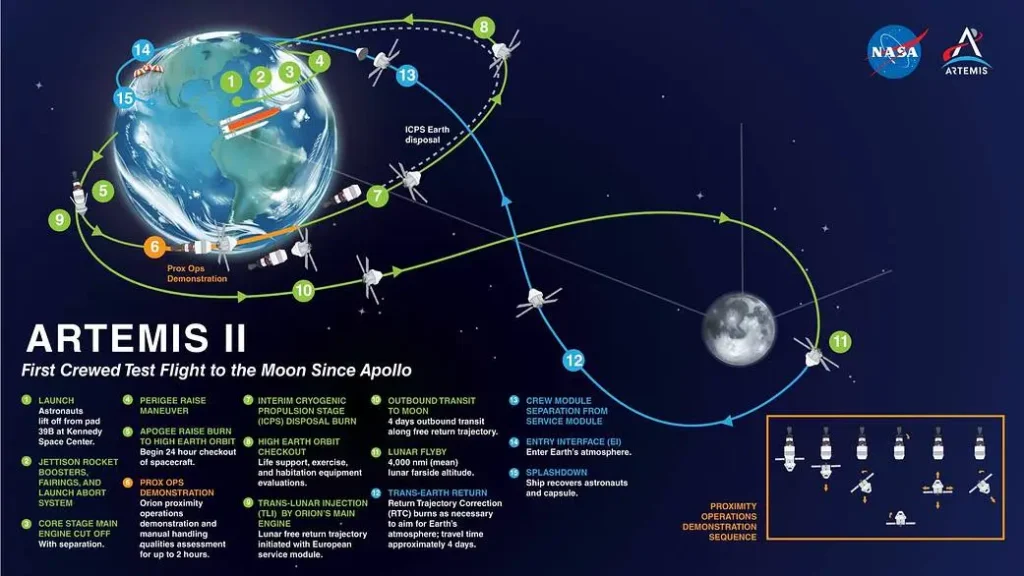
The answer depends on the engine and the trajectory. The Apollo missions reached the Moon in about three days using a direct transfer orbit. Artemis II spent ten days traveling out and looping back along a free-return trajectory in April 2026. Robotic probes can take much longer when they fly fuel-saving “ballistic” paths — India’s Chandrayaan-3 lander, for example, used a slow spiral that lasted about a month. Future high-thrust nuclear-electric ships could one day shorten the trip to under twenty-four hours, though no such vehicle has yet flown.
Is there water on the Moon?
Yes — far more than scientists once believed. Until 2009, most researchers assumed the Moon was bone dry. That year, NASA’s LCROSS mission slammed a spent rocket stage into a permanently shadowed crater near the south pole and discovered substantial water ice in the resulting plume. Since then, instruments aboard India’s Chandrayaan-1 and NASA’s SOFIA airborne observatory have detected hydroxyl molecules and water across the lunar surface, including on sunlit slopes. The richest deposits sit in cold-trap craters at both poles, where ice has accumulated for billions of years. Estimates suggest hundreds of millions of tons may lie within reach of future miners — enough to supply drinking water, breathable oxygen, and rocket propellant for generations.
When will tourist trips be organized?
Genuine lunar tourism remains a few years out. The most ambitious recent project, Yusaku Maezawa’s “dearMoon” mission, would have flown artists around the Moon aboard SpaceX’s Starship; Maezawa cancelled it in June 2024 because of repeated delays. Today, most analysts expect the first paying lunar flyby passengers to launch in the late 2020s once Starship and Orion finish their crewed test campaigns. Surface tourism — actually walking on the Moon as a paying customer — looks more like a 2030s or 2040s prospect, and many industry watchers think it will remain a billionaire’s pastime well into mid-century.
When will the next Moon landing happen?
After NASA pushed Artemis III back to a low-Earth-orbit lander demonstration in February 2026, the agency now targets early 2028 for the first crewed Artemis surface landing, which will fly under the Artemis IV banner. China continues to aim for its first crewed Moon landing in 2030, with two taikonauts riding the Mengzhou capsule and the Lanyue lander. Several robotic landers from American, Indian, Japanese, and European companies will touch down between now and then, but the next human boot prints in lunar dust should appear sometime around 2028 if Artemis stays on track.
Will the next people on the Moon be Chinese or American?
That race is genuinely close. The United States holds the legacy advantage — twelve Americans walked on the Moon during Apollo, and Artemis II proved in April 2026 that NASA can again send astronauts around the Moon and bring them home safely. But the American program has accumulated delays around heat-shield repairs, lander development, and budget fights, while China has stuck doggedly to its long-range plan. Beijing has tested the Mengzhou capsule, ground-fired the Long March 10 rocket, and run lander simulations on schedule. If NASA hits its 2028 target, Americans return first. If Artemis IV slips even another year, the next bootprints could speak Mandarin. Most independent analysts call the outcome a coin flip.
Why does it matter so much who gets there first?
Three reasons drive the urgency. First, the south polar region contains the only known concentrations of water ice within easy reach, and the best landing sites are limited; whoever arrives first essentially picks the prime real estate. Second, treaties on outer space prohibit national land claims, but they do not forbid a nation from setting up a “safety zone” around its hardware — a soft form of territorial influence. Third, prestige still matters: the country that returns to the Moon first sets the tone for international partnerships, attracts allies to its program (the Artemis Accords already have more than sixty signatories), and demonstrates the technological and industrial muscle to lead the next century of space activity. Whoever wins the south pole shapes the rules everyone else will follow.
Who will build the first residential modules on the Moon?
A patchwork of partners is sketching the first habitats. NASA has contracted SpaceX and Blue Origin to develop lander vehicles whose habitable volumes will double as short-stay quarters for surface crews. ICON, an American construction firm, won a NASA contract to develop “Olympus,” a 3D-printed habitat system that uses lunar regolith as its primary building material. The European Space Agency has worked with the architecture firm Foster + Partners on inflatable domes shielded by 3D-printed regolith shells. Japan’s JAXA, in partnership with Toyota, is developing a pressurized lunar rover called the Lunar Cruiser, which would let astronauts live and work for up to thirty days at a time without returning to a fixed base. China’s International Lunar Research Station partnership with Russia, Belarus, Pakistan, and others plans modular habitats that arrive on Long March 10 launches starting in the early 2030s.
When will the first lunar villages be built?
The first true villages — meaning permanent installations large enough to support rotating crews of several people for months at a time — should appear in the early-to-mid 2030s. NASA’s Artemis Base Camp concept envisions a habitation module, a pressurized rover, and a power plant set up near the south pole during Artemis V or VI. China’s ILRS plan calls for a robotic-built basic outpost by around 2035, with crewed expansion through the 2040s. ESA director general Josef Aschbacher has described Europe’s vision of a “Moon Village” — not a single base, but a community of cooperating outposts run by different agencies and companies, sharing roads, power lines, and communication relays. The first generation of permanent residents could move in before 2040.
How will lunar settlers obtain water?
Settlers will mine it. Mission planners are designing rovers and excavators that will dig regolith from permanently shadowed craters near the poles, then heat the material in solar ovens to drive off the water vapor. The vapor condenses in cold traps, and the resulting liquid water can either go straight to drinking-water purification or feed electrolysis units that split it into hydrogen and oxygen. The hydrogen becomes rocket fuel, and the oxygen serves both as breathing gas and as oxidizer. NASA’s PRIME-1 and VIPER missions, both targeting the south pole, will scout the most promising deposits during the late 2020s.
How do engineers plan to build on the Moon?
Three construction techniques dominate current research. Inflatable structures arrive packed inside a launch vehicle, expand on the surface, and provide immediate pressurized volume. 3D-printed regolith walls — built by robotic printers that fuse lunar soil with binders or with concentrated sunlight — surround those inflatables and shield them from radiation, micrometeoroids, and temperature swings. Buried habitats, dug into the regolith with bulldozer-like rovers and then covered, deliver the strongest protection of all. Several teams are also studying lunar lava tubes — natural underground tunnels left by ancient volcanic flows — which could shelter cities-sized populations beneath dozens of meters of solid rock.
Will it be possible to grow vegetables on the Moon?
Yes, and the work has already started. China’s Chang’e 4 lander carried a small biosphere experiment to the lunar far side in 2019, and a cotton seed sprouted briefly inside that capsule before the cold killed it. Researchers at the University of Florida have grown thale cress in tiny samples of real Apollo regolith. Future lunar greenhouses will rely on hydroponics or aeroponics — soilless techniques that recycle water and nutrients with minimal waste. Leafy greens, tomatoes, peppers, strawberries, dwarf wheat, and potatoes all rank as strong candidates for early crops. LED lighting, powered by solar panels and stored battery energy, will replace sunlight during the two-week lunar night.
Will settlers produce all their own food?
Eventually, yes — but not for decades. Early crews will eat mostly Earth-grown food, supplemented by fresh greens and herbs from their greenhouses, simply because launching food up from Earth costs less than building a fully self-sufficient farm at the start. As infrastructure grows, settlers will add fish (tilapia adapt well to closed systems), insects (rich in protein and easy to raise), and possibly cultured meat grown in bioreactors. A truly self-sufficient lunar colony — one that produces every calorie it eats, recycles all its waste, and survives an Earth supply cutoff — probably remains a 2050s or 2060s achievement.
What minerals lie on the lunar surface?
The Moon’s regolith contains, by mass, a great deal of oxygen — roughly forty percent of the surface material is oxygen locked inside oxide minerals. Silicon, iron, calcium, aluminum, magnesium, and titanium round out the major constituents, all in usable concentrations. The lunar maria (the dark plains visible to the naked eye) are particularly rich in iron and titanium oxides. The polar craters add water ice. Two materials especially excite future planners: ilmenite, a titanium-iron oxide that yields oxygen when heated with hydrogen, and helium-3, a rare isotope embedded in surface dust by billions of years of solar wind, which some researchers consider a possible fuel for future fusion reactors. Every gram of construction material that settlers can pull from local regolith is a gram they don’t have to launch from Earth.
Who was the first man on the Moon?
Neil Armstrong, commander of NASA’s Apollo 11 mission, stepped onto the lunar surface at 02:56 UTC on July 21, 1969 (still July 20 in the Americas). His crewmate Buzz Aldrin followed about twenty minutes later, while command module pilot Michael Collins orbited overhead. Armstrong’s first words — “That’s one small step for [a] man, one giant leap for mankind” — instantly became one of history’s most-quoted sentences. Eleven other men followed during the next three years, and then the program ended with Apollo 17 in December 1972. No human returned to the lunar surface for the next half-century.
What spacecraft fly under the Artemis program?
Artemis relies on a stack of complementary vehicles. The Space Launch System (SLS) is NASA’s super-heavy-lift rocket — taller than the Statue of Liberty and roughly fifteen percent more powerful than the Saturn V that launched Apollo. The Orion crew capsule, built by Lockheed Martin, carries up to four astronauts on the Earth-Moon journey and brings them home through the atmosphere at 11 kilometers per second. For the surface itself, NASA has contracted two Human Landing Systems: SpaceX’s Starship HLS, a stainless-steel giant that descends and ascends on its own engines, and Blue Origin’s Blue Moon lander, a smaller two-stage vehicle. A new Axiom-built spacesuit, called the AxEMU, replaces the half-century-old Apollo-era design.
Why did NASA choose the name Artemis?
Artemis was the Greek goddess of the Moon, the hunt, and the wilderness — and, crucially, the twin sister of Apollo. NASA picked the name in 2019 to signal continuity with the Apollo program while emphasizing a new chapter: where Apollo sent only American men, Artemis was originally chartered to land the first woman and the first person of color on the lunar surface. The Trump administration removed the equity language from official program goals in early 2025, but the mythological pairing — Apollo and his sister returning to the Moon together — remains the program’s poetic core. Orion, the crew capsule, takes its name from the hunter-companion of the goddess Artemis in classical mythology.
Could we build a train or an elevator to the Moon?
Both ideas exist on paper. A lunar space elevator is far more feasible than the famously impossible Earth version, because the Moon’s gravity is weaker and existing materials like Kevlar or Zylon could in principle support a cable anchored at the Earth-Moon Lagrange point L1. Engineers at the Liftport Group and at academic institutions have published serious designs. Nothing is under construction today, but a working lunar elevator could appear by mid-century if economic demand justifies the investment. As for a “train,” researchers at NASA’s Innovative Advanced Concepts program have funded a feasibility study for a magnetically levitated lunar railway called FLOAT, which would shuttle cargo across the surface using superconducting tracks. Surface trains could plausibly link villages and mines within twenty years; a true Earth-to-Moon railway, however, belongs firmly in the realm of science fiction.
How will we communicate with the moonwalkers?
For nearside operations, ordinary radio and laser links work directly between Earth ground stations and lunar surface assets. The far side, however, blocks all line-of-sight signals, so anyone working there needs a relay. China demonstrated this with its Queqiao satellites, which forwarded data from the Chang’e 4 and Chang’e 6 landers on the far side. NASA, ESA, and JAXA are now jointly building a much more ambitious system called LunaNet — essentially an internet for the Moon. Commercial relay satellites in lunar orbit will provide continuous coverage, navigation services analogous to GPS, and shared standards so that hardware from any partner agency can connect seamlessly. By the early 2030s, an astronaut on the south pole should be able to video-call Earth as easily as we make a phone call across town today, with only the unavoidable 1.3-second light-speed delay.
What will the inhabitants of the Moon be called?
No name has officially won out. “Lunarian” reads most naturally in English and shows up frequently in science-fiction novels. “Selenite,” derived from Selene, the older Greek name for the Moon, has a more poetic feel and was popularized by H.G. Wells in The First Men in the Moon (1901). “Lunar settlers” or “lunar residents” sounds bureaucratic but accurate. Some commentators have proposed “Moonlings” as a friendlier diminutive, while sci-fi author Andy Weir uses “Artemisians” in his novel Artemis. The first generation of permanent residents will probably settle the question themselves, the way “Americans” eventually replaced “British colonists” on a distant frontier four centuries ago.
A new chapter
Half a century after Apollo, humanity is finally returning — and this time, the goal is not to plant a flag and leave, but to stay. Within fifteen years, children may grow up looking at Earth as a blue marble in their black sky. They will mine ice from the dark, eat lettuce grown under LED lights, walk in suits descended from the AxEMU prototype, and perhaps argue about whether to call themselves Lunarians or Selenites. The Moon is no longer just a destination. It is becoming, slowly and unmistakably, an address.
NASA Artemis Program — official mission hub https://www.nasa.gov/humans-in-space/artemis/Anchor suggestion: “NASA’s Artemis program” ESA Lunar 3D Printing / Moon Village — European base-building research https://www.esa.int/Enabling_Support/Space_Engineering_Technology/Building_a_lunar_base_with_3D_printingAnchor suggestion: “3D-printed regolith habitats” China Manned Space Agency 2030 Plan (RAND analysis) — clear English-language overview https://www.rand.org/pubs/commentary/2025/11/china-is-going-to-the-moon-by-2030-heres-whats-known.htmlAnchor suggestion: “China’s 2030 crewed lunar mission” NASA LCRNS / LunaNet — the Moon’s future communications network https://www.nasa.gov/goddard/esc/lcrns/Anchor suggestion: “LunaNet, an internet for the Moon” Apollo 11 Mission (NASA) — for the Neil Armstrong / first Moon landing reference https://www.nasa.gov/mission/apollo-11/Anchor suggestion: “Apollo 11 mission”
