

In the short, defiant verses of William Ernest Henley’s poem Invictus, we find the words: “I am the master of my fate, I am the captain of my soul.” Most of us read those lines and feel a flicker of inspiration, a momentary boost of courage to face a bad day at the office or a difficult conversation. But then there is Alex Zanardi.
To look at the life of Alessandro Zanardi is to see those words translated into flesh, blood, and carbon fiber. He is not just a man who survived; he is a man who refused to be diminished. Compared to him, the very concept of “Invictus” finds its ultimate human vessel. His story is not merely one of sporting excellence, but a blueprint for how to live with a ferocity of spirit that turns tragedy into a mere comma in a much longer, more beautiful sentence.
The Energy of a Natural Born Fighter
Long before the world knew him as a symbol of disability rights and paralympic glory, Alex Zanardi was a whirlwind of energy in the high-octane world of motor racing. To understand the man who “got back up,” you must first understand the man who never wanted to slow down.
Born in Bologna, Italy, Alex was fueled by a “great energy” that was infectious. In the 1990s, he became a legend in the CART (Championship Auto Racing Teams) series in the United States. He didn’t just win; he won with a theatrical flair that earned him the nickname “The Pineapple” and started the tradition of doing “donuts” (spinning the car in circles) after a victory.
Alex Zanardi drove with an aggressive, joyful abandonment. He was the man who made the “Pass of the Century” at Laguna Seca, diving through the dirt of the Corkscrew turn to snatch victory. This wasn’t just skill; it was a manifestation of a soul that believed anything was possible if you had the courage to try. This innate, sun-drenched Italian optimism would eventually become his greatest tool—not for driving cars, but for rebuilding a life.
The Day the World Stopped: Lausitzring, 2001
On September 15, 2001, the energy that had propelled Zanardi to the top of the racing world met a catastrophic halt. During a race at the EuroSpeedway Lausitz in Germany, Alex spun his car across the track into the path of oncoming traffic. He was struck at over 320 km/h (200 mph).
The impact was so violent that the car was severed in two. Zanardi lost both of his legs, one at the knee and the other at the thigh. He lost 75% of his blood. He was read his last rites by a chaplain. In clinical terms, he died seven times that day.
But Alex Zanardi did not stay dead.
The world watched in horror, assuming this was the tragic end of a brilliant career. We saw a broken man. But Alex, waking up in a hospital bed days later, saw something else. He looked at his wife, Daniela, and his young son, Niccolò, and he didn’t see what he had lost. He saw what he still had.
“When I woke up and realized I had no legs, I didn’t ask why me? I asked, ‘How am I going to do all the things I want to do without legs?'” — Alex Zanardi
Getting Back Up: The Resurrection
How Zanardi motivated thousands of people started in the rehabilitation ward. Most people in his position would have spent years in mourning. Alex spent days. He was impatient with grief. He began designing his own prosthetic legs, unsatisfied with the standard models.
The sight of Zanardi returning to the Lausitzring just two years later to finish the final 13 laps of the race he never completed remains one of the most powerful moments in sports history. He drove a specially modified car, and he did it with the same grin he had before the accident.
He didn’t just “cope.” Alex thrived. He returned to professional racing in the World Touring Car Championship, winning races against able-bodied drivers. Alex proved that the “limit” is a psychological construct, not a physical one. By showing up, by refusing to hide his prosthetic limbs, and by laughing at his own misfortune, he gave permission to thousands of others facing disability to stop apologizing for their existence and start reclaiming their joy.
The Handbike and the Golden Glory
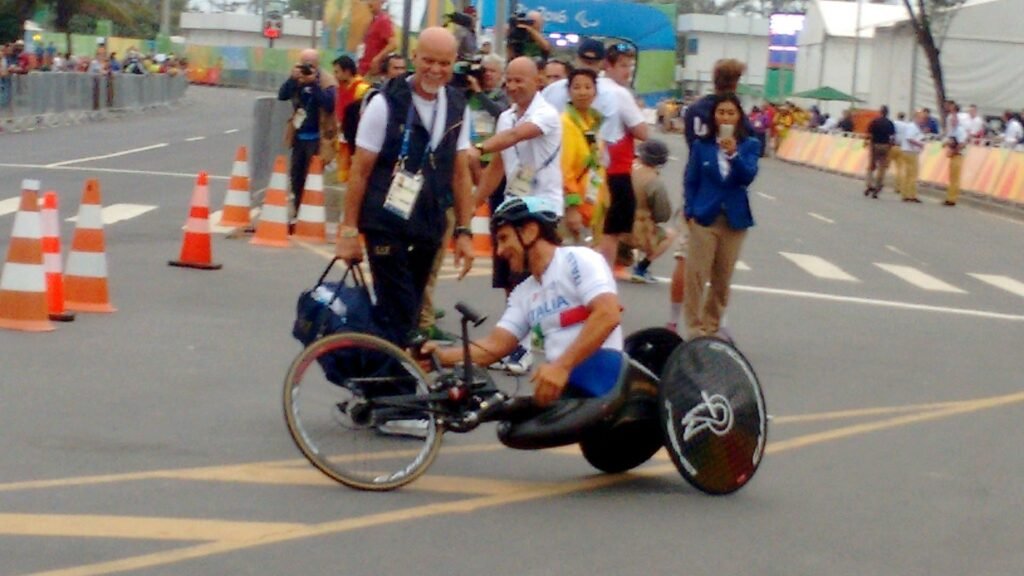
Just when the world thought Zanardi had reached his peak of “comeback” stories, he pivoted. He took up handcycling, a sport that requires immense upper-body strength and a different kind of endurance.
Watching Alex Zanardi at the London 2012 Paralympics was a spiritual experience for many. At 45 years old, an age when most athletes are long retired, he won two gold medals. The image of him sitting on the finish line at Brands Hatch, lifting his handbike over his head with one arm, his face etched with a mixture of exhaustion and pure, unadulterated triumph, became iconic.
He repeated the feat in Rio 2016, winning more gold. Alex wasn’t doing it to “prove” he was still an athlete. He was doing it because he loved the struggle. Invictus loved the “great energy” of the competition. He taught us that the goal isn’t the medal—it’s the person you become while you’re trying to win it.
A Great Father: The Heart Behind the Hero
While the world saw the champion, his family saw the man. Alex often spoke of his son, Niccolò, as his greatest motivation. He didn’t want his son to grow up with a “victim” for a father. He wanted Niccolò to see a man who faced the storm and told the wind to blow harder.
Being a great father, to Alex, meant more than just providing; it meant being an example of resilience. He involved his family in every step of his recovery. He remained a devoted husband to Daniela, who stayed by his side through every surgery and every race.
Their bond is a testament to the fact that behind every “Invictus” soul is a support system built on love. Alex showed us that being a hero isn’t about being invulnerable—it’s about being vulnerable enough to love and being strong enough to lead your family through the darkest valleys. Niccolò, now a man himself, often speaks of his father not as a “disabled legend,” but as a source of constant, grounding light.
An Example for Everyone: Facing the Difficult Times
We carry Alex Zanardi in our hearts because his life is an antidote to the cynicism of the modern world. We live in an era where it is easy to feel defeated by the smallest inconveniences. All of us feel “stuck” in our jobs, our routines, or our fears.
Then we think of Alex.
We think of the man who, after losing his legs, said: “I am a very lucky man because I have been able to live two lives.” He helps us face difficult times by shifting our perspective. He teaches us that:
- Resilience is a Choice: It is not something you are born with; it is something you decide to have every morning when you wake up.
- Focus on the “Can”: If you lose 90% of your capabilities, you still have 10%. Alex Zanardi is the king of that 10%.
- Humor is a Shield: Alex often joked about his “bionic” parts. By laughing at his situation, he took away the power of the tragedy to hurt him.
The Second Storm: The 2020 Accident
In June 2020, tragedy struck again. During a handbike race in Tuscany, Alex was involved in another horrific collision with a truck. He suffered severe head and facial trauma. Once again, the world held its breath. Once again, the prognosis was grim.
But true to the spirit of Invictus, the battle continues. As of today, Alex is in a long process of recovery. The “great energy” is now focused inward, on the slow, grueling task of neurological rehabilitation.
Even in his silence, he continues to motivate. His family’s privacy and strength, and the occasional updates of his progress, serve as a reminder that the fight isn’t over until you say it’s over. He is still teaching us—not through gold medals now, but through the quiet, stubborn persistence of staying alive.
Why We Carry Him in Our Hearts
Alex Zanardi is a man to always carry in your heart because he represents the best of the human spirit. He is the personification of the idea that while we cannot control what happens to us, we have total control over how we respond.
When you find yourself in a dark place—whether it’s a personal loss, a professional failure, or a physical struggle—think of the man from Bologna. Think of the donuts he spun in the grass at Laguna Seca. Think of the way he held his handbike toward the London sky.
He is an example for everyone because he didn’t wait for life to be “perfect” or “fair” before he decided to be happy. He found happiness in the grit, in the sweat, and in the “second life” he was given.
Alex Zanardi is Invictus. He is the unconquered. And as long as we remember his story, a little bit of that unconquerable spirit lives within us, too. He is the light that reminds us: no matter how many times we fall, we have the power to get back up. We are the masters of our fate. We are the captains of our souls.
Thank you, Alex, for showing us how to truly live.
