

In Chelsea, Anthony McCall turns projected light into something that feels almost physical—inviting viewers to walk through evolving geometric forms and experience cinema as architecture, sculpture, sound, and time.
What if light could be entered?
At Sean Kelly in New York, Anthony McCall continues a five-decade investigation into that seemingly impossible question with Solid Light, 1973, 2020, 2026. Bringing together works from across his career, the exhibition demonstrates how a beam of projected light can become a spatial object—one that changes slowly, occupies the room, and depends on the movement of the viewer.
The exhibition runs from September 11 through October 31, 2026, marking McCall’s seventh solo exhibition with Sean Kelly. It brings together three significant works: Line Describing a Cone (1973), Skylight (2020), and the newly debuted Swarm (2026).
The Cinema You Can Walk Into
McCall began developing his “solid light” works in the early 1970s, emerging from the experimental film culture of London and New York.
His breakthrough Line Describing a Cone radically reconsidered what a projected film could be. Instead of presenting an image on a screen, McCall projects a simple animated line into a darkened, haze-filled room.
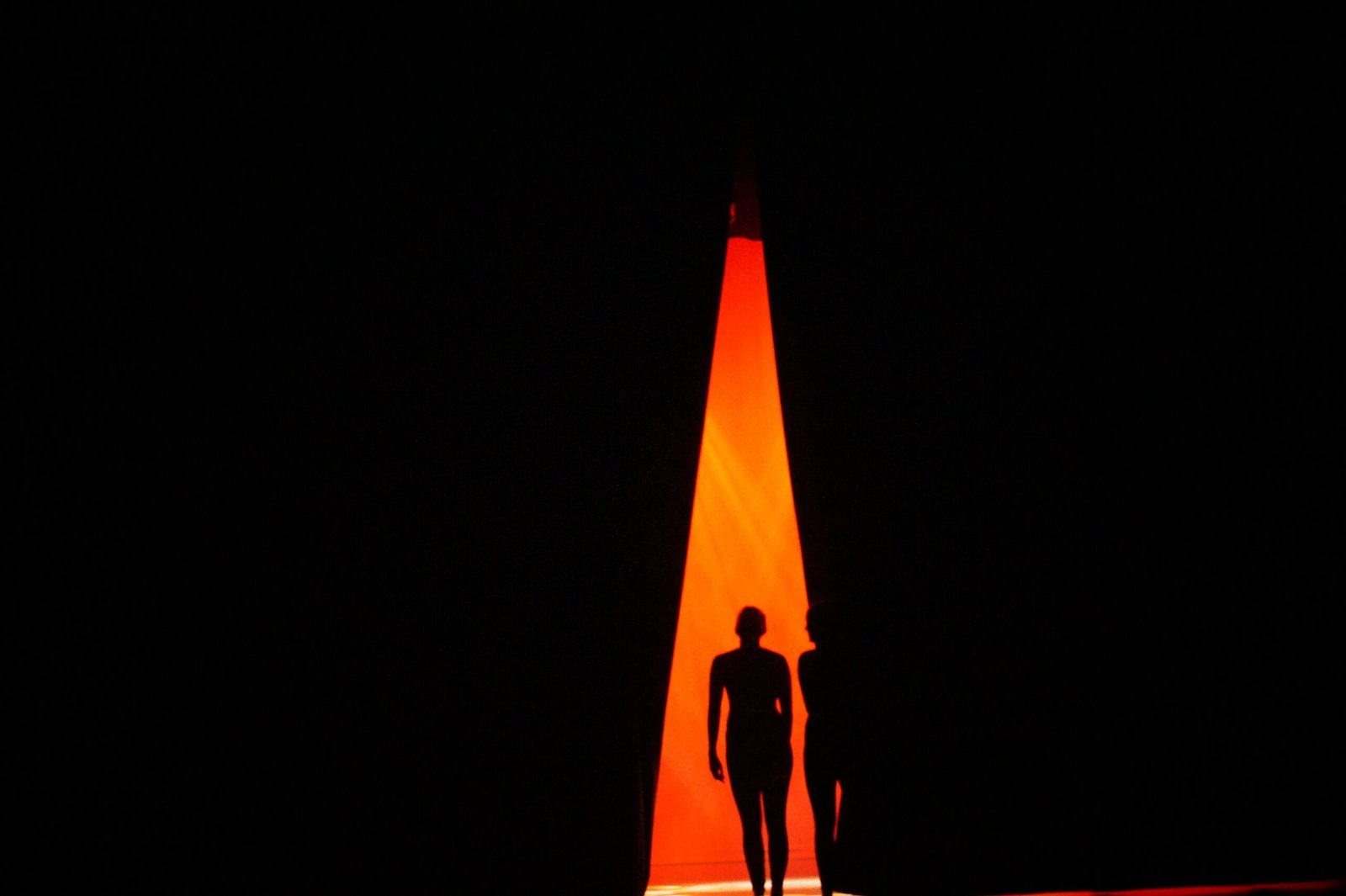
Slowly, the line expands and curves until the viewer perceives a three-dimensional cone made from light.
The distinction is important.
The artwork is not simply something to look at from a fixed position. Visitors can walk around it, move through it, and change their perspective. The spectator’s body becomes part of the viewing experience.
McCall has described the work as something that should be understood as sculpture changing over time—a description that captures the unusual relationship between cinema and physical space at the heart of his practice.
From Projection to Presence
Traditional cinema generally asks viewers to remain seated and look toward a screen.
McCall reverses that relationship.
His projected images leave the screen behind and occupy the surrounding atmosphere. Haze makes the light visible as a volume, allowing something normally perceived only as illumination to appear almost tangible.
This transformation is central to the idea of “solid light.”
The light is not literally solid. Yet within the gallery, it can appear to have weight, depth, density, and architectural presence.
That optical contradiction is where much of McCall’s work begins.
A line becomes a cone.
A projection becomes an object.
A movie becomes an environment.
And an audience becomes part of the sculpture.
Fifty Years of an Expanding Idea
Solid Light, 1973, 2020, 2026 connects different stages of McCall’s artistic development.
At one end is Line Describing a Cone, the foundational 1973 work that established his investigation into projected light as a three-dimensional form.
At another is Skylight, created in 2020, a vertical installation that extends the solid-light concept through a slowly shifting cone projected from above. The work is accompanied by an original score by composer David Grubbs.
Together, the works reveal an artist repeatedly returning to the same basic materials—light, darkness, movement, duration, sound—but finding new spatial possibilities within them.
The simplicity is deceptive.
Because the visual vocabulary may be minimal, the viewer becomes more aware of perception itself.
Skylight: Light, Sound and Atmosphere
In Skylight, light becomes almost meteorological.
The vertical form gradually changes while Grubbs’s soundtrack evokes the approach and retreat of an imagined storm, incorporating distant rumbles, flashes of lightning, and the rhythm of falling rain.
The result is not simply an audiovisual accompaniment.
Sound changes the perceived character of the light.
The eye encounters geometry, while the ear introduces atmosphere, anticipation, and movement. The work consequently operates between abstract sculpture and an imagined natural phenomenon.
The gallery becomes a place where light can behave like weather.
Swarm: A New Direction
The exhibition’s newest work, Swarm (2026), brings McCall’s language of light into the contemporary technological landscape.
Premiering at Sean Kelly, the work consists of two conical volumes of light rotating slowly in opposite directions. One moves clockwise while the other turns counterclockwise, unfolding over a fifteen-minute duration. A gradually intensifying soundscape accompanies the visual movement.
The work draws on the increasing presence of drones in everyday life.
That reference introduces a different kind of contemporary space.
Where early solid-light works questioned the relationship between film and the physical body, Swarm connects McCall’s long-standing interest in moving forms with a technology associated with surveillance, automation, aerial vision, and increasingly normalized machine presence.
Yet McCall does not abandon his essential vocabulary.
Light still moves.
Time still matters.
The viewer still occupies the space.
The Viewer Is Part of the Work
One of the most important aspects of McCall’s installations is that there is no single ideal viewpoint.
Move closer and the volume changes.
Walk around it and its geometry appears different.
Step inside the beam and the relationship between body and light changes again.
The artwork therefore cannot be separated from physical presence.
This makes McCall’s installations particularly relevant to an era dominated by screens. Much contemporary visual culture is consumed through phones, computers, and fixed displays. McCall instead asks audiences to put down the screen and occupy an actual environment.
The work must be experienced with the body.
Between Film, Sculpture and Drawing
McCall’s practice refuses easy categorization.
His works can be understood as films because they unfold through projected imagery and duration. They function as sculptures because their forms occupy three-dimensional space. They resemble drawings because animated lines generate the visual structures. And they approach performance because viewers move through and around them.
Sean Kelly describes McCall’s practice as redefining the possibilities of sculpture, drawing, cinema, and sound through immersive environments.
That hybridity has helped make solid light an influential language within contemporary installation art.
The gallery is no longer simply a container for an artwork.
The gallery itself becomes the medium.
Chelsea as a Laboratory for Light
Presented at Sean Kelly’s New York gallery, the exhibition arrives within Chelsea’s dense ecosystem of contemporary art spaces.
For New York audiences, that context matters. Chelsea has long been a place where artists test new relationships between image, architecture, technology, and spectatorship.
McCall’s work fits naturally into that environment while also reaching backward into the history of experimental film and conceptual art.
His career demonstrates that immersive art did not begin with contemporary digital projections or virtual reality.
Long before today’s immersive environments, McCall was already asking how projected light could occupy real space.
Cinema After the Screen
More than fifty years after Line Describing a Cone, the fundamental question behind McCall’s work remains surprisingly current.
What happens when an image escapes its screen?
At Sean Kelly, the answer unfolds slowly.
A line expands.
A cone emerges.
Light becomes volume.
Sound alters perception.
A new form rotates.
And the viewer moves through it.
The experience is not about watching a finished image. It is about witnessing an image becoming an object—and recognizing that perception itself is part of the artwork.
Anthony McCall: Solid Light, 1973, 2020, 2026
Sean Kelly, New York
September 11–October 31, 2026
475 Tenth Avenue, New York, NY 10018
Anthony McCall’s Solid Light ultimately asks audiences to reconsider something they encounter every day.
Light does not normally appear to have shape.
Cinema does not normally have a body.
And sculpture does not normally disappear.
In McCall’s world, those assumptions begin to dissolve.
What remains is an experience built from the simplest materials imaginable: darkness, light, time, sound—and the presence of another person moving through the room.
