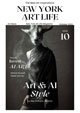


New York Art Life Magazine sits down with Chayanidh Chantraprapawat, also known as Fortune Chantraprapawat, to discuss her journey in architecture and experiential design. She brings a fresh perspective to the bustling creative scene in New York. She currently serves as a Creative Designer at My Beautiful City USA. The creative agency has worked with a roster of global luxury and cultural icons, including Jacquemus, Victoria Beckham Beauty, Nike, and Reformation. The agency crafts immersive environments that captivate attendees and garner extensive press coverage across top-tier media outlets like Vogue, Business of Fashion, and The New York Times.
Before dominating the experiential design space, she honed her technical skills as a designer at NITAPROW, an award-winning firm in Bangkok, where she produced detailed construction designs and created visualizations for residential projects. She also contributed her analytical and graphic design skills as a Research Intern at the Thailand Development Research Institute. She also trained at Architects 49 Limited, Thailand’s leading international architectural design firm, which provided her with a firm grasp of material reality, project coordination, and spatial logic. These core competencies now anchor her ephemeral fashion sets in tangible, structural reality.
Prior to joining My Beautiful City, she had an extensive background in independent work across fashion and live performance. She successfully coordinated production design for the Onsirin runway at New York Fashion Week. She was also a part of the production team for a highly acclaimed dance production at Lincoln Center. Fortune executed these independent projects before taking on her current agency role. This specific timeline allowed her to develop a robust independent portfolio before dedicating her full creative energy to agency collaboration. She now focuses entirely on her role within the agency ecosystem. She continuously pushes the boundaries of how audiences interact with physical spaces.
Fortune Chantraprapawat holds a Master of Science in Advanced Architectural Design from Columbia University. Fortune was shortlisted as one of the top 30 finalists from over 5000 competitors in the Global Design Graduate Show, in collaboration with Gucci. She achieved this impressive honor by designing a brilliant speculative project addressing waste-free futures for the postal service. We are absolutely thrilled to explore her creative process, her architectural roots, and her ambitious vision for the future of experiential design.
New York Art Life Magazine: Welcome to New York Art Life Magazine. We are delighted to feature your story. How did your early experiences in Bangkok shape your approach to architecture and design?
Fortune Chantraprapawat: Thank you for having me. Growing up in Bangkok profoundly influenced my creative vision. The city presents incredible visual contrasts everywhere you look. Ancient temples exist right next to ultramodern skyscrapers. This stark juxtaposition taught me to appreciate multiple layers of history and modernity within a single space. I learned to observe how people naturally navigate highly complex urban environments.
While studying for my undergraduate degree at Chulalongkorn University, I learned that a building must serve its community and inspire those who interact with it. Bangkok instilled a vibrant, chaotic energy in me. I channel that exact energy into every spatial concept I develop today. The streets of my hometown taught me that true architecture involves emotion just as much as it involves technicality.
New York Art Life Magazine: You transitioned from traditional architecture to experiential and set design. What sparked this specific shift in your career trajectory?
Fortune Chantraprapawat: Traditional architecture creates permanent structures meant to last for decades or even centuries. I love buildings that stand the test of time, but I was also drawn to the immediate emotional impact of temporary spaces — there’s something fascinating about creating something that shines for a single night or a weekend, and then lives on only in people’s memories. I took short courses at Central Saint Martins in art direction and set design. Those courses opened my eyes to the world of narrative environments. I realized I could apply my strict architectural training to the fast-moving world of events and fashion. Experiential design allows me to tell a complete story in a single night. I can manipulate sound, lighting, and spatial flow to evoke a specific feeling from the guests. The temporary nature of these events grants me a unique kind of creative freedom.
New York Art Life Magazine: You earned a shortlist nomination for the Global Design Graduate Show in collaboration with Gucci. Can you tell us about your speculative project on waste-free futures?
Fortune Chantraprapawat: I completed that project during my graduate studies at Columbia University. I focused on the excessive carbon emissions generated by transporting paper waste. The project speculated on ways in which new programs could expand the United States Postal Service and transform its mission to reduce emissions, in response to the current policy of the USPS.
By proposing waste collection and distribution systems and incorporating recycling and packaging programs in correspondence to the current Post Office Network System. The project hopes to transform the USPS services and role for the zip code, as well as for City, State, and Federal programs, possessing a new architecture in every sense of the term.
New York Art Life Magazine: Before joining your current agency, you worked independently as a freelance production designer. Tell us about coordinating the Onsirin runway at New York Fashion Week.
Fortune Chantraprapawat: Designing for a runway requires absolute precision and perfect timing. The audience’s focus must remain entirely on the garments. My job involved creating a dynamic environment that enhanced the clothing collection without overpowering the fashion itself. I collaborated closely with the venue’s production team and the fashion design team at Onsirin to ensure every technical element synchronized perfectly. A runway show operates exactly like a highly choreographed theatrical performance. I applied my architectural knowledge to ensure that the visuals, lighting, and sound could support the models’ rapid movement safely and beautifully.
New York Art Life Magazine: Your previous freelance work also extended to cultural performances at Lincoln Center. How does working with professional dancers differ from designing for fashion models?
Fortune Chantraprapawat: Working alongside professional dancers gave me a much deeper understanding of kinetic movement and musicality. They require specific spatial dimensions to perform safely. I worked on The Fabulous Waack Dancers show as part of the Summer in the City program at Lincoln Center. We also performed this as a showcase for The Bessies Award. The Dance Enthusiasts published a wonderful review praising the show.
The visuals in the performance must perfectly complement the music and movement. I spent a massive amount of time attending rehearsals with the dancers. I needed to anticipate their spatial needs and ensure their absolute safety on stage. Designing for dancers forces you to think about space as a living, breathing partner in the performance.
New York Art Life Magazine: Let us revisit your architectural roots in Thailand. What valuable lessons did you learn during your time as a designer at NITAPROW?
Fortune Chantraprapawat: My time at NITAPROW fundamentally strengthened my abilities to translate abstract ideas into physical spaces. I worked primarily on residential projects, and I produced highly detailed construction documents and floor plans. I created three-dimensional models and renders to communicate the design intent to our clients clearly.
This specific role demanded extreme patience and a razor-sharp eye for minute details. I also learned how to communicate effectively with construction contractors and material suppliers. This practical experience remains invaluable to me now in experiential design.
New York Art Life Magazine: You also trained at Architects 49 Limited. How did working at such a major architectural firm shape your professional work ethic?
Fortune Chantraprapawat: Architects 49 operates as one of the most prominent architectural firms in Thailand. The office environment felt incredibly fast-paced and highly professional. I coordinated daily with various office teams. I participated in various phases of the design process, moving from early conceptualization through final construction. The sheer scale of their projects taught me the absolute importance of clear, concise communication within a large creative team.
I was a part of the team that was responsible for creating advanced visualizations for a major national competition entry. My time at Architects 49 taught me to be a valuable, reliable team player under immense pressure. I learned how to manage my time effectively and deliver high-quality work on strict deadlines. Those foundational professional skills help me navigate the fast-paced environment of being in a global creative agency.
New York Art Life Magazine: You spent time as a Research Intern at the Thailand Development Research Institute. How does data collection influence your creative design process today?
Fortune Chantraprapawat: My time at TDRI taught me how to ask the right questions and gather relevant information. I supported the research team with data collection and designed comprehensive research booklets. I learned how to present complex information visually through layouts and illustrations, and I approach spatial design with the same analytical mindset, and I do a lot of research on the clients and concepts before I even begin sketching. Data informs my creative intuition. If I know exactly what their primary objectives are, I can come up with ideas that optimize their experience. I track the success of past events to improve my future designs. I believe the best spatial narratives are grounded in solid research
New York Art Life Magazine: You now serve as a Creative Designer at My Beautiful City. How do you approach your role within the agency while respecting the collaborative process?
Fortune Chantraprapawat: I approach my agency role with deep respect for the entire collaborative process. Every single person in the agency plays a crucial role. As a Creative Designer, I support the design team and creative director by developing experiential concepts and working on each project from the conceptualization stage to execution.
I feel honored to contribute my technical expertise and creative ideation to such a prestigious group of professionals. The agency environment fosters incredible growth through shared knowledge.
New York Art Life Magazine: New York City presents a highly competitive environment. How do you draw inspiration from the city itself to fuel your professional output?
Fortune Chantraprapawat: Walking down the street in New York City provides a constant source of inspiration. I constantly observe the diverse architectural styles clashing and blending across different neighborhoods. The sheer density of the city forces architects and designers to innovate constantly. The diverse cultures and communities of artists, designers, and dancers in the city motivate me. I feel so grateful for being able to surround myself with incredibly talented people every single day. Seeing the brilliant work produced by my peers pushes me to refine my own craft. I absorb the relentless energy of New York and try to channel it into my practice.
New York Art Life Magazine: Your background includes studying at Central Saint Martins. How did studying in London expand your creative vocabulary?
Fortune Chantraprapawat: The short courses at Central Saint Martins exposed me to a completely different approach to design. Traditional architecture focuses heavily on permanence and rigid structure. The courses in London focused entirely on narrative emotion and temporary illusion. That experience fundamentally changed my career trajectory. It perfectly bridged the gap between my architectural training in Bangkok and the emotional storytelling required in experiential design.
New York Art Life Magazine: Sustainability becomes increasingly important every year. How do you envision the future of sustainable practices within the experiential design industry?
Fortune Chantraprapawat: The experiential design industry historically produces a significant amount of material waste. I feel a deep professional responsibility to help change this reality. I want to see the industry adopt biodegradable materials and prioritize local sourcing. And I believe designers should think beyond the event itself and consider how materials can be reused or repurposed to extend their life beyond a single installation. This requires intentional planning, including how each element will be dismantled and recycled after the build. A beautiful event should leave a lasting emotional impression, not a lasting environmental scar.
New York Art Life Magazine: Artificial intelligence rapidly changes the design landscape. How do you see these emerging tools integrating into your future workflow?
Fortune Chantraprapawat: I view artificial intelligence as an incredibly powerful collaborative tool. I do not fear technology replacing human intuition. I see it enhancing our capabilities. Machine learning algorithms can generate thousands of spatial variations in seconds. However, the human designer must always curate the final output. The algorithm cannot feel emotion. It cannot understand why a specific texture evokes nostalgia or comfort.
New York Art Life Magazine: What advice would you give to young architects who want to transition into experiential and production design?
Fortune Chantraprapawat: From my own experience, staying curious beyond architecture has shaped everything — immersing myself in art, dance, music, fashion, performance, and theatre has taught me more about space and storytelling than I expected. Collaborating with people who think differently from me has pushed my work in directions I wouldn’t have found alone. And at the core of it all, I always come back to the same thing — every space should welcome and embrace the people who inhabit it. For me, that’s what design is about: serving and creating community.
We thank Fortune Chantraprapawat for sharing her brilliant insights with New York Art Life Magazine. Her incredible journey from the vibrant streets of Bangkok to the glamorous event spaces of New York City inspires us all. She proves that a strong technical foundation can beautifully support the most ethereal and artistic visions. Her dedicated work continues to elevate the professional standard for experiential design across the entire industry.
She transforms ordinary rooms into unforgettable immersive landscapes. We eagerly anticipate her future projects and the innovative new ways she will challenge our perception of physical space. Her unwavering dedication to blending architectural rigor with narrative emotion makes her a true visionary in her chosen field. Readers can follow her ongoing success and look out for her upcoming spatial masterpieces. She will undoubtedly continue to shape the way brands and audiences interact for many years to come.
