

Subheadline: From Anthony McCall’s pioneering “solid light” installations to geometric public sculptures and immersive environments across New York, light is increasingly being experienced as something physical, spatial and architectural.
There was a time when light in an exhibition was primarily understood as a tool: something that illuminated a painting, shaped a photograph or created atmosphere. Contemporary artists have increasingly challenged that assumption, treating light itself as material.
In New York this fall, that idea comes sharply into focus at Sean Kelly Gallery, where British-born, New York-based artist Anthony McCall presents Solid Light, 1973, 2020, 2026, an exhibition spanning more than five decades of his experiments with projected light, cinema, sculpture, drawing and sound. Running September 11 through October 31, the exhibition brings together Line Describing a Cone (1973), Skylight (2020) and the new Swarm (2026).
The exhibition provides an especially timely lens through which to consider a broader development in contemporary art: the transformation of light from something seen into something experienced physically.
When Light Takes Shape
McCall’s work is central to this conversation.
His Solid Light series, which began in the early 1970s, occupies a space between experimental film, sculpture, drawing and performance. The Whitney Museum of American Art describes the works as investigations into projection, light, darkness and duration that require viewers to encounter the work phenomenologically rather than simply observe it.
The breakthrough came with Line Describing a Cone, created in 1973.
Projected into a haze-filled room, a slowly evolving line eventually forms a three-dimensional cone of light. The viewer is able to move around and through the illuminated volume, making the human body part of the visual experience.
The distinction is important.
The work does not merely depict a geometric form. It produces one through light, time and space.
The cone has no conventional solid material. Yet, within the darkened gallery, it occupies space with an almost architectural presence.
Geometry You Can Walk Through
This is where immersive geometry becomes particularly compelling.
A projected triangle, cone, plane or curve can behave differently from geometry on a canvas or screen. It surrounds the viewer rather than remaining at a distance.
McCall’s installations make that relationship central. As visitors move, their bodies interrupt the projected forms. The work therefore changes according to both time and position.
In Skylight, a vertical axis of light descends toward a plinth, creating another volumetric form that viewers can approach. The installation incorporates a soundtrack by composer and guitarist David Grubbs, adding sound to the relationship between light and space.
The effect is closer to entering a drawing than looking at one.
A New “Swarm”
The newest work in Sean Kelly’s exhibition, Swarm (2026), brings the artist’s decades-long investigation into a contemporary technological context.
The work uses two rotating conical volumes of light accompanied by another Grubbs soundscape. The movement introduces an increasingly dynamic spatial experience and references the presence of drones—technology that can be associated with recreation as well as warfare.
Placed alongside McCall’s 1973 work, Swarm creates an unusual historical conversation.
The technology has changed dramatically. The fundamental artistic question has not: Can something immaterial occupy space as convincingly as sculpture?
From Light Sculpture to Geodesic Form
New York’s interest in geometric light is not limited to gallery interiors.
In Manhattan’s Meatpacking District, artist Leo Villareal’s BUCKYBALL has provided a large-scale public example. Presented from June 10 through September 28, 2026, the 18-foot illuminated sculpture uses a network of hexagons and pentagons to form concentric geodesic spheres inspired by the structure of Buckminsterfullerene and the geodesic architecture associated with Buckminster Fuller.
The sculpture combines physical geometry with programmable LED light.
That combination changes the way the structure operates after dark. The geometry is not simply an outline; light becomes an active component of its identity.
Placed within the urban landscape, BUCKYBALL also demonstrates how immersive principles can operate without enclosing the viewer inside a gallery.
The city itself becomes the environment.
Immersion Through Reflection and Movement
Elsewhere in New York, immersive design is increasingly incorporating geometry, reflection and responsive technology.
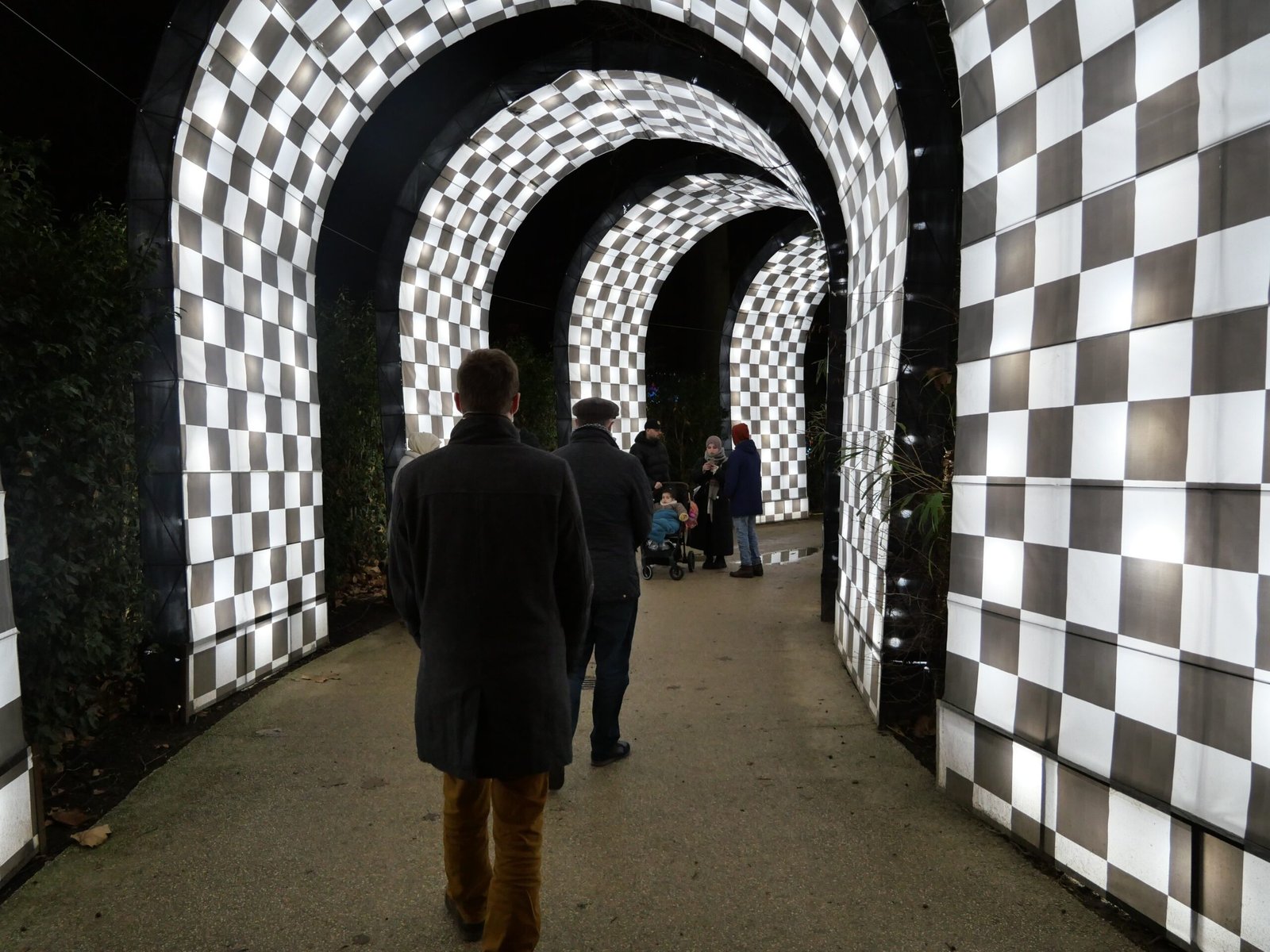
At Edge NYC in Hudson Yards, a major 2026 transformation introduced seven indoor immersive environments inspired by New York City’s light, sound and energy. The installations include Reflections, featuring interactive mirrored panels; Infinite City, composed of mirrored and translucent light pillars inspired by skyscrapers; Crystal Cave, built around dichroic crystal forms; and Kaleidoscope, which surrounds visitors with changing reflections and patterns.
These experiences operate differently from McCall’s work, but they share a fundamental principle: space is no longer merely where the artwork happens. Space is part of what the artwork is.
Mirrors multiply bodies. Light defines boundaries. Movement changes perception.
The visitor becomes an active variable within the geometry.
The Architecture of Perception
What connects these seemingly different projects is their interest in perception.
Immersive art does not necessarily require massive digital screens or complicated technology. McCall’s work demonstrates that a projector, darkness and carefully controlled atmospheric conditions can be enough to transform a room.
The resulting geometry exists only through an interaction between light, space, time and the viewer.
That makes the experience fundamentally different from viewing an object behind glass.
The audience does not simply stand outside the work.
The audience enters it.
Why “Solid Light” Matters Now
In an era dominated by screens, virtual environments and increasingly sophisticated digital imagery, McCall’s work offers an intriguing counterpoint.
His installations make something that normally feels intangible appear physically present.
At Sean Kelly Gallery, Solid Light, 1973, 2020, 2026 demonstrates how an idea developed more than half a century ago can still feel relevant to contemporary discussions around immersive art.
Meanwhile, projects such as BUCKYBALL and the immersive environments at Edge NYC show how geometry, light and responsive technologies are moving into public and experiential spaces.
Together, they point toward a changing understanding of sculpture.
Sculpture does not always need weight.
Architecture does not always need walls.
And light does not always need to remain intangible.
In the most compelling immersive environments, light becomes volume, geometry becomes atmosphere, and the viewer becomes part of the composition.
