

Filmmaking, where every visual element contributes to the narrative, the roles of the Cinematographer, Gaffer, and AC (Focus Puller) are paramount. These are the artists and technicians who sculpt with light and shadow, capturing the ephemeral moments that define cinematic storytelling. The versatile Olivier Metzler exhibits masterful expertise in these disciplines. Based in the vibrant creative hub of Brooklyn, New York, Metzler has carved a path, lending his expertise to an astonishing array of projects, from evocative narrative shorts and impactful documentaries to high-stakes corporate campaigns and recognized television series. His work, characterized by understanding aesthetic nuance and technical mastery, consistently elevates the visual language of each production he touches.
NYAL Magazine is privileged to sit down with Metzler, a craftsman whose expertise as a sought-after Cinematographer, indispensable Gaffer, and skilled Focus Puller provides a unique and holistic perspective on the filmmaking process. His cinematography credits reveal an eye for storytelling, evident in projects like the critically acclaimed “River,” an official selection at numerous prestigious film festivals including Outfest Fusion, as well as his operating work on “Legion 44,” which is playing in select, major movie theaters across the world; and simultaneously his corporate cinematography wok for iconic brands such as Chanel, Swarovski, and Guess demonstrates an ability to translate brand identity into compelling, polished visuals.
As Gaffer, Metzler’s contributions are equally significant, illuminating sets for major productions including the Hulu docuseries “Thank You, Goodnight: The Bon Jovi Story,” and a multitude of dynamic campaigns for the fashion giant Aritzia. His gaffing work extends to striking commercials for Vogue, Tiffany & Co., and even a spot for the Tony-nominated Broadway revival of “Romeo + Juliet.” This extensive experience across diverse formats and scales underscores a profound understanding of light’s power to shape mood, define character, and drive narrative.
In this exclusive interview, Olivier Metzler shares insights gleaned from his multifaceted career. We delve into his journey into the world of film, the symbiotic relationship between his roles as Cinematographer and Gaffer, and his approach to crafting distinct visual identities for projects ranging from independent cinema to global brand campaigns. He discusses the specific challenges and rewards of notable works, the importance of collaboration, and his perspective on the evolving technological
landscape of filmmaking. Join us as we explore the vision and technique of a professional who truly understands how to make every frame count.
NYAL Magazine (Raya Tosca): Olivier, thank you for taking the time to speak with NYAL Magazine today. Your body of work is impressively diverse, spanning cinematography and gaffing across narrative films, high-profile corporate campaigns, documentaries, and even major television series. It’s a pleasure to have you.
Olivier Metzler: Thank you for having me, Eleanor. It’s an honor to be featured in NYAL Magazine. I appreciate the opportunity to discuss my work.
NYAL Magazine: Let’s start at the beginning. What drew you to the world of filmmaking, and specifically to the art and science of lighting and cinematography? And how has basing yourself in Brooklyn influenced your career?
Olivier Metzler: The allure of filmmaking, for me, was always rooted in its power to evoke emotion and tell stories in a way no other medium can. I was captivated by how light and shadow could fundamentally alter the mood of a scene, how a specific camera movement could reveal character, or how composition could guide the audience’s eye. Initially, I was just fascinated by the magic of cinema, but as I learned more, that fascination turned into a passion for understanding the craft behind it. I started experimenting with cameras, learning about lenses, and, most importantly, discovering the profound impact of lighting. Light isn’t just about exposure; it’s about sculpting, revealing, and concealing. It’s a language.
Brooklyn and New York City are at large, an unparalleled environment for a filmmaker. There’s an incredible energy here, a constant influx of diverse stories waiting to be told, and a vast community of talented artists and technicians. The city itself is a constantly evolving character, offering endless visual inspiration. Being in Brooklyn provides access to a wide range of projects, from independent narratives to large-scale commercial productions. It’s a competitive environment, certainly, but also incredibly stimulating and collaborative. It encourages you to learn and refine your skills continually.
NYAL Magazine: You navigate seamlessly between roles – Cinematographer, Gaffer, and you also have experience as an AC. How do these different perspectives inform one another in your approach to a project?
Olivier Metzler: They are intrinsically linked, and experience in one role profoundly enriches my understanding and execution in others. As an AC, you develop an intimate knowledge of the camera system, lenses, and on-set workflow – precision and preparedness are paramount. This foundation is invaluable as a Cinematographer, where you’re making broader creative decisions but still need to understand the technical feasibility and implications.
When I’m working as a Cinematographer, my gaffing experience allows me to communicate my lighting vision with greater clarity and efficiency to the lighting team. I understand the tools, the time it takes to set up specific rigs, and the nuances of how different fixtures will render on camera. It fosters a more collaborative and informed dialogue with my Gaffer.
Conversely, when I’m the Gaffer, my cinematography experience helps me anticipate the Director of Photography’s needs. I can better understand their aesthetic goals, the mood they’re trying to achieve, and how lighting will interact with their chosen camera and lenses. It’s about more than just placing lights; it’s about understanding the ‘why’ behind the DP’s requests and contributing solutions that enhance their vision. Ultimately, all these roles are about serving the story and collaborating effectively to bring a director’s vision to life. Each role gives you a different piece of the puzzle, and having a grasp of multiple pieces makes you a more holistic and effective filmmaker.
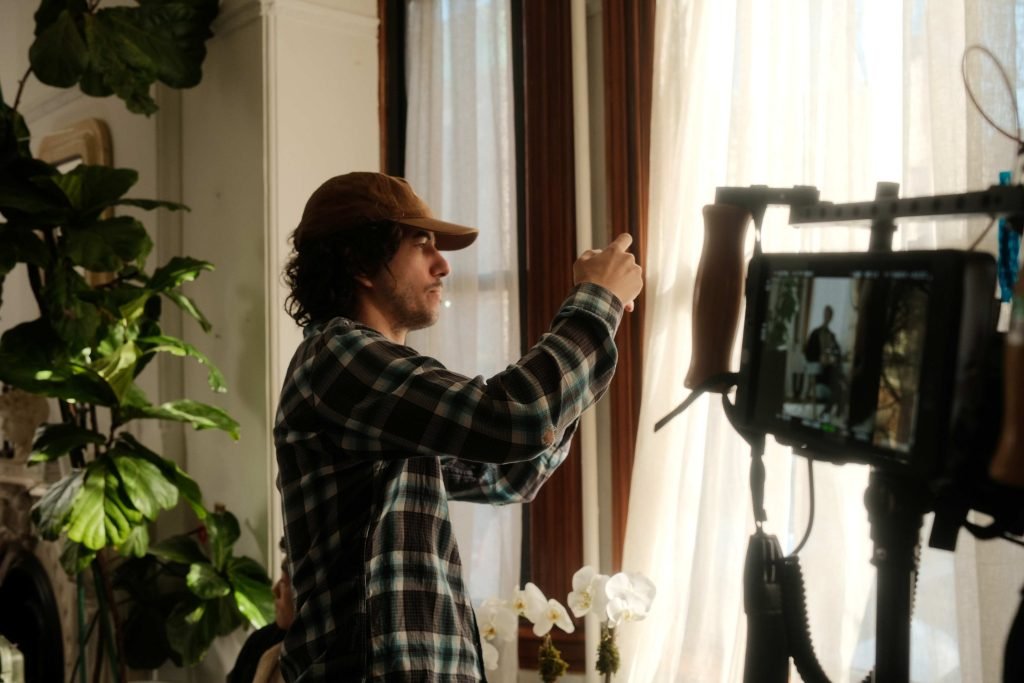
NYAL Magazine: Your work on the documentary “Smoot” (dir. Travae Davis) and the narrative film “River” (dir. Joshua Hernandez) also stands out. “River” had an impressive festival run, including Outfest Fusion QTBIPOC Film Festival. What were the distinct visual challenges and rewards of these projects?
Olivier Metzler: “Smoot” was a documentary, so the approach was about capturing reality authentically while still crafting compelling visuals. With documentaries, you often have to be adaptable, working with available light or augmenting it subtly to maintain a sense of naturalism. The reward comes from helping to tell a true story and shedding light on important subjects.
“River,” directed by Joshua Hernandez, was a narrative piece with a strong voice and an important story within the QTBIPOC community. Its selection at festivals like Outfest Fusion, Gasparilla, and the Philadelphia Latino Film Festival was a testament to the team’s hard work and the film’s resonance. For “River,” the cinematography aimed to support the emotional journey of the characters. We focused on creating a visual language that felt intimate and true to their experiences. Lighting was designed to enhance the mood of each scene, whether it was vulnerability, tension, or joy. Seeing “River” connected with audiences at these festivals was incredibly rewarding. It underscores the power of independent films to give voice to diverse perspectives.
NYAL Magazine: You’ve also done significant corporate cinematography, including “Guess Bottle & Perfumer,” “Chanel Spring25,” “Interparfums x Ferragamo,” and the “Swarovski Speaker Series.” How does cinematography for high-end brands differ from narrative work?
Olivier Metzler: Corporate cinematography, especially for luxury brands like Guess, Chanel, Swarovski, and Interparfums, demands a very high level of polish and precision. The primary goal is to represent the brand’s identity and showcase the product in the most aspirational and aesthetically pleasing way possible. While narrative work is about serving the story’s emotional arc, corporate work is often about creating an immediate visual impact that aligns with established brand aesthetics.
With projects like the “Swarovski Speaker Series,” it was a live event, which brings its own set of challenges and excitement. You need to ensure beautiful coverage of the speakers, while also capturing the ambiance and the brilliance of the Swarovski crystals. For product-focused shoots like “Guess Bottle & Perfumer” or the Chanel and Interparfums projects, it’s about meticulous lighting to highlight textures, forms, and the luxurious quality of the products. Every reflection, every shadow is considered. There’s often less room for gritty realism and more emphasis on elegance, clarity, and sophistication. The collaboration with the director and the creative team from the brand is very tight, ensuring the visuals perfectly encapsulate their message.
NYAL Magazine: Your experience as an operator on the feature documentary “Legion 44” sounds extensive, involving significant international travel and challenging shooting conditions. Could you elaborate on the operational scope of this project and some of the notable environmental or logistical challenges you faced while capturing footage for this climate-focused film?
NYAL Magazine: My role as camera operator on “Legion 44”, a documentary directed by the acclaimed Lailla Conners, was quite an undertaking. The film explores innovative carbon dioxide removal (CDR) technologies and the visionaries behind them, which necessitated a global production schedule.
We traveled and shot on location from Iceland to the UK, Oman to France, Germany to Liechtenstein, Switzerland, and several regions on the West and East Coasts of the United States. Operationally, this involved recording interviews with a wide range of subjects, including researchers, entrepreneurs, and business owners on the front lines of the CDR industry in each of these locations. One of the main challenges was adapting to the vastly different and often extreme environmental conditions. The harsh and unpredictable climate of the Icelandic tundra is characterized by strong winds and intermittent rain. Filming in the Omani desert in stifling heat. Managing the logistics of equipment across multiple countries and ensuring consistent, high-quality footage despite these environmental variables presents operational challenges. The documentary is currently playing in select major theaters around the world, following its world premiere at AMC Empire 25 during NYC Climate Week 2024 and the United Nations General Assembly, a testament to the dedication that went into its production.
NYAL Magazine: Shifting to your extensive Gaffer work, it’s quite a list, and remarkably current. You’ve worked on everything from the narrative short “Pulpitum,” now on its 2025 festival tour, to massive commercial campaigns for Aritzia, and the critically acclaimed Hulu series “Thank You, Goodnight: The Bon Jovi Story.” How do you approach gaffing on such varied productions?
Olivier Metzler: The fundamental goal of gaffing is always the same: to execute the Director of Photography’s vision for lighting, safely and efficiently. However, the scale, pace, and specific creative demands vary wildly.
For a narrative short like “Pulpitum” (dir. Caleb Reese Paul), which is doing well on the festival circuit, the collaboration with the DP is often very intimate. Resources might be tighter, so creativity in achieving the desired look with the available tools is key. It’s about meticulous planning and making every lighting decision count towards the story.
Then you have large-scale commercial campaigns, like the numerous Aritzia shoots – the Spring25 Valentine’s Day, Sweatfleece, Winter24 Photo Booth, Winter 24 Holiday, Wilfred, Tailored Outerwear, Bronze, Fall24 TNA, and Babaton. Working with Aritzia is always dynamic. They have a very strong brand aesthetic – clean, modern, and often quite sophisticated. The pace on commercial sets is typically fast, and you need to be able to deliver high-quality lighting setups quickly and adapt to changes on the fly. It often involves creating flattering beauty light and ensuring the clothing looks its best. The sheer volume of content, especially with assets for TikTok and Instagram, means we’re often thinking about how the lighting translates across different platforms.
NYAL Magazine: The Bon Jovi documentary series for Hulu, “Thank You, Goodnight,” must have been a significant undertaking. What was your role as Gaffer on a project of that magnitude, which blends archival footage with contemporary interviews?
Olivier Metzler: Working on “Thank You, Goodnight: The Bon Jovi Story” was a fantastic experience. For a series like this, the interview setups are crucial. You’re dealing with iconic figures, and the lighting needs to be professional, flattering, and consistent with the overall tone of the documentary. My role involved working closely with the Director of Photography to design and implement lighting for the interview segments. This often means creating a look that feels both cinematic and intimate, allowing the subjects to be comfortable while ensuring they are captured beautifully. Given the archival nature of much of the series, the contemporary interviews needed to have a premium quality that stood up alongside the band’s incredible history. It’s about crafting an environment where these personal stories can unfold, and the lighting plays a supportive, yet impactful role in that. The positive reception from outlets like Rolling Stone, The Guardian, and Billboard was great to see.
NYAL Magazine: You’ve also gaffed for other major brands and diverse projects: “WSJ SNL 50th Anniversary” online series, the “Not My Problem x Laila!” music video which garnered significant media attention, commercials for Asics X Bodega, Reebok, Vogue x Ebay for the MET Gala, and even the Broadway commercial spot for “Romeo + Juliet,” which is now a Tony nominee. That’s an incredible range.
Olivier Metzler: It certainly keeps things interesting! Each project brings unique challenges. The “WSJ SNL 50th Anniversary” series (dir. Andrea Oliveri) involved lighting interviews with comedy legends like Keenan Thompson and Heidi Gardner. The key there was creating a comfortable yet professional atmosphere for engaging conversations.
The “Not My Problem x Laila!” music video (dir. Otmara Marrero) was a lot of fun, aiming for a vibrant, retro, ’80s aesthetic. Music videos often allow for more stylized and expressive lighting. Seeing it get coverage on Billboard, Vibe, and Complex was a great nod to the team’s creative vision.
Commercials like Asics X Bodega “Winning Streak” (dir. Michael B. Janey) or Reebok “Get On Track” (dir. Hannah Bundy) are about dynamic, energetic lighting that complements the athletic nature of the brands. The Vogue x Ebay MET Gala commercial (dir. Jordana Koffsky) was all about capturing high fashion and glamour, often under tight timelines around a major event.
Gaffing the commercial for the Broadway production of “Romeo + Juliet” (dir. Sam Gold) was a unique experience, translating the theatricality and drama of the stage into a
compelling cinematic promotion. Its Tony nomination for Best Revival is fantastic, and it’s rewarding to contribute, even in a small way, to a production of that caliber.
NYAL Magazine: With so many varied projects, can you speak to the importance of building ongoing relationships with directors and production companies?
Olivier Metzler: Building long-term relationships is incredibly important in this industry. When you work with the same directors, or production companies like Definite Films or the in-house team at Aritzia, you develop a shorthand. There’s a mutual understanding of aesthetic preferences, working styles, and expectations. This trust and familiarity allow for a more efficient and creatively fulfilling process. You can anticipate needs, suggest ideas more freely, and collectively push the boundaries of what you can achieve. These repeat collaborations are a testament to consistent quality and good teamwork, which I always strive for.
NYAL Magazine: Looking at your recent work, there’s a strong emphasis on commercial and corporate content, but also narrative and documentary. How do you balance the artistic aspirations with the commercial demands?
Olivier Metzler: I find that each type of project feeds the other. Commercial work hones your technical skills, your ability to work efficiently under pressure, and your understanding of how to create highly polished images that serve a specific communication goal. These are invaluable skills. The resources and access to cutting- edge equipment in commercial productions often allow for experimentation that can then be applied creatively to narrative or documentary projects where budgets might be more constrained.
Conversely, narrative and documentary work deeply exercise the storytelling muscles. They push you to think about how visuals serve emotion, character development, and thematic depth. This storytelling sensibility is surprisingly beneficial in commercial work too. Even a 30-second spot or a corporate piece is trying to tell a micro-story or evoke a particular feeling. The ability to think narratively helps create more engaging and impactful commercial content.
The balance comes from appreciating what each type of work offers. Commercial projects provide stability and the opportunity to work with incredible teams and gear, while independent narratives and documentaries offer a different kind of creative freedom and the chance to explore more personal or unconventional stories. For me, it’s not about choosing one over the other, but rather about embracing the diversity of challenges and learning the opportunities that each presents. Both require a high level of artistry and craftsmanship.
NYAL Magazine: You mentioned creative freedom. How does that differ between, say, a narrative short like “River” and a global campaign for L’Oréal or Chanel?
Olivier Metzler: The nature of creative freedom is definitely different. With a narrative short like “River,” the creative freedom often lies in the conceptual stage and the interpretation of the script. As a cinematographer, you’re collaborating closely with the director to build a visual world from the ground up. You might experiment more with mood, texture, and unconventional camera work to serve the specific story and emotional arc. The constraints are often budgetary or logistical, but the creative vision can be quite singular.
For a global campaign like L’Oréal or Guess, the “brand” itself is a central character with an established identity and visual language. The creative freedom here is more about innovating within those established parameters. How can you bring a fresh perspective while remaining true to the brand’s core? How can you make the product look even more appealing, the talent even more radiant, within a very specific aesthetic framework? The execution needs to be flawless, and the collaboration involves more stakeholders – the director, the agency, and the client. While the sandbox might be more defined, the challenge of creating something beautiful and practical within it is immensely rewarding. There’s a different kind of precision and artistry involved in achieving that level of polish.
NYAL Magazine: The pace of technological advancement in filmmaking is relentless. How do you stay up to date with the latest cameras, lighting technologies, and software? Are there any advancements that you find especially exciting or transformative for your work?
Olivier Metzler: Staying current is an ongoing commitment. It involves a lot of reading industry publications, attending workshops and trade shows when possible, and, most importantly, networking and discussing new tech with peers – fellow DPs, gaffers, ACs, and rental house technicians. Hands-on experience is, of course, the best way to learn.
LED lighting technology has been a complete game-changer, especially in my work as both a Gaffer and a Cinematographer. The level of control over color temperature, hue, saturation, and intensity, often wirelessly, allows for incredible creative flexibility and speed on set. Fixtures are becoming more lightweight, more powerful, and more versatile. This means we can create complex lighting environments more efficiently and with greater precision than ever before. Innovations in full-spectrum LEDs are also leading to better color rendition in LED emitters, which is crucial for capturing accurate skin tones and product colors.
On the camera side, the advancements in sensor technology, dynamic range, and resolution continue to push boundaries. Higher sensitivity in low light offers more creative options, and the improved latitude provides greater flexibility in post-production. The integration of more sophisticated internal recording formats and Log profiles also streamlines workflows.
NYAL Magazine: Looking ahead, what are your aspirations? Are there particular types of projects, genres, or collaborations you’re eager to pursue, especially as a Cinematographer?
Olivier Metzler: I’m always eager to continue growing and challenging myself. As a Cinematographer, I’m keen to take on more feature-length narrative projects. I enjoy the deep dive into character and story that a longer format allows. I’m particularly drawn to dramas, psychological thrillers, and visually driven art-house films where cinematography can play a central role in the storytelling. I’m also interested in exploring more stylized documentaries that push the boundaries of the form. Collaboration is at the heart of filmmaking, so I’m always looking to connect with visionary directors who have unique stories to tell and a strong artistic perspective. I believe the best work comes from a true partnership between the director and the DP.
While I deeply enjoy my gaffing work and will continue to pursue compelling projects in that capacity, my long-term focus is to increasingly helm projects as Director of Photography. Each role informs the other, but the holistic visual authorship of cinematography is where my ultimate passion lies. I’d love to shoot more international co-productions as well, to experience different filmmaking cultures and visual landscapes.
NYAL Magazine: Olivier, this has been an incredibly insightful conversation. Your dedication to both the art and craft of visual storytelling is evident in your diverse and accomplished body of work. Thank you so much for sharing your experiences and perspectives with NYAL Magazine. We wish you continued success in all your future endeavors.
Olivier Metzler: Thank you, Raya. It’s been a real pleasure speaking with you and sharing my journey. I appreciate NYAL Magazine taking the time to highlight the work that goes on behind the camera. I look forward to what’s next.
Links
Read Also:
Hằng Nguyễn, Versatile And Dedicated Cinematographer
Top 7 NYC Art Gallery Types That Are Best for Emerging Artists
