

At Sundaram Tagore Gallery in Chelsea, Miya Ando transforms thousands of Japanese rain words into meditative fields of indigo, silver, graphite, and light.
Discover the exhibition: What does rain look like when every subtle variation of it has a name? For New York artist Miya Ando, the answer begins with attention—to language, atmosphere, memory, and the passage of time.
From October 15 through November 14, 2026, Sundaram Tagore Gallery in Chelsea presents Miya Ando: Rain Drawings, a solo exhibition of new and recent works that extends the artist’s long investigation into fleeting natural phenomena.
The exhibition develops ideas first explored in Ando’s 2025 book, Water of the Sky: A Dictionary of 2,000 Japanese Words for Rain, published by The MIT Press. That project grew from her fascination with the extraordinary specificity with which rain has been observed and named in Japanese culture. Rather than treating rain as one generalized atmospheric condition, the book recognizes a vast vocabulary for distinctions of season, intensity, sound, duration, mood, and visual appearance.
From 2,000 Words to Images
Ando’s rain project is as much about language as it is about drawing.
Over three years, the artist created nearly 2,000 drawings corresponding to the rain words she encountered. One hundred of those original works appear in the book, while the complete project exists as a monumental hand-bound volume of 2,209 pages. Only two copies were made, each covered in hand-dyed indigo linen. One of those rare volumes will be displayed as part of the Chelsea exhibition.
For Rain Drawings, Ando returns to selected terms and creates entirely new visual interpretations at a larger scale. The shift from small drawings to expansive works changes the experience: individual marks and tonal transitions become environments of atmosphere, inviting viewers to slow down rather than simply identify an image.
Her approach asks a deceptively simple question: Does giving something a name change the way we see it?
In Ando’s practice, the answer appears to be yes. Naming can sharpen perception. A word can transform an ordinary weather condition into something worthy of sustained observation.
Indigo as a Measure of Time
The material language of the exhibition is particularly important.
Ando uses natural indigo dye, graphite, pure silver powder, and occasionally sumi on handmade kōzo paper. Indigo is deeply connected to her personal history. Her family comes from Okayama, Japan, a region with a longstanding tradition of indigo dyeing, and Ando has been familiar with the material since childhood.
The dye also introduces time directly into the making process.
Once natural indigo touches the paper, the artist cannot simply erase or reverse the mark. The depth of color depends on exposure and timing, with subtle differences producing anything from pale blue to extremely dark tones. In creating gradients, Ando works in increments of seconds, carefully controlling the process to achieve transitions between light and darkness.
That makes time both subject and method.
The rain depicted in these works is temporary, but the physical act of making them is also governed by duration. Each gradient records a decision about how long the material has been allowed to act. The resulting image becomes a quiet record of elapsed time.
Looking Upward Through Rain
The exhibition’s compositions move between landscape, abstraction, and shifting points of view.
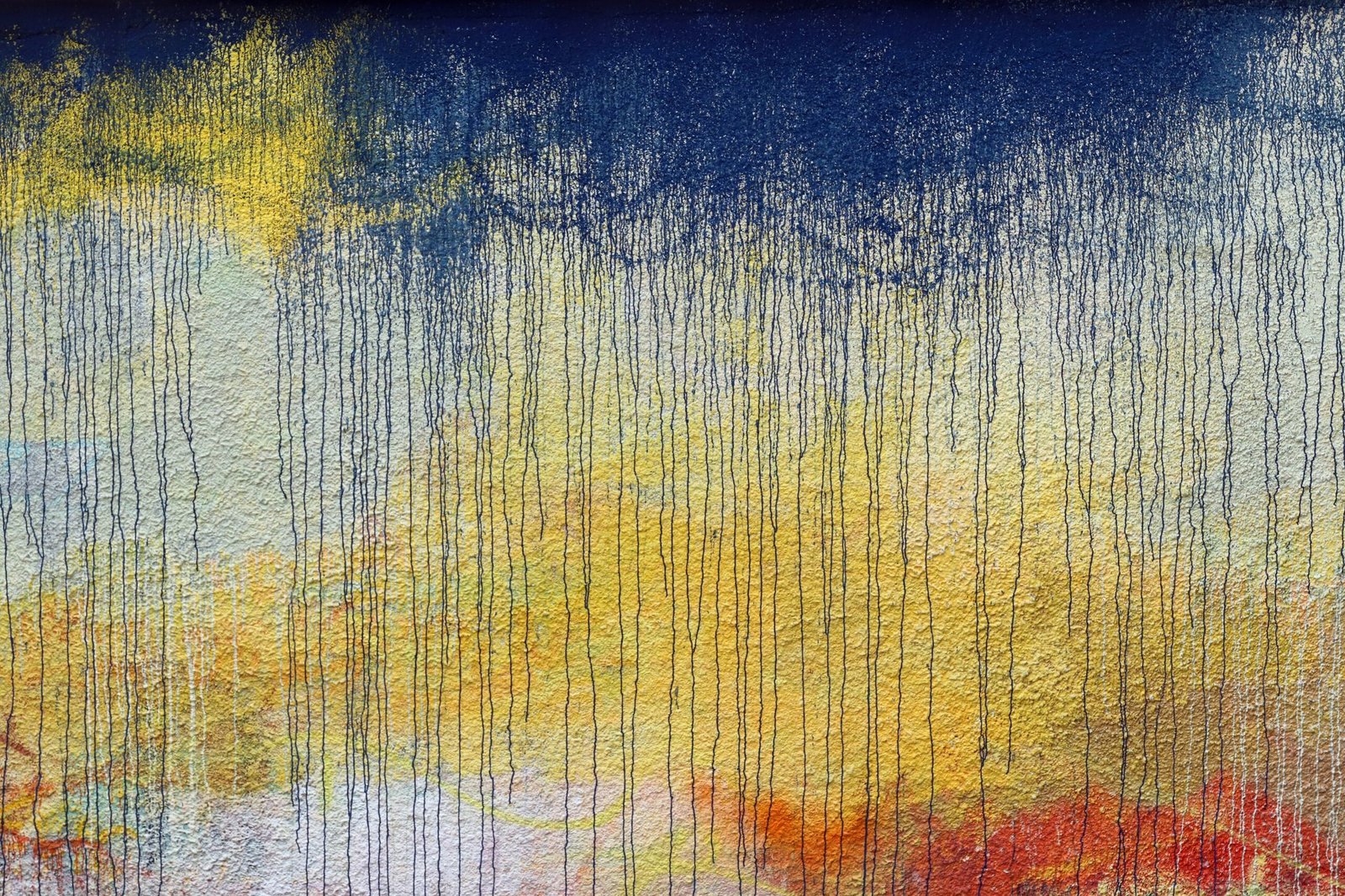
Some works suggest looking upward through rain toward a blue sky. Others evoke mist, moonlight, darkness, or distant atmospheric conditions. Rather than offering straightforward illustrations, Ando creates spaces in which weather becomes an experience of perception.
The scale reinforces that effect. Works range from approximately 39 by 39 inches to a monumental 94-by-94-inch drawing. At this size, rain and mist cease to function merely as subjects and instead become immersive fields of color, texture, and light.
Pure silver powder introduces another layer of change. Depending on the viewer’s position and the surrounding light, reflective elements can subtly alter the surface. The work therefore refuses to remain completely fixed: looking becomes part of the experience.
A New York Artist with a Global Practice
Ando, born in Los Angeles in 1973 and now based in New York, works across painting, sculpture, installation, and material-based practices. Her background includes East Asian Studies at the University of California, Berkeley, further study at Yale and Stanford, and an apprenticeship with a master metalsmith in Japan.
Her work has been exhibited at institutions including The Noguchi Museum in New York, Asia Society Texas, the Smithsonian American Art Museum, the Los Angeles County Museum of Art, and other international venues. Her work is also held in numerous museum collections.
Her engagement with rain represents a particularly concentrated expression of the concerns that have shaped her broader practice: impermanence, atmosphere, reflection, material transformation, and the relationship between human perception and the natural world.
Chelsea and the Art of Slowing Down
In the accelerated environment of contemporary Chelsea, Rain Drawings offers a distinctly slower encounter.
The exhibition does not depend on spectacle. Instead, it asks viewers to notice distinctions that might ordinarily disappear: a change in blue, the density of mist, the suggestion of rain against a distant sky, the reflective quality of silver, or the difference between one kind of rain and another.
That attentiveness is central to Ando’s larger project. Her rain dictionary began as an investigation into words, but it ultimately became an investigation into seeing.
The exhibition therefore sits at an intriguing intersection of art and language. The Japanese vocabulary surrounding rain provides the conceptual foundation, while Ando’s materials translate those distinctions into visual experience.
At Sundaram Tagore Gallery, the result is less a conventional depiction of weather than a meditation on how humans perceive fleeting things.
Rain Drawings opens on October 15, 2026, with an opening reception with the artist from 6–8 p.m. at the gallery’s Chelsea location, 542 West 26th Street. The exhibition remains on view through November 14, 2026.
