


New economic data released this week shows that the **United States of America economy grew more slowly than economists had anticipated at the end of 2025 — a sign that fiscal disruptions and policy decisions may be dampening growth as the nation heads into 2026.
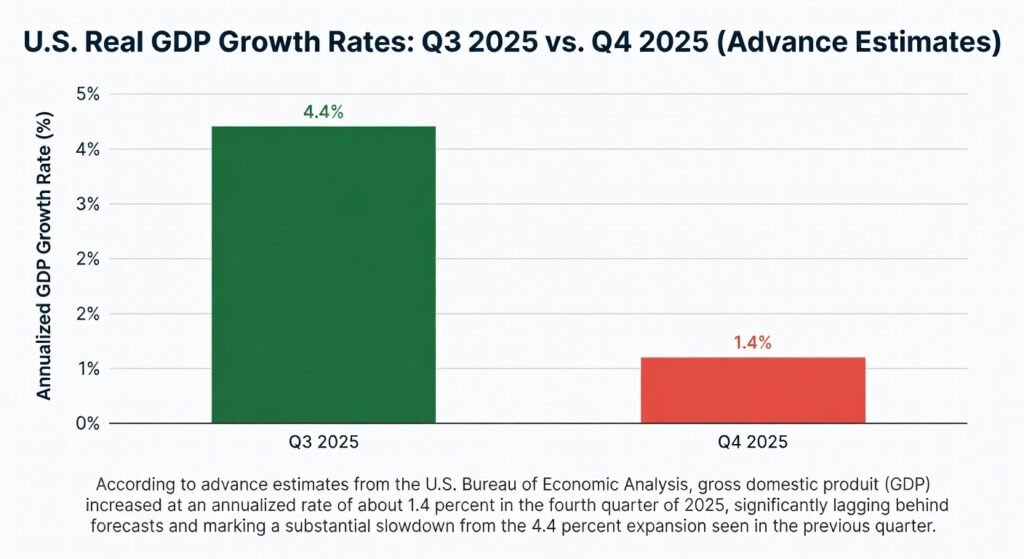
According to advance estimates from the U.S. Bureau of Economic Analysis, gross domestic product (GDP) increased at an annualized rate of about 1.4 percent in the fourth quarter of 2025, significantly lagging behind forecasts and marking a substantial slowdown from the 4.4 percent expansion seen in the previous quarter.
Economic Headwinds: Shutdown and Policy Drag Growth
Economists point to several factors behind the slowdown:
- A record-long federal government shutdown late last year is believed to have shaved off significant economic activity, as federal services and spending contracted sharply.
- Consumer spending, a major driver of overall growth, cooled in the latter part of the year.
- Broader policy uncertainty — including trade tensions and tariff debates — may have weighed on business investment and hiring decisions.
Despite these headwinds, the economy still managed modest growth for the full year, growing at a pace slower than in 2024, although the annual figure remained positive.
Economists traditionally don’t rely solely on headline GDP — they also watch employment, inflation, and spending patterns to gauge overall health. While growth slowed, inflation measures and some job data show pockets of resilience, adding nuance to the broader economic picture.
What This Means Going Into 2026
The weaker GDP reading for the last quarter of 2025 has sparked discussion about how the economy might fare in the new year:
- Some economists expect a rebound in growth later in 2026 as government spending normalises and tax cut effects take hold, potentially supporting consumer demand and investment.
- Others caution that structural challenges — including trade policy ripple effects and uneven labor market gains — could keep growth modest.
Decision-makers at the Federal Reserve will closely watch incoming economic indicators to shape interest rate and monetary policy going forward.
Why These Numbers Matter
GDP — the broadest measure of economic output — reflects how much the nation produces and consumes. Slower growth can influence financial markets, corporate investment decisions, and household confidence. For cultural sectors, including arts and entertainment industries, economic health can impact discretionary spending, tourism trends, and public funding for cultural programs.
As 2026 unfolds, economists and policymakers alike will be tracking whether the slowdown stabilises or gives way to renewed momentum — and what that means for sectors ranging from manufacturing to digital media and creative industries.
