

In MoMA’s Sculpture Garden, a constantly changing installation connects artificial intelligence, human perception, and biological processes—asking what it means to imagine a world beyond the human mind.
What does a thought look like before it becomes an image? And what happens when a machine attempts to interpret the activity of a human brain? These questions shape UUmwelt, French artist Pierre Huyghe’s immersive installation now presented in the Abby Aldrich Rockefeller Sculpture Garden at the Museum of Modern Art.
On view from July 1 through November 29, 2026, the work uses machine learning, brain-imaging data, and real-time visitor input to generate an evolving sequence of images. Presented on freestanding screens throughout the garden, UUmwelt brings the language of artificial intelligence into an outdoor setting where art, architecture, and the living environment intersect.
From brain activity to machine-generated images
The project began with a collaboration between Huyghe and neuroscientists in Kyoto, Japan. A human subject was asked to imagine a series of images while an fMRI scanner recorded patterns of brain activity. An artificial neural network then used this data to generate thousands of visual interpretations of what the person might have imagined.
The resulting images are not straightforward representations of private thoughts. They are fragmentary, shifting, and often difficult to identify. They reveal a machine attempting to interpret signals associated with imagination—producing images that are at once connected to human perception and distinctly unlike it.
That uncertainty is central to the work. Rather than presenting artificial intelligence as a transparent tool that simply reproduces what a person sees or thinks, Huyghe draws attention to the distance between mental experience and machine interpretation. The images invite viewers to consider what is lost, transformed, or newly produced when one form of intelligence attempts to translate another.
An installation that responds to its surroundings
In MoMA’s presentation, UUmwelt is not a fixed sequence of images. The installation is activated in real time by the gazes of visitors, detected through sensors, as well as data drawn from virtual simulations of cancer-cell mutations. These inputs influence which images appear and how they are sequenced across the screens.
The system therefore changes as people move through the garden. Visitors do not simply look at a completed artwork; their presence becomes one of the conditions shaping its development. The installation’s imagery emerges through an interaction between human attention, computational processes, and biological data.
Huyghe’s use of cancer-cell simulations introduces a further connection between technological systems and living processes. The artist draws a metaphorical relationship between algorithmic proliferation and metastatic growth. This is not a medical model of cancer, but an artistic framework for thinking about systems that multiply, adapt, and develop in ways that can exceed straightforward human control.
What does “UUmwelt” mean?
The title plays on the German scientific term umwelt, commonly used to describe the perceptual world available to an organism through its particular sensory and physical capacities. A human, a bee, and a bat do not experience their surroundings in identical ways. Each encounters a world shaped by its own sensory system.
Huyghe’s added “U” unsettles the term, suggesting an environment in which the boundaries between human and machine cognition become less stable. The installation proposes an encounter between different kinds of intelligence—not as a simple exchange of information, but as an ongoing process in which each system changes what the other can perceive or produce.
MoMA describes the work as a “collective production of imagination between two kinds of intelligences.” The phrase captures the installation’s open-ended character: the images are neither entirely human nor entirely independent of human thought. They emerge from a relationship between brain activity, machine interpretation, and the conditions of display.
The Sculpture Garden as an active environment
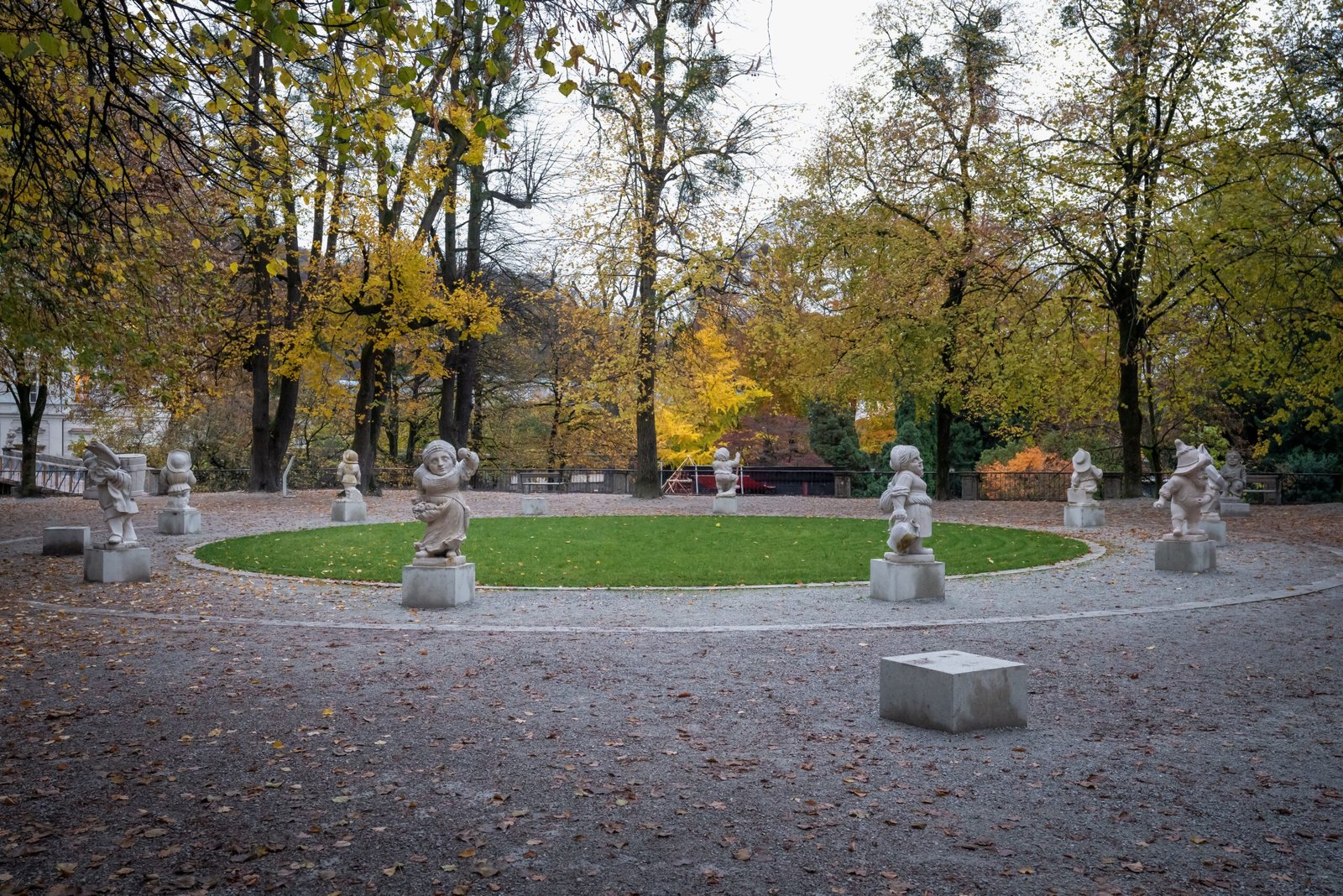
The setting is more than a backdrop. MoMA’s Sculpture Garden is a space where artworks share an environment with changing daylight, weather, plants, visitors, and the architecture surrounding the Museum. Installing UUmwelt there extends the work’s central question: how does an environment shape what can be perceived?
The screens introduce a moving visual system into the garden, while the visitors’ gazes help activate its changing content. The experience differs from watching a film with a predetermined beginning and end. Instead, the installation offers an evolving field of images whose sequence responds to external inputs.
That approach is consistent with Huyghe’s broader practice, which has explored relationships among art, technology, human and nonhuman life, and natural systems. His projects often move beyond the idea of an artwork as a self-contained object, treating it instead as a situation shaped by multiple participants and conditions.
A timely encounter with artificial intelligence
As AI-generated images become increasingly common in everyday life, UUmwelt offers a more unsettled encounter with machine vision. It does not simply celebrate technological possibility or present a warning about automation. Instead, it makes the process of interpretation visible—and leaves open the question of whether machine-generated images can ever share the meaning of the thoughts that helped produce them.
The work also shifts attention away from the assumption that human perception is the measure of every possible world. By placing visitors, neural networks, and biological simulations within one responsive system, Huyghe proposes an artwork that is continually being formed through relations among different kinds of input.
At MoMA, UUmwelt turns the Sculpture Garden into a place to observe those relations unfolding. Its images may be elusive, but the questions they raise are direct: who—or what—gets to imagine, how can one system understand another, and what new forms of experience might emerge when the human mind is no longer the only point of reference?
Exhibition details
Pierre Huyghe: UUmwelt
The Museum of Modern Art, Abby Aldrich Rockefeller Sculpture Garden
July 1–November 29, 2026
11 West 53rd Street, New York, NY
Organized by Stuart Comer, The Lonti Ebers Chief Curator of Media and Performance, with Kelly Filreis and Elizabeth Wickham. Scientific expertise by Kamitani Lab/Kyoto University and ATR.
