

More than 140 haute couture creations enter into conversation with art, science, and natural history in a landmark exhibition exploring how fashion can reshape our understanding of the body.
Fashion can be worn, observed, and admired—but in the work of Dutch designer Iris van Herpen, it can also suggest movement, biological growth, architecture, and forces that are usually invisible to the human eye. At the Brooklyn Museum, Iris van Herpen: Sculpting the Senses invites visitors to experience couture as an interdisciplinary art form, where traditional handcraft meets experimental technology.
Making its North American debut in Brooklyn, the exhibition opened May 16, 2026, and brings together more than 140 of Van Herpen’s haute couture creations alongside contemporary artworks, scientific artifacts, and natural history specimens. The Brooklyn Museum’s exhibition listing gives January 3, 2027, as the closing date, while the designer’s website currently lists December 5, 2026. Visitors should check the Museum’s current calendar before planning a visit.
Fashion beyond the garment
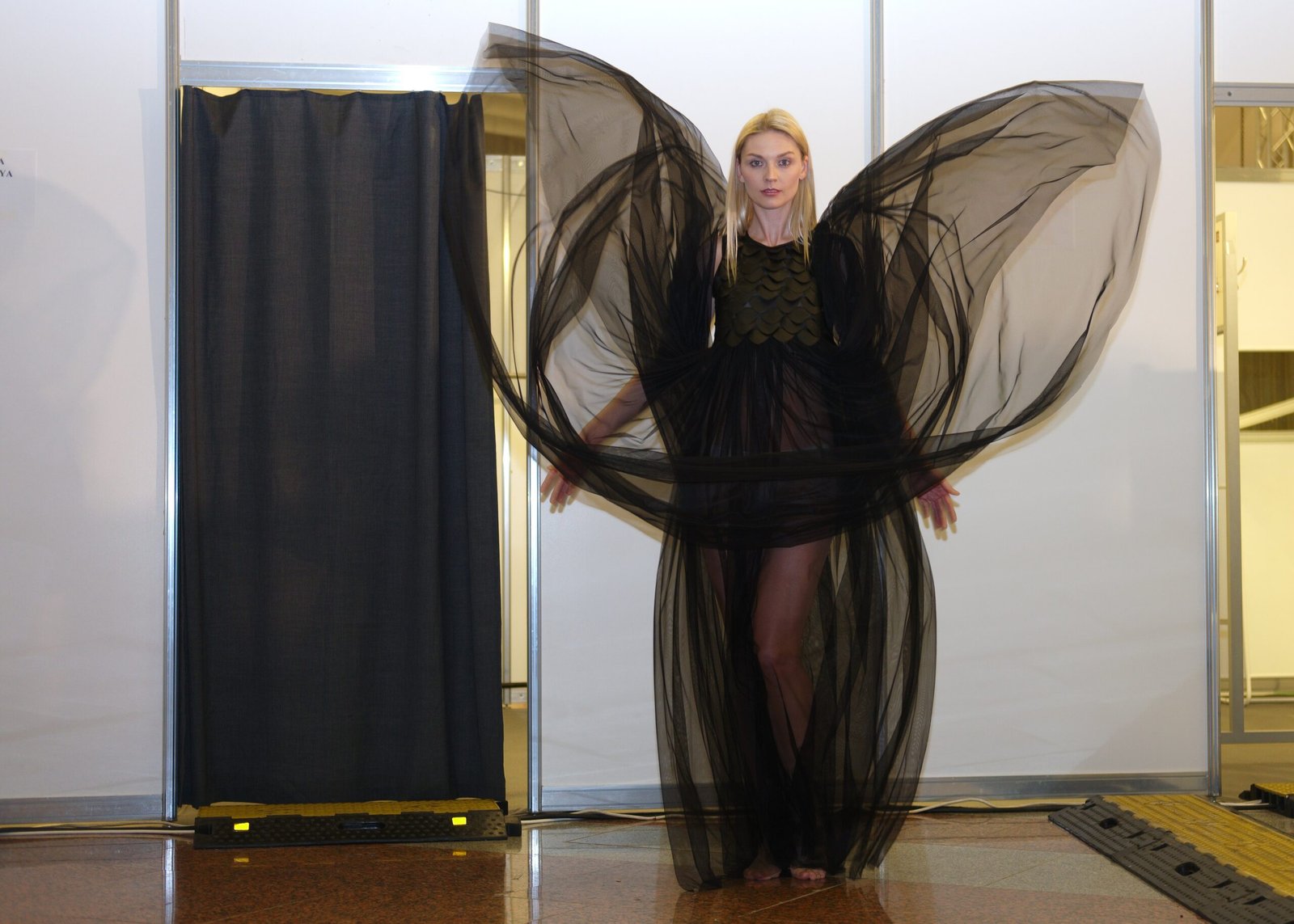
Van Herpen’s designs challenge the conventional separation between clothing and sculpture. Her garments often appear to extend beyond the body, forming intricate structures that suggest waves, cellular networks, skeletal systems, or the movement of air and water. Rather than treating fashion as decoration alone, she approaches it as a way to investigate the body’s relationship with space, motion, and its environment.
The exhibition follows that expansive approach. It places couture in dialogue with works by artists and designers including Philip Beesley, Rogan Brown, Casey Curran, Kim Keever, and Nick Knight. Coral, fossils, skeletons, and other scientific and natural-history materials broaden the context, revealing how the natural world can serve as both inspiration and a field of research.
The result is not simply a display of extraordinary clothing. It is an invitation to consider how a dress might communicate ideas about transformation, perception, and the interconnected systems that shape life.
The body as a changing landscape
Across the exhibition, the body is presented not as a fixed form but as something responsive to its surroundings. Van Herpen’s work draws on disciplines including biology, physics, architecture, chemistry, and mathematics. The designer’s official exhibition overview describes a journey from the micro to the macro, asking how the body occupies space and how it might change in a rapidly evolving world.
This perspective is visible in the contrast between delicate surfaces and complex structures. Some pieces evoke organic growth; others seem engineered around the body, creating an impression of movement even when the garment is still. The forms can feel simultaneously fragile and architectural, suggesting that the boundary between nature and technology is less fixed than it may first appear.
One featured example is the Morphogenesis Dress from the Sensory Seas collection of 2020, made with laser-cut and screenprinted mesh, duchesse satin, and laser-cut Plexiglas. The work was created in collaboration with architect and artist Philip Beesley. Its materials and construction demonstrate the exhibition’s central interest in couture as a meeting point for artistic vision, technical experimentation, and material research.
Craft and technology in the same process
Van Herpen’s practice is frequently associated with advanced fabrication, including 3D printing and laser-cutting. Yet the exhibition also emphasizes the importance of traditional couture techniques and close attention to material. Its account of her process resists the idea that technology simply replaces handcraft. Instead, the two operate together, expanding what a garment can become.
A reimagined version of the designer’s Amsterdam atelier gives visitors a view into this experimental process. Hundreds of material samples help convey the research and testing behind the finished pieces, while a cabinet of curiosities connects accessories and design elements with objects from the natural sciences. The exhibition also incorporates moving images and a sound composition by Salvador Breed, extending the experience beyond sight alone.
This multisensory approach is central to the exhibition’s title. “Sculpting” refers not only to the shaping of fabric and materials, but also to the way perception itself can be shaped through light, sound, texture, and movement.
A global exhibition arrives in Brooklyn
Organized by the Musée des Arts Décoratifs in Paris, Sculpting the Senses has traveled internationally, with presentations at institutions including Queensland Art Gallery | Gallery of Modern Art in Brisbane, ArtScience Museum in Singapore, and Kunsthal Rotterdam. Its Brooklyn presentation marks the exhibition’s North American debut and Van Herpen’s first major New York exhibition.
At the Brooklyn Museum, the presentation is organized by Matthew Yokobosky, Senior Curator of Fashion and Material Culture, with Imani Williford, Curatorial Assistant in Photography, Fashion, and Material Culture. The exhibition continues the Museum’s long history of fashion presentations while placing a contemporary designer’s work in conversation with its wider collections and interdisciplinary interests.
That context matters. By bringing fashion into a museum environment alongside contemporary art and scientific objects, the exhibition asks visitors to look beyond familiar categories. A garment can be a design, a sculpture, a technological experiment, and a proposition about the future of the human body—all at once.
An invitation to look, listen, and reconsider
The exhibition’s significance lies in its refusal to keep fashion within the limits of the runway. Van Herpen’s creations make visible a world of connections: between the body and its environment, the handmade and the engineered, the microscopic and the monumental. They also raise questions about how designers might work with materials and technologies while remaining attentive to the natural systems that inspire them.
For New York audiences, Sculpting the Senses offers an encounter with couture that is as much about ideas and perception as it is about clothing. At the Brooklyn Museum, the garments do not simply dress the body. They transform it into a site of inquiry—one where art, science, and imagination meet.
Exhibition details
Iris van Herpen: Sculpting the Senses
Brooklyn Museum, 200 Eastern Parkway, Brooklyn, NY
Opened May 16, 2026
The Museum’s online exhibition listing currently gives January 3, 2027, as the closing date; the designer’s website lists December 5, 2026. Check the Museum’s visitor information for the latest schedule.
