


Subheadline:
Apple’s What Holds Us exhibition puts photographs by Alex Prager, Jack Davison, and Jimmy Chin on the gallery wall—and raises a familiar but increasingly complicated question: does the artistic status of a photograph depend on the camera that made it?
Discover Hook
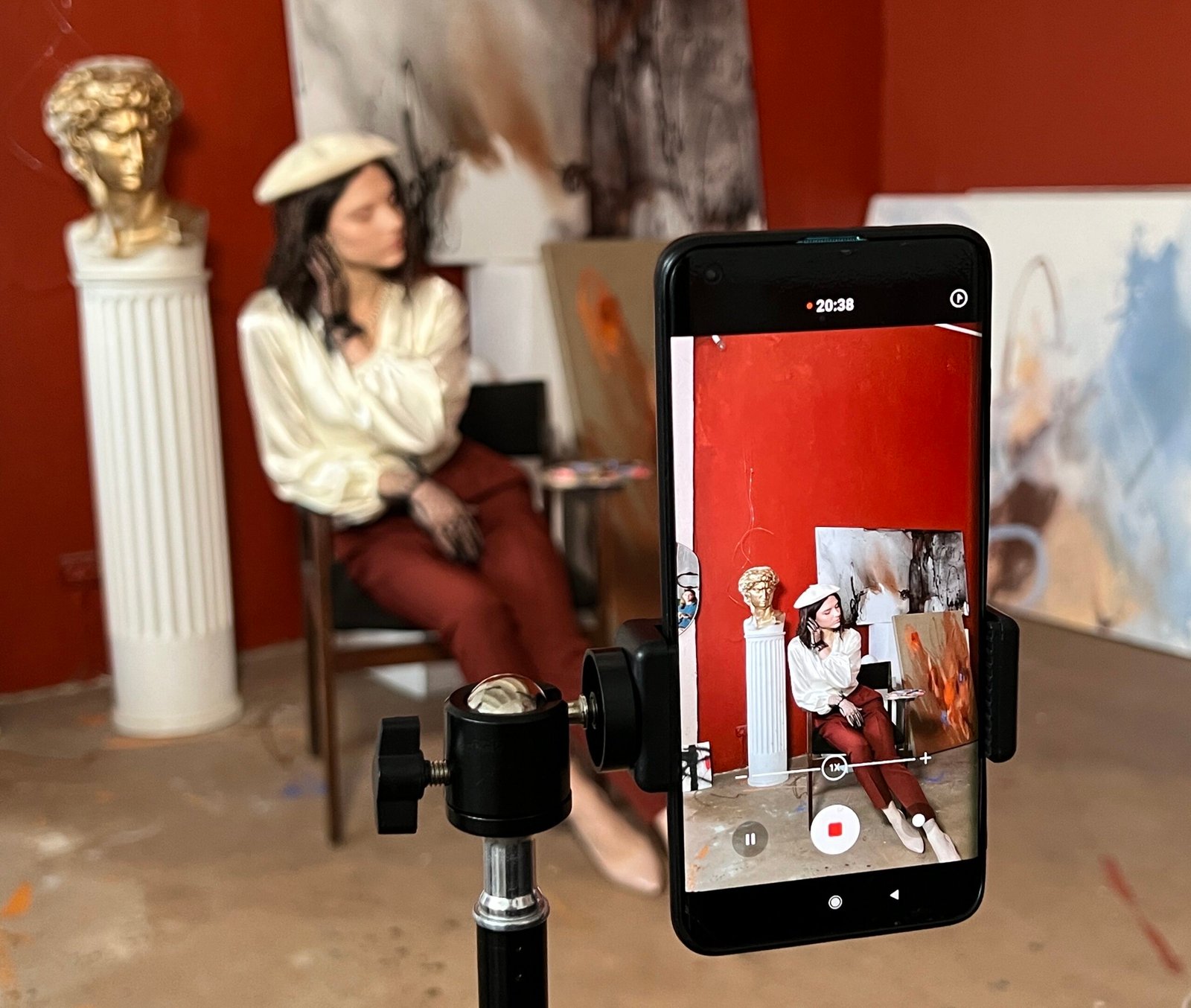
A photograph can begin with a phone and end on a gallery wall. But does the device behind the image change how we understand the art?
That question is at the center of a new photography exhibition in New York. “What Holds Us,” curated by Kathy Ryan, brings together work by Alex Prager, Jack Davison, and Jimmy Chin, with every photograph created exclusively on Apple’s new iPhone 18 Pro. The exhibition opened in New York from September 18–20, 2026, before traveling to London and Shanghai.
The project arrives at an interesting moment for photography. Smartphone cameras have moved far beyond the snapshot, incorporating increasingly sophisticated optics, computational imaging, RAW capture, manual controls, and—on the iPhone 18 Pro—its first variable-aperture main camera. Apple is now explicitly presenting the phone as a serious creative instrument.
But technical capability does not automatically settle the question of artistic legitimacy.
The gallery wall still asks a different question: what makes a photograph art?
When the Camera Becomes Part of the Conversation
For decades, photographic culture has attached meaning to equipment.
Large-format cameras, Leica rangefinders, medium-format systems, film stocks, darkrooms, lenses, and printing processes have all been connected to particular photographic traditions. The tools could influence aesthetics, working methods, and even the physical relationship between photographer and subject.
The smartphone changes that relationship.
An iPhone is simultaneously camera, communication device, editing platform, archive, publishing tool, and social-media interface. It is an object carried by millions of people rather than a specialized instrument reserved for professional photographers.
That accessibility is central to Apple’s argument.
Kathy Ryan, who curated What Holds Us and previously served for many years as director of photography at The New York Times Magazine, describes the iPhone’s immediacy as part of its creative appeal. Apple says the exhibition is intended to demonstrate how photography can embrace new tools while remaining connected to the underlying values of the craft.
That proposition inevitably creates tension.
If a celebrated photographer can make a gallery-scale photograph with the same basic device carried by millions of people, the distinction between professional equipment and consumer technology becomes less meaningful.
Three Photographers, Three Arguments
One of the most interesting aspects of What Holds Us is that the three photographers do not use the iPhone in the same way.
Jimmy Chin took the device into the Bugaboo Mountains of British Columbia, photographing climbers, rock, snow, ice, and vast landscapes. His approach demonstrates one practical advantage of a compact camera: when weight and mobility matter, carrying less equipment can directly affect what is possible in the field. Apple reports that Chin worked in conditions where winds reached approximately 70 miles per hour.
Jack Davison moved in the opposite direction, creating intimate studio portraits involving clay and chalk. His subjects interact physically with the materials, leaving fingerprints, marks, and traces across their bodies and surroundings.
Davison has emphasized the way the smaller device changed his physical relationship with subjects. Instead of placing a larger camera directly between photographer and sitter, he could hold the phone lower while maintaining eye contact.
Alex Prager used the iPhone for elaborate staged scenes, working with crowds and cinematic compositions on a Los Angeles soundstage. Her photographs deliberately play with movement, scale, color, and the feeling that a scene is unfolding rather than simply being captured.
Prager has also described the camera as resembling a kind of video stream, reflecting how contemporary audiences increasingly encounter photography alongside moving images and social-media content.
The three approaches therefore make the exhibition less about a single “iPhone aesthetic” and more about what different artists can do with the same instrument.
The Technology Has Changed, But the Artistic Questions Remain
The iPhone 18 Pro is not simply a conventional phone camera with more megapixels.
Apple’s new system includes a 48MP Fusion Main camera with variable aperture, allowing the photographer to manually select among four aperture settings. The camera also adds new Pro controls for settings including aperture, shutter speed, white balance, and exposure monitoring. Apple’s computational imaging pipeline and updated Photographic Styles add further control over the final image.
Those features matter because they move smartphone photography closer to the vocabulary traditionally associated with dedicated cameras.
But technology alone cannot produce artistic intention.
A technically sharp photograph can be visually empty. Conversely, an image made with modest equipment can become culturally or emotionally significant because of its subject, timing, composition, context, or the ideas behind it.
That distinction is precisely why the What Holds Us project is interesting beyond Apple’s marketing.
Can a Corporate Commission Become Fine Art?
There is another layer to the debate: authorship and sponsorship.
What Holds Us is an Apple presentation designed around the capabilities of Apple’s newest flagship phone. That makes the exhibition simultaneously an art project and a technology showcase.
The arrangement is not hidden. The photographs were made entirely on iPhone 18 Pro, and Apple’s own announcement explicitly presents the exhibition as demonstrating the creative possibilities of its new camera system.
For viewers, that creates an unavoidable question about context.
Would the photographs be received differently if the same artists had produced identical images with a conventional professional camera?
And does knowing the device used to make an image change our judgment of the image itself?
These questions are not unique to smartphones. Photography has repeatedly confronted debates over commercial sponsorship, manipulation, new technologies, and changing production methods.
The difference today is that the technology being promoted is already part of everyday life.
From “Shot on iPhone” to “Made by an Artist”
Apple has spent years turning “Shot on iPhone” into a recognizable photographic phrase.
The new exhibition takes that idea into a more explicitly fine-art context.
Earlier Shot on iPhone campaigns largely emphasized the impressive photographs ordinary users could create. What Holds Us changes the proposition by placing established photographers inside a curated exhibition environment.
The device becomes part of the artwork’s story.
Yet the artists remain responsible for the decisions that define the photographs: where to stand, what to frame, whom to photograph, how to direct a subject, when to press the shutter, and how the resulting image should function within a larger body of work.
In that sense, the debate may eventually shift away from “Was it shot on an iPhone?” toward a more useful question:
What did the artist do with the technology?
The Gallery Wall Changes the Meaning
A smartphone photograph normally lives within a very different ecosystem.
It appears on a six-inch screen, surrounded by notifications, messages, advertisements, videos, and other photographs. Its audience may encounter it for less than a second while scrolling.
A gallery changes that relationship.
A large print asks the viewer to stop. Scale changes perception. Lighting changes the image. The surrounding photographs create associations. Curatorial decisions establish sequence and meaning.
The photograph is no longer simply an image produced by a phone.
It becomes part of an exhibition.
That distinction is important to the fine-art debate because photographs have never existed independently of their presentation. The print, book, newspaper, magazine, screen, billboard, and gallery have all given photographic images different cultural lives.
A New Chapter in Mobile Photography
What Holds Us does not resolve whether smartphone photography should be considered fine art—and perhaps that is precisely why the exhibition is worth examining.
Its importance lies in the collision of several developments: increasingly sophisticated mobile cameras, established photographers experimenting with consumer technology, contemporary audiences accustomed to screen-based imagery, and an art world increasingly interested in how images are produced and circulated.
The exhibition also arrives just as the iPhone 18 Pro introduces optical variable aperture and expanded manual controls, giving photographers more direct control over aspects of image-making traditionally associated with dedicated cameras.
Whether those capabilities represent a technological breakthrough, a marketing strategy, or simply another step in photography’s long evolution depends partly on how the resulting images are judged.
The larger point may be simpler.
Photography has never been defined solely by the machine.
From glass plates to film, digital sensors to smartphones, each technological shift has changed what photographers can do. The artistic question remains what they choose to do with it.
At a time when almost everyone carries a camera, What Holds Us asks viewers to look again at the distance between taking a photograph and making a photograph.
And that distance may be where the next chapter of fine-art photography is being written.
“What Holds Us”
Curated by Kathy Ryan
Artists: Alex Prager, Jack Davison, Jimmy Chin
New York presentation: September 18–20, 2026
New York location: 456 West 18th Street
The exhibition is scheduled to travel to London and Shanghai.
