


The Beauty of What Holds a Garment Together
Fashion usually asks us to look at the finished silhouette.
The line of a shoulder. The shape of a jacket. The fall of a skirt. The movement of fabric across the body.
But what happens when the construction itself becomes the subject?
In contemporary fashion, seams are increasingly moving from the inside of the garment to the center of the visual conversation. Cuts, darts, panels, exposed stitching, shifted closures and reconstructed shapes can become as expressive as color or print.
For NY Art Life, “Seam-Forward” is a useful way to describe this broader creative tendency: a design language in which construction is not concealed but deliberately emphasized.
New York’s current fashion landscape offers plenty of evidence of this structural approach. Recent runway analysis has identified exposed darts, emphasized seams, asymmetric construction and deconstructed tailoring among the season’s notable design devices.
The seam is no longer merely functional.
It can become the artwork.
Construction Becomes Composition
A seam performs a practical job.
It joins two pieces of fabric. It controls shape. It determines how a garment sits on the body.
But designers can also manipulate that practical function to create visual tension.
A seam can travel across the body rather than following a conventional side line. A panel can interrupt an otherwise continuous surface. A dart can become visible instead of disappearing into the fabric. A sleeve can be constructed around an unusual geometric line.
These choices turn patternmaking into composition.
The garment begins to resemble an architectural object.
This is where fashion and contemporary art increasingly overlap.
Artists have long treated materials, surfaces and construction as subjects. Fashion designers work with the same physical vocabulary, but their canvas moves.
It walks.
It bends.
It changes shape with the person wearing it.
The Cut as a Creative Gesture
The word “cut” carries an interesting double meaning.
In fashion, cutting is the moment when flat material begins its transformation into three-dimensional form.
In art, cutting can imply interruption, fragmentation or reconstruction.
That connection makes the cut particularly powerful in contemporary design.
Instead of hiding the evidence of transformation, designers can make it visible.
The viewer sees where the garment was divided, joined, folded or reshaped.
The construction becomes part of the narrative.
Recent New York fashion signals have included asymmetric tailoring, skewed closures, draped panels, exposed darts and deconstructed suits—approaches that challenge the expectation that tailoring must appear perfectly resolved and symmetrical.
Deconstruction Without Destruction
Deconstruction has a long history in fashion.
But today’s interpretation does not necessarily mean destroying a garment.
It can mean revealing its logic.
A jacket can expose its internal architecture. A traditional suit can be shifted off-axis. A familiar dress can be divided into panels and reconstructed. A seam can become exaggerated enough to function almost like a drawn line.
This creates an intriguing contradiction.
The garment may look unfinished while actually requiring extraordinary precision.
The apparent irregularity can depend on highly controlled patternmaking.
That tension between precision and imperfection is one reason construction-focused fashion can feel particularly relevant to contemporary art.
The Body Completes the Work
A garment exists differently on a hanger than it does on a body.
This distinction is especially important for designers exploring unconventional cuts.
Recent work from Ashlyn, for example, has been described through ideas of patternmaking, geometry, asymmetry, tension and the relationship between flat shapes and the human body. The designer’s Spring 2027 approach begins with simple geometric forms and explores how the body changes their meaning.
The principle is fundamental to fashion.
Fabric has one shape before it meets the body and another afterward.
A seam can appear straight when laid flat and curved when worn.
A geometric panel can become organic through movement.
The body therefore becomes part of the construction process.
The finished piece is never entirely finished until someone inhabits it.
Seams as Evidence of Labor
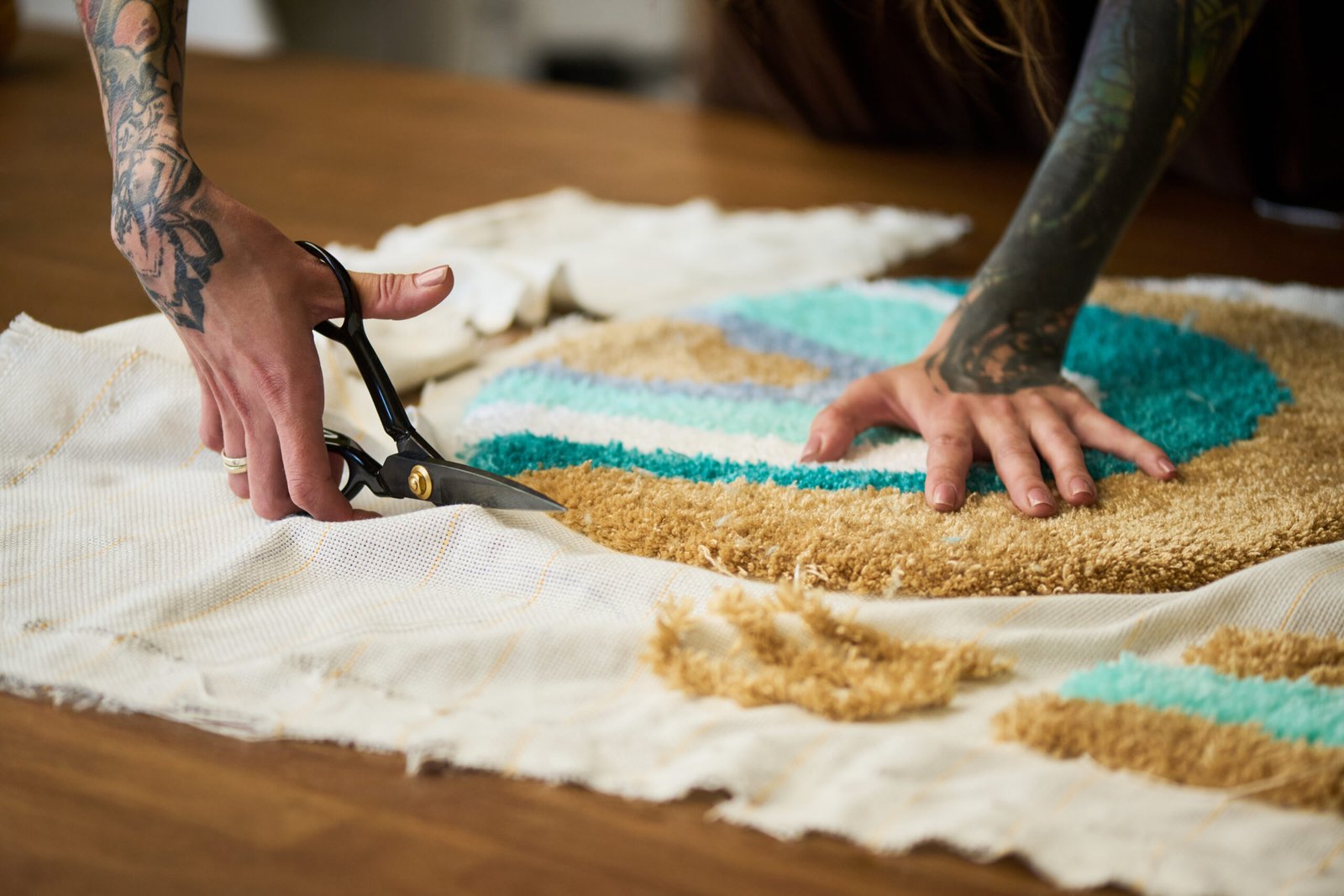
There is another reason exposed construction matters: it makes labor visible.
Modern fashion often presents a polished final image. Campaign photography, runway lighting and digital presentation can make clothing appear almost effortless.
But garments are built through cutting, pressing, fitting, stitching, altering and repairing.
A visible seam can bring some of that labor back into view.
That makes construction a form of storytelling.
It tells the audience that the object was made.
This idea is especially relevant at a moment when fashion is negotiating questions about speed, mass production, technology and craftsmanship.
Showing how something is constructed can become a quiet argument for paying attention to the process.
Repair, Mending and the Beauty of Imperfection
The seam also has a relationship with repair.
A repaired garment contains evidence of its history.
Instead of hiding the intervention, some contemporary designers emphasize it through contrasting stitches, reinforced panels or deliberately visible joins.
The result can transform damage into design.
This approach also connects with a broader interest in clothing longevity.
A garment that can be repaired rather than discarded acquires a different relationship with time.
Its seams become records of use.
Its alterations become part of its biography.
Its imperfections can make it more individual.
In that sense, “seam-forward” design can be read not only as an aesthetic approach but as a way of thinking about the life of an object.
Fashion as Soft Architecture
There is an architectural quality to construction-focused fashion.
Both architecture and clothing organize space.
Architecture defines rooms around the body. Clothing defines space immediately around the body.
A shoulder seam establishes one boundary.
A side panel changes another.
A folded or draped section creates volume.
A sharply engineered waist changes the relationship between torso and garment.
This is why contemporary tailoring can feel sculptural.
The designer is effectively constructing a temporary architecture that moves through the city.
New York is an especially appropriate environment for this approach.
The city itself is built from visible joins—steel, concrete, glass, brick, scaffolding, bridges and infrastructure layered across one another.
Its fashion can reflect the same structural sensibility.
From Hidden Technique to Visual Language
Historically, many of fashion’s most important technical decisions were intended to disappear.
A good seam was often one the viewer barely noticed.
Contemporary design can reverse that expectation.
The seam becomes visible.
The dart becomes graphic.
The lining becomes part of the composition.
The edge is deliberately unfinished.
The construction is no longer merely supporting the design.
It becomes the design.
That shift changes how an audience reads clothing.
Instead of asking only, “What does this garment look like?” we begin asking:
How was it built?
Why does the seam travel there?
What happens when the body moves?
What is being revealed rather than concealed?
Those questions move fashion closer to the language of contemporary art.
New York’s Role
New York has always provided fertile ground for designers interested in experimentation.
Its fashion culture is connected to art schools, independent studios, theater, dance, music, architecture and street culture.
That interdisciplinary environment makes the city particularly receptive to clothing that treats construction as creative expression.
The current NYFW landscape demonstrates how established tailoring codes can be manipulated through asymmetry, exposed structure, unconventional proportions and deconstruction.
Meanwhile, designers such as Ashlyn demonstrate how patternmaking itself can become a conceptual starting point rather than simply a technical stage in the process.
The result is not one unified style.
It is a shared interest in making construction visible.
The Future Is in the Seams
“Seam-Forward” should not be understood as a formal fashion movement.
It is better understood as an editorial lens for recognizing a recurring design idea: the structure of the garment can be as expressive as its surface.
In that sense, the seam becomes more than a line of thread.
It represents construction, labor, movement, repair and transformation.
It shows where one thing becomes another.
And perhaps that is why the language feels so contemporary.
At a time when digital images can make fashion appear infinitely polished and instantly reproducible, visible construction reminds us that clothing still begins with physical material, human decisions and the act of making.
The cut creates the possibility.
The seam holds it together.
And when designers choose to show both, the garment becomes something more than clothing.
It becomes a record of how it was made.
